The Jakarta Post
Please Update your browser
Your browser is out of date, and may not be compatible with our website. A list of the most popular web browsers can be found below.
Just click on the icons to get to the download page.


Popular Reads
Top Results
No results found. Please check your search term and try again
Can't find what you're looking for?
View all search results
Popular Reads
Top Results
No results found. Please check your search term and try again
Can't find what you're looking for?
View all search resultsCelebrating literature, culture and nature at the Lake Toba Writers Festival
On the volcanic shores of Lake Toba, an unpretentious festival is keeping deep storytelling alive in an age of shallow feeds.
Change text size
Gift Premium Articles
to Anyone
Share the best of The Jakarta Post with friends, family, or colleagues. As a subscriber, you can gift 3 to 5 articles each month that anyone can read—no subscription needed!
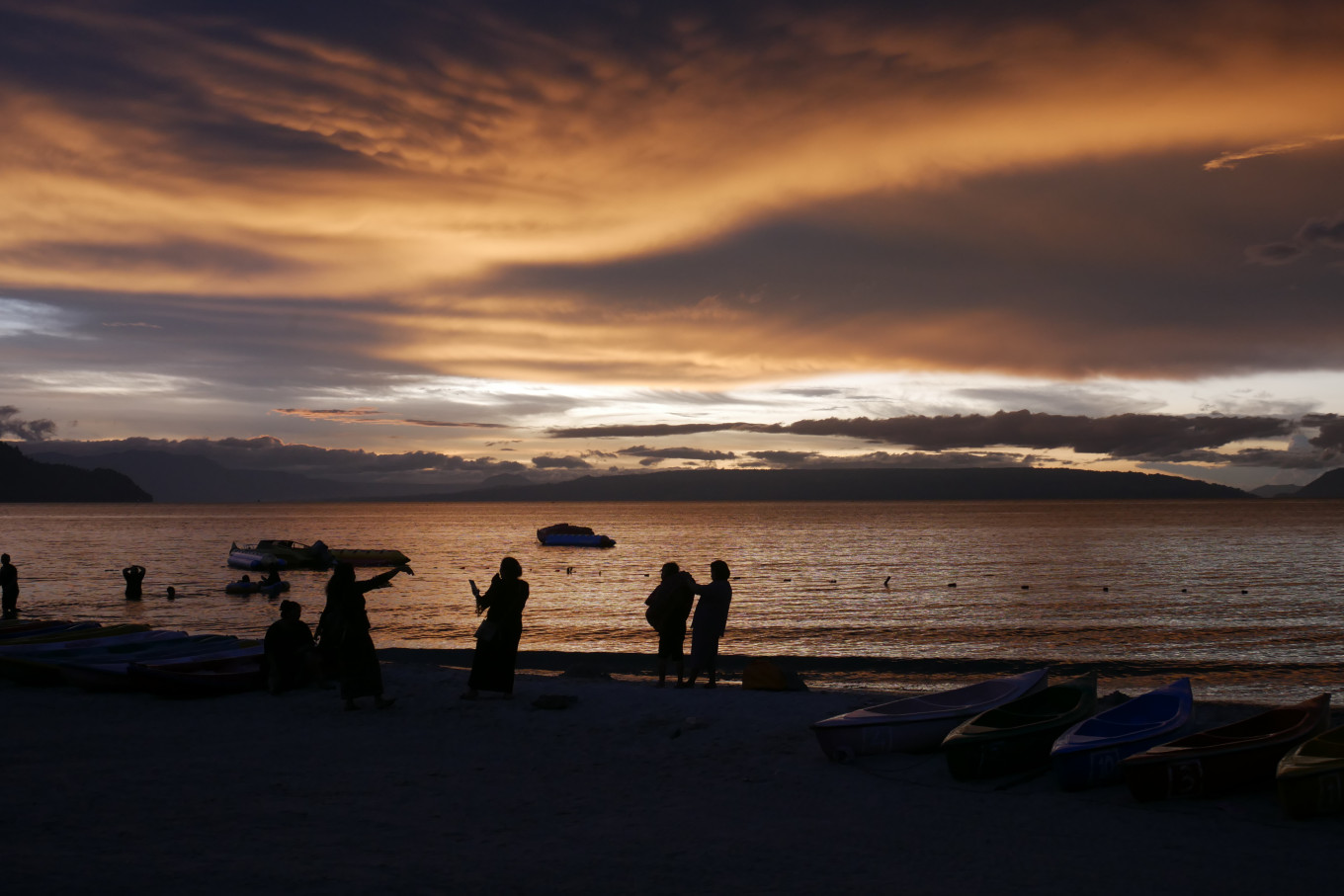 Visitors are seen enjoying the sunset on Lake Toba at Bulbul Beach, in Balige, Toba regency, in June 2022. (JP/Tonggo Simangunsong) (JP/Tonggo Simangunsong )
F
ormed by a colossal volcanic eruption some 74,000 years ago, Lake Toba in North Sumatra is the kind of place that naturally pulls people in. As the world’s largest crater lake, and one of Indonesia’s top priority destination, it draws hundreds of thousands of visitors each year for its splendid scenery, rich Batak heritage and distinctive local cuisine.
The lake invites all kinds of seekers. Adventure lovers throng to the lake for hiking, running and cycling along its surrounding hilly and forested terrain and, since recently, powerboat racing.
Geologists have been exploring the UNESCO Global Geopark’s 16 distinct geosites there, studying ancient rocks and remnants of prehistoric cataclysms. Nature lovers and scientists are drawn to the unique flora and fauna of the region, including the Tapanuli orangutan, which was identified as a distinct great ape species only in 2017.
Local communities based on ancient clans or marga have for generations lived around the lake. Those living in the diaspora regularly return home to honor their elders, celebrate festivities and reconnect with their roots. Beyond the physical landscape lies a sacred realm of spirits and ancestors, drawing healers, shamans, spiritualists and thinkers across eras.
For centuries the lake has inspired the creativity of writers, poets, song writers, musicians and dance choreographers. But while the age of social media-driven instant gratification has somehow provided space for music and dance, it has sadly relegated literature, poetry and drama to the background.
A great novel cannot be read in a few minutes; a poignant poem cannot be understood on the go and “speed reading” of a drama is a futile exercise. In the morally compromised societies of today, the “copy paste” ethic has overridden originality. This deterioration is being accelerated by the poorly regulated development of AI with the wave of plagiarism likely to become an all-encompassing tsunami. Themes like the “death of literature”, “bastardization of languages” and a “post literature world” no longer look academic for those concerned.

One such group is composed of poets, writers, readers, academics, journalists and culture lovers in North Sumatra. They are a diverse group hailing from various ethnic backgrounds such as Batak, Malay, Nias, Chinese and Indian. Each has evolved unique literary and poetic traditions.