The Jakarta Post
Please Update your browser
Your browser is out of date, and may not be compatible with our website. A list of the most popular web browsers can be found below.
Just click on the icons to get to the download page.


Popular Reads
Top Results
No results found. Please check your search term and try again
Can't find what you're looking for?
View all search results
Popular Reads
Top Results
No results found. Please check your search term and try again
Can't find what you're looking for?
View all search resultsFrom fuel to batteries: Trading one dependence for another
Unless it builds the supply chain to match its electric ambitions, the country risks trading its costly addiction to foreign oil for imported batteries and coal-fired power.
Change text size
Gift Premium Articles
to Anyone
Share the best of The Jakarta Post with friends, family, or colleagues. As a subscriber, you can gift 3 to 5 articles each month that anyone can read—no subscription needed!
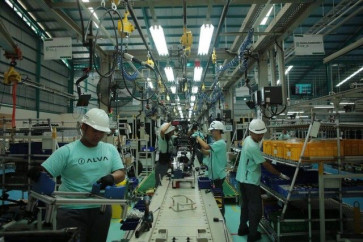
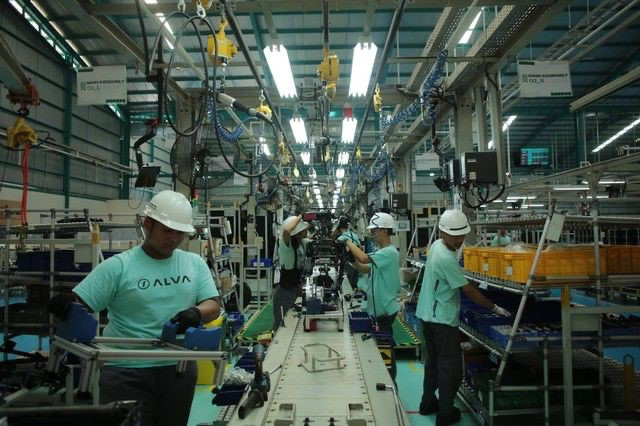 Workers assemble electric motorcycles on Sept. 21, 2023, at the Alva manufacturing plant in Cikarang, West Java. (Alva Auto/-)
O
n paper, the math is encouraging: An electric motorcycle in Indonesia generates around 26 grams of carbon dioxide (CO2) per kilometer, compared with roughly 45 g from the internal combustion bike it replaces. That comparison draws on real domestic data, matching a Viar Q1 running at 3.33 kilowatt-hour (kWh) per 100 km against a Honda Beat delivering 60.6 km per liter.
Factoring in the country’s 2024 grid carbon intensity (680 g of CO2 per kWh), state electricity company PLN’s 8.55 percent transmission losses and a 95 percent charging efficiency, the electric two-wheeler comes out at roughly 26 g/km. Factor in upstream refining and fuel transport, and the gasoline engine clocks in at 45 g.
The national effect, however, remains almost invisible. The Indonesian Motorcycle Industry Association (AISI) recorded 6,412,769 domestic motorcycle sales last year. Over the same period, the Transportation Ministry’s type test registration certificate (SRUT) logged just 55,059 electric motorbikes, not even 1 percent of the annual market. By mid-2025, Indonesia's cumulative electric fleet sat near 196,000 units.
Put another way, dealerships across the nation sell that many gas motorbikes roughly every 11 days. This staggering imbalance explains why energy security, rather than climate altruism, drives the state's strongest argument for electrification.
Domestic crude and condensate output slipped to around 582,000 barrels a day in 2024, while national fuel consumption climbed to roughly 1.7 million barrels per day, contributing to an oil and gas import bill of US$36.3 billion that same year. This means that every liter of Pertalite or Pertamax kept out of a fuel tank blunts our vulnerability to volatile global oil markets.
I first heard this point emphasized during a ministry briefing last year, and its political staying power is obvious.

The National Police Traffic Corps registered 173.7 million motor vehicles across the archipelago in 2025. Of these, 145.7 million, or nearly 84 percent, were two-wheelers. If policymakers want electrification to make a real dent in fuel import reliance, the humble motorbike cannot remain an afterthought to flashier four-wheel EV initiatives.