The Jakarta Post
Please Update your browser
Your browser is out of date, and may not be compatible with our website. A list of the most popular web browsers can be found below.
Just click on the icons to get to the download page.


Popular Reads
Top Results
No results found. Please check your search term and try again
Can't find what you're looking for?
View all search results
Popular Reads
Top Results
No results found. Please check your search term and try again
Can't find what you're looking for?
View all search resultsThe Donald Trump shock in East Asia
The consequences of Trump’s behavior are even more serious for East Asia than they are for Europe.
Change text size
Gift Premium Articles
to Anyone
Share the best of The Jakarta Post with friends, family, or colleagues. As a subscriber, you can gift 3 to 5 articles each month that anyone can read—no subscription needed!
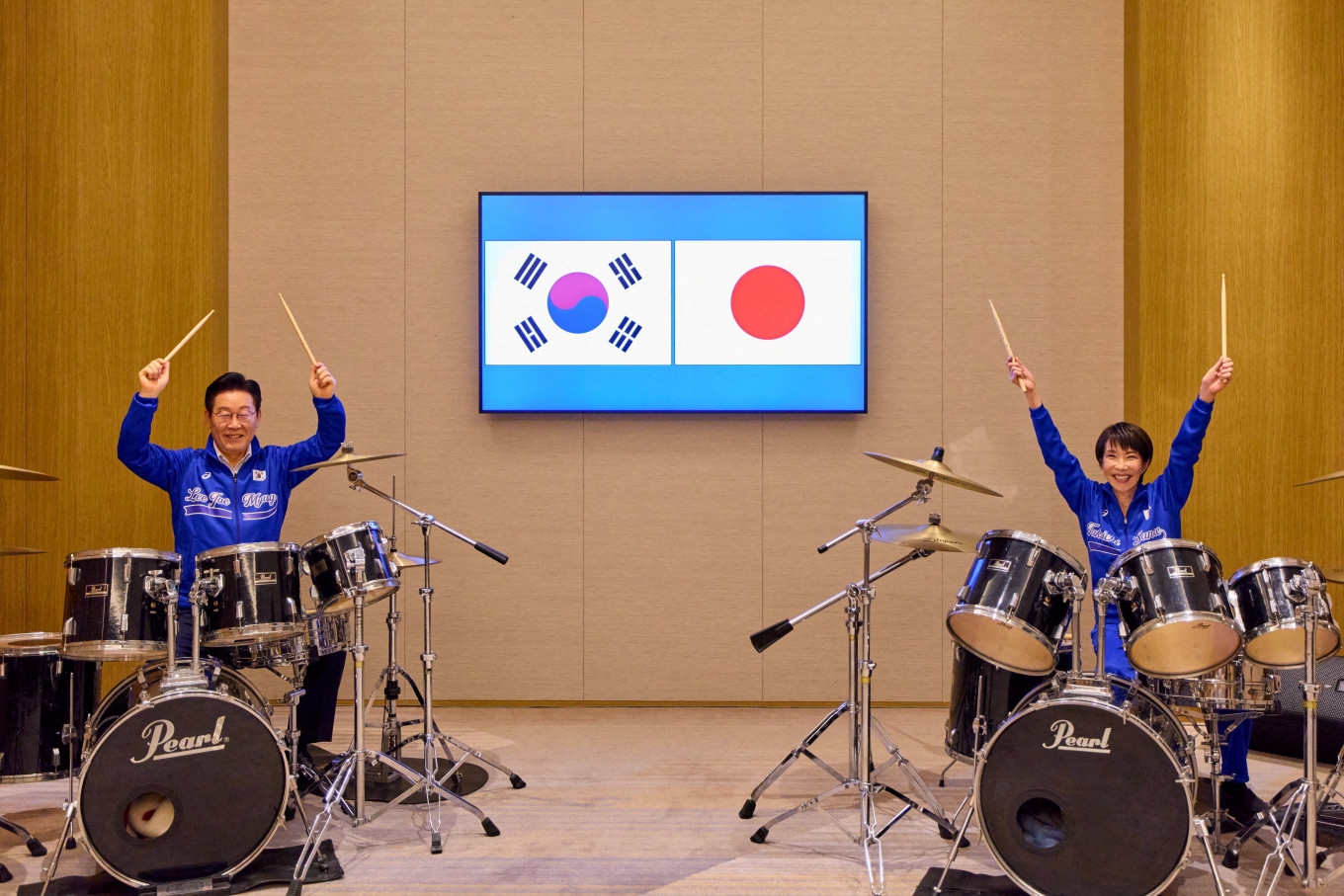 Japanese Prime Minister Sanae Takaichi (right) and South Korean President Lee Jae Myung pose on Jan. 12, 2026, for photographs before performing on drums after their meeting in Nara, Japan. (Reuters/Yonhap/Reuters/Yonhap)
O
n Aug. 16, one day after the anniversary of Emperor Hirohito’s announcement of Imperial Japan’s unconditional surrender to the Allies in 1945, United States President Donald Trump ordered the Pentagon to “substantially reduce” joint military exercises with South Korea. His reasons were odd, to say the least. He wrote on his Truth Social platform that the annual Ulchi Freedom Shield exercises “send a signal that is totally inappropriate and hostile, to a Country that, as long as Donald J. Trump has been President, has been unthreatening and respectful.”
That respectful and unthreatening country is none other than North Korea, which has been ramping up its nuclear capabilities since Trump’s ill-advised and fruitless meetings with North Korean dictator Kim Jong Un in 2019. Seven years later, Kim’s regime has been respectfully launching ballistic missiles over the Sea of Japan with some frequency.
By now, it is well known that Trump can change longstanding US foreign policy on a whim, depending on his mood or whether he feels sufficiently esteemed by a foreign leader. But this was apparently no whim: just over a week later, he canceled a joint amphibious landing drill with US and South Korean marines.
Trump claims that he is angry with South Korea for refusing to join his war on Iran, a conflict as reckless as it is counterproductive. Maybe he is. But there might be a deeper reason for his alarming behavior. Trump wants to be remembered as the greatest US president, the man who managed to establish world peace. Trump’s chosen path to reach that goal is to strike deals with dictators who might threaten the US. Once the world is divided between big powers, America can exist in splendid isolation and will no longer be taken advantage of by smaller countries.
It is often said that Trump prefers dealing with autocrats like Kim and Russian President Vladimir Putin because he is envious of their grandiose trappings and unfettered power. While this is certainly possible, he may also believe that it is easier to make a deal with a tyrant than with a politician who must answer to voters.
Whatever the reason for Trump’s erratic policies, the canceled military exercises came as a shock to the South Koreans and have alarmed the Japanese. Ever since the end of World War II, US military guarantees have allowed European and East Asian democracies to thrive by deterring potentially hostile powers. Even though plenty of local wars erupted under Pax Americana, a world war became unthinkable. Historical wounds still caused friction between Japan and South Korea; but so long as Uncle Sam was in charge, such problems could be managed.

Now that Trump has blown gaping holes into the postwar order by threatening to withhold help for NATO members and by weakening military cooperation with one of the most important US allies in East Asia, all the comforting assumptions of Pax Americana have gone out the window. The consequences of Trump’s behavior are even more serious for East Asia than they are for Europe.