The Jakarta Post
Please Update your browser
Your browser is out of date, and may not be compatible with our website. A list of the most popular web browsers can be found below.
Just click on the icons to get to the download page.


Popular Reads
Top Results
No results found. Please check your search term and try again
Can't find what you're looking for?
View all search results
Popular Reads
Top Results
No results found. Please check your search term and try again
Can't find what you're looking for?
View all search resultsDelhi's BRICS moment: A bite without teeth
New Delhi Declaration holds an 11-nation bloc together, but ducks the Middle East, and Washington breathes easy.
Change text size
Gift Premium Articles
to Anyone
Share the best of The Jakarta Post with friends, family, or colleagues. As a subscriber, you can gift 3 to 5 articles each month that anyone can read—no subscription needed!
 Set as preferred source
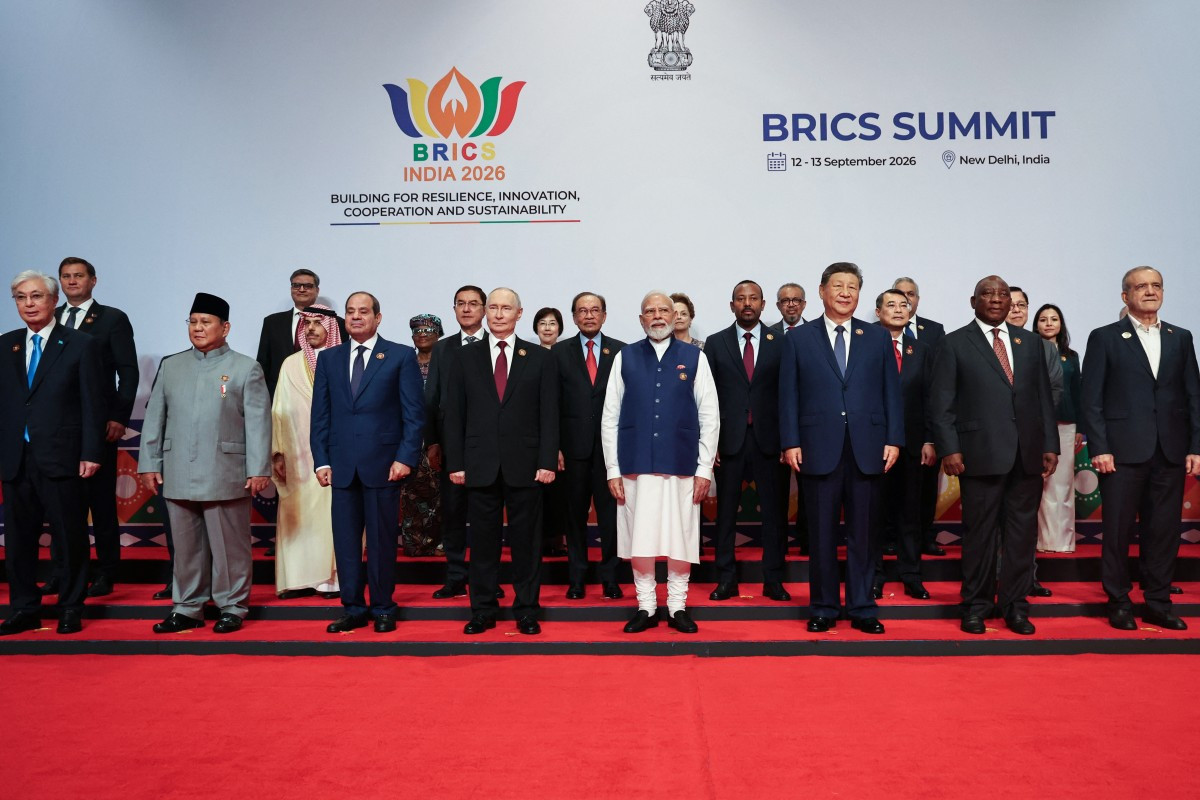 In this pool photograph distributed by the Russian state agency Sputnik, leaders of participating countries gather for a family photograph during the 18th BRICS Summit in New Delhi on Sept. 13, 2026. (AFP/Sputnik)
Eleven leaders sat around the table in New Delhi, but one region was kept deliberately out of focus.
Adopted on Sept. 12, the 18th BRICS Summit’s New Delhi Declaration, titled “Building for Resilience, Innovation, Cooperation and Sustainability”, is the most expansive document the bloc has produced. Spanning 140 points, it demands United Nations Security Council reform, challenges unilateral sanctions, calls for an equitable energy transition and targets cooperation on critical minerals and artificial intelligence.
It also pushes for trade settlement in local currencies while addressing food security, health and disaster response. In scope, it is everything an emerging-economy communiqué ought to be.
Yet on the Middle East, the crisis where its members are most sharply divided, the bloc opted for safety over substance. That contrast is the real takeaway of the summit.
Getting the expanded group to agree on any 140-point text is a genuine diplomatic feat for India as host. The room held the original five, the 2023 entrants (with Saudi Arabia participating short of full accession) and a ring of partner states. But procedural success should not be confused with substantive consensus.
Where interests converge, the declaration is assertive. It directly rebukes unilateral economic sanctions, reflecting shared grievances across the membership. It hits out at trade-distorting tariffs, an unmistakable nod to Western protectionism.

On energy, it balances calls for renewables with explicit recognition of fossil fuels, a compromise that suits Gulf oil exporters and coal-reliant members alike. On technology, it frames BRICS as a rule-maker in AI governance rather than a passive adopter. For India, securing an explicit condemnation of the Pahalgam terrorist attack was an important host-nation win.