The Jakarta Post
Please Update your browser
Your browser is out of date, and may not be compatible with our website. A list of the most popular web browsers can be found below.
Just click on the icons to get to the download page.


Popular Reads
Top Results
No results found. Please check your search term and try again
Can't find what you're looking for?
View all search results
Popular Reads
Top Results
No results found. Please check your search term and try again
Can't find what you're looking for?
View all search resultsFeeding, not poisoning
The food poisoning incident has left parents a lingering question: How could a program intended to nourish children end up putting their health at risk? And, perhaps more frighteningly, could their children be next?
Change text size
Gift Premium Articles
to Anyone
Share the best of The Jakarta Post with friends, family, or colleagues. As a subscriber, you can gift 3 to 5 articles each month that anyone can read—no subscription needed!
 Set as preferred source
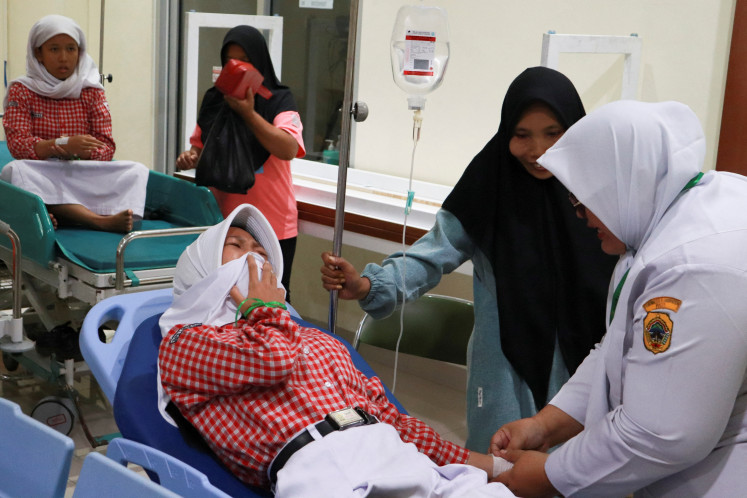
 A student reacts while receiving treatment for food poisoning at a regional general hospital after eating a government-sponsored free school meal in Pati, Central Java, on Sept. 9, 2026. (Reuters/Ragil Kuswanto)
F
or 16-year-old Febiona Purba, a student in Karo, North Sumatra, the fallout from a single state-provided lunch stretches far beyond acute food poisoning. It has followed her home, into hospital wards and into an uncertain future.
In the month following the mass poisoning incident at her school, Febiona has been transformed from a bright, high-achieving student into a teenager grappling with memory loss, recurring seizures and impaired speech. According to her mother, she now struggles to recognize close friends and relatives.
Her ordeal is not an isolated one. At least 15 of the 353 students sickened in the regency's Aug. 13 outbreak still require frequent hospitalization. Some battle persistent gastrointestinal damage; others have developed severe kidney complications.
Local police have begun investigating potential criminal negligence in Febiona's case, marking the first formal probe after thousands of poisoning incidents have plagued the government’s flagship initiative.
Doctors have performed two electroencephalogram (EEG) tests on the girl and reported that her brain activity is normal. Yet, the tragedy leaves the public, and parents in particular, confronting a haunting question: How did an initiative conceived to nourish children end up jeopardizing their lives? And, more chillingly: Could their own children be next?
Since the free nutritious meal program launched in January last year, roughly 53,000 students and teachers have fallen ill. The National Nutrition Agency (BGN), which oversees the rollout, has repeatedly pledged tighter safety measures, promising stricter delivery windows and closing thousands of kitchens lacking the Health Ministry’s Hygiene and Sanitation Compliance Certificate (SLHS).

Yet these interventions remain woefully insufficient. Month after month, reports of contamination persist unabated. In the first 10 days of this month alone, more than 3,000 student recipients fell ill.