The Jakarta Post
Please Update your browser
Your browser is out of date, and may not be compatible with our website. A list of the most popular web browsers can be found below.
Just click on the icons to get to the download page.


Popular Reads
Top Results
No results found. Please check your search term and try again
Can't find what you're looking for?
View all search results
Popular Reads
Top Results
No results found. Please check your search term and try again
Can't find what you're looking for?
View all search resultsHidden fiscal risk behind Indonesia’s military expenditure
Indonesia is entering an era of bigger defense budgets and small budgetary visibility. Yet the institutions that allow the legislature and the public to determine where money goes have not strengthened.
Change text size
Gift Premium Articles
to Anyone
Share the best of The Jakarta Post with friends, family, or colleagues. As a subscriber, you can gift 3 to 5 articles each month that anyone can read—no subscription needed!
 Set as preferred source
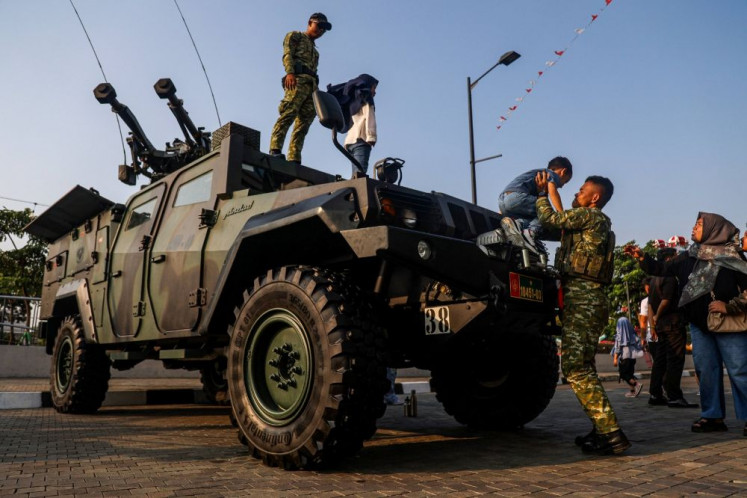
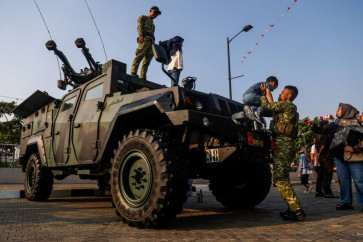
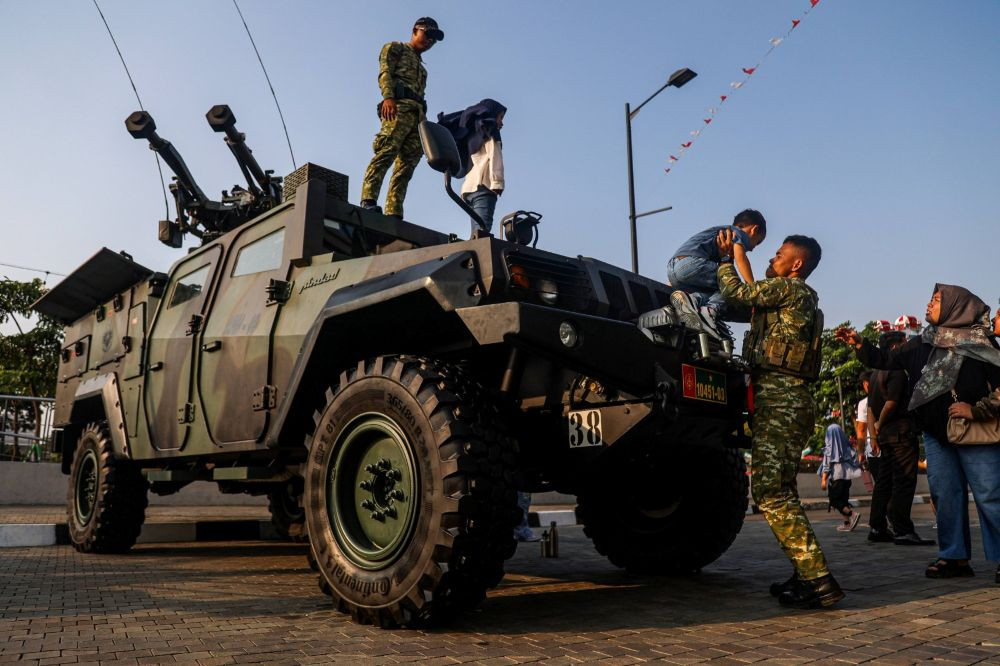 Real wheels: A member of the Indonesian Army (right) helps a boy down from a Komodo armored vehicle by state arms maker PT Pindad on Aug. 24, 2026, during a military exhibition at Living World Grand Wisata in Bekasi, West Java. (Antara/Darryl Ramadhan)
I
ndonesia is entering in an era of bigger defense budgets and small budgetary visibility. Military expenditure planned for 2026 has more than doubled from Rp 139.2 trillion in 2024 to Rp 335.3 trillion (US$18.97 billion). The increase signals a political commitment to military modernization not seen for decades. Yet the institutions that allow the legislature and the public to determine where that money goes have not strengthened at the same pace.
Defense features as a headline priority in the government's State Budget Draft 2027, yet largely absent from the subsequent debate at the House of Representatives. The proposed supplementary allocation for 2027 is substantial, and if past patterns hold, much of it will flow through the Budget Section of the State General Treasurer (BA BUN), where oversight is thinnest.
Indonesia's defense budget has evolved throughout different political regimes, each with its own challenges and conditions. The Post-Independence to Old Order period was characterized by high expenditure, weak budgeting and fiscal unsustainability.
Prioritization of defense was made possible due to high perception of threat, from Dutch aggression to foreign-sponsored insurgency. Political instability and decentralized defense institutions challenged the planning and discipline budgeting. While the government committed to the largest share of military expenditure in history, namely 46.6 percent of the 1962 State Budget (which was equal to about 4.3 percent of GDP), partly dependent on the unaccounted-off budget generated by regional military units. The economic crisis in 1964 rendered the large budget unsustainable.
The New Order reversed the previous trajectory. As development priorities shifted toward the economy, defense's share of the APBN declined gradually to an average of 12.4 percent (which is equal to 2.24 percent of GDP). In reality, however, the overall picture is harder to depict. The regime’s authoritarian rules might have delivered political stability and economic growth, but at the expense of civilian oversight. Fiscal budget data was yet to be reliable, since the defense budget continued relying partly on off-budget or military-linked economic activity.
The Reform Era (1998–today) broke the pattern of the defense budget twice over. First, until 2024 the proportion of military expenditure collapsed to under 1 percent GDP or equal to between 3 percent to 4.99 percent of the budget. Aspiration to raise the expenditure was anchored to a precondition of economic growth at 8 percent, which was never met since the trend of deindustrialization unfolded in 2002. But the current government reversed the commitment; starting in 2025, the expenditure was above 1 percent GDP even when economic growth is only at 5.21 percent.

Second, different from military expenditure under the Old and New Order that rose and fell with oil revenue, under the Reform Era, it has been leaning on foreign borrowing, primarily for arms procurement. This has accelerated under the current government. Foreign debt rose from an average of 7 percent of total defense revenue sources over 2019-2024 to about 25 percent in the past two years. Since arms procurement is import-heavy, spending largely bypasses potential domestic multiplier effects and furthermore introduces a currency risk to future fiscal capacity.