The Jakarta Post
Please Update your browser
Your browser is out of date, and may not be compatible with our website. A list of the most popular web browsers can be found below.
Just click on the icons to get to the download page.


Popular Reads
Top Results
No results found. Please check your search term and try again
Can't find what you're looking for?
View all search results
Popular Reads
Top Results
No results found. Please check your search term and try again
Can't find what you're looking for?
View all search resultsMobilizing middle powers in a multi-directional world
Middle powers are critically important in at least two spheres of influence: in the UN and in protection against mass atrocities.
Change text size
Gift Premium Articles
to Anyone
Share the best of The Jakarta Post with friends, family, or colleagues. As a subscriber, you can gift 3 to 5 articles each month that anyone can read—no subscription needed!
 Set as preferred source
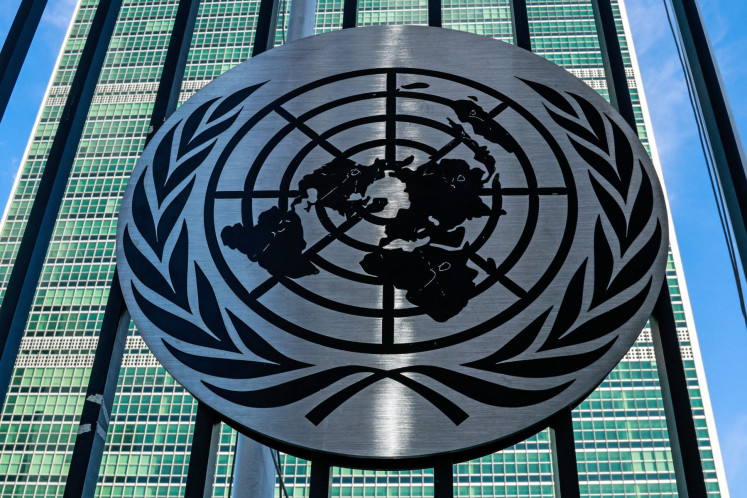
 The United Nations (UN) logo is seen on a gate outside the UN headquarters ahead of the UN General Assembly (UNGA) on Sept. 21, 2025, in New York, the United States. (AFP/Kena Betancur)
T
he term “middle powers” has been invoked increasingly in international relations, at a time when multilateralism is being ruptured by irresponsible behavior on the part of some superpowers. Yet, it is easier to define what it is not, rather than what it is. Middle powers do not cover the superpowers which enjoy the prerogative of exercising the veto in the United Nations Security Council.
Beyond that, the parameters of middle powers remain flexible. The term is often cited to include Canada, Australia, New Zealand, Japan and South Korea. It can also encompass several countries in Europe, Asia, Central and South America and Africa. A viable test is to include those countries that can prove themselves to be democratic, with free and fair elections, a multiparty system and respect for international law.
Their mobilization is multi-directional and is critically important in at least two spheres of influence. First, the UN (or whatever remains of it), and second, protection against mass atrocities.
In regard to the UN, there is currently a catalytic reform process known as the UN80 initiative. It is complemented by various UN General Assembly (GA) and UN Human Rights Council (HRC) resolutions on revitalization for a more coherent and effective UN system. There are various work-streams on peace and security, humanitarian action, sustainable development and human rights, aiming for adjustments by the end of 2026.
It can be expected that some UN agencies will be merged to save cost, bearing in mind the current debilitating financial shortfall and cutbacks in staff and resources. Decentralization of agencies is expected to take place, enabling more access to the field level. De-bureaucratization is at the heart of the process.
UN bodies, such UN Human Rights Committees, which used to sit and deliberate in developed settings should revolve more to the various regions which are less developed, as part of the cross-fertilization. The new Humanitarian Compact should enable more transparency of the vast UN procurement process for the sake of efficiency and credibility.

The various mandates which have expanded in the UN system will be subject to more intensive and consistent review and rationalization. For example, the former posts of UN Special Rapporteur on contemporary forms of slavery and UN Special Rapporteur on human trafficking have now been merged as one mechanism. This is only just the beginning, as the financial noose is tightening. However, it is still important to retain the most essential elements of the system with the understanding that peace and security, development and human rights are intrinsically interwoven and mutually supporting.