The Jakarta Post
Please Update your browser
Your browser is out of date, and may not be compatible with our website. A list of the most popular web browsers can be found below.
Just click on the icons to get to the download page.


Popular Reads
Top Results
No results found. Please check your search term and try again
Can't find what you're looking for?
View all search results
Popular Reads
Top Results
No results found. Please check your search term and try again
Can't find what you're looking for?
View all search resultsWhat if young people create, not just seek, jobs?
The future job market belongs not to those waiting for a vacancy, but to the graduates equipped to turn society’s friction into economic opportunity.
Change text size
Gift Premium Articles
to Anyone
Share the best of The Jakarta Post with friends, family, or colleagues. As a subscriber, you can gift 3 to 5 articles each month that anyone can read—no subscription needed!
 Set as preferred source
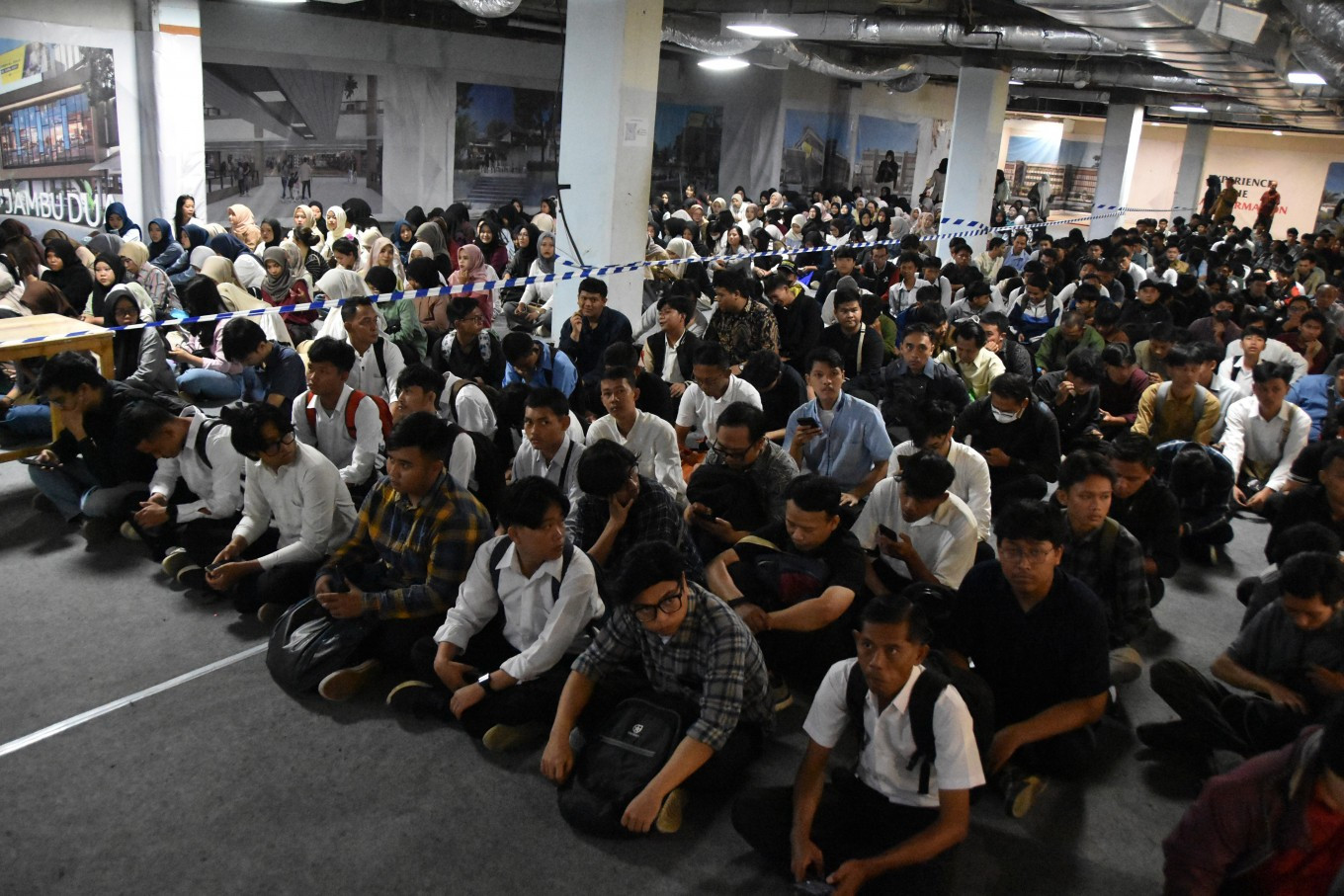 Jobseekers wait in line on June 8 during the opening of the 2026 Bogor Job Fair at Plaza Jambu Dua in Bogor, West Java. (Antara/Arif Firmansyah)
F
or generations, the conventional career path was straightforward: study hard, earn a university degree, secure a stable job and work your way up. For many Indonesian families, this remains the defining aspiration for their children. Yet today’s economic landscape makes that formula increasingly difficult to sustain.
Indonesia has expanded higher education enormously, but degrees alone have not produced a corresponding rise in valuable capabilities. A degree remains important, but it is no longer a reliable guarantor of employability or upward mobility. When credentials become commonplace, what distinguishes graduates is less the certificate on the wall and more what they can execute with what they know.
This friction is visible in Indonesia's youth labor market. Statistics Indonesia (BPS) reports that youth unemployment is twice the historical average, with over a third of young workers employed below their qualification level. The issue is not merely one of job volume; it reflects a mismatch between the skills young people possess and those the contemporary economy demands.
The private sector cannot indefinitely absorb every graduate into productive, well-compensated employment. We must confront an uncomfortable question: What if Indonesia's youth became job creators rather than perpetual job seekers?
This is not a call for every Gen Z graduate to launch a venture. Most will not, and many should not. A resilient economy requires dedicated employees, researchers, civil servants and corporate leaders as much as founders. Entrepreneurship must not serve as a euphemism for underemployment, nor should we romanticize the risks of building an enterprise. The proposition is more grounded: entrepreneurship should become a viable, accessible pathway to economic participation.
While education remains a vital investment, its return now hinges on applied capability. Universities can no longer focus solely on preparing graduates to compete for existing vacancies. Higher education must actively cultivate the capacity to identify problems, recognize commercial opportunities, iterate solutions and generate real value.

Academic research on entrepreneurship has long focused on opportunity recognition. Successful founders do not possess mythical traits denied to others. Rather, they spot subtle shifts in consumer behavior, technology or supply chains that others overlook, using their distinct perspectives to identify latent possibilities.