The Jakarta Post
Please Update your browser
Your browser is out of date, and may not be compatible with our website. A list of the most popular web browsers can be found below.
Just click on the icons to get to the download page.


Popular Reads
Top Results
No results found. Please check your search term and try again
Can't find what you're looking for?
View all search results
Popular Reads
Top Results
No results found. Please check your search term and try again
Can't find what you're looking for?
View all search resultsWhich ASEAN equity laggards could soon become leaders?
While AI-fuelled equity gains in North Asia have hogged the spotlight this year, select ASEAN markets have quietly staged a breakout of their own.
Change text size
Gift Premium Articles
to Anyone
Share the best of The Jakarta Post with friends, family, or colleagues. As a subscriber, you can gift 3 to 5 articles each month that anyone can read—no subscription needed!
 Set as preferred source
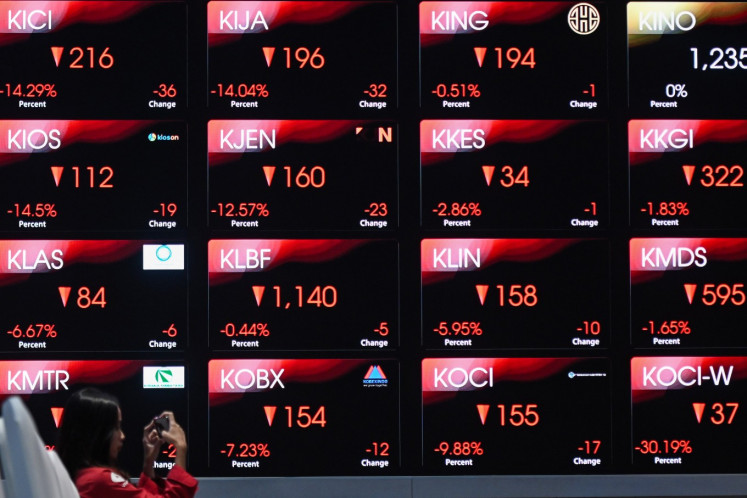
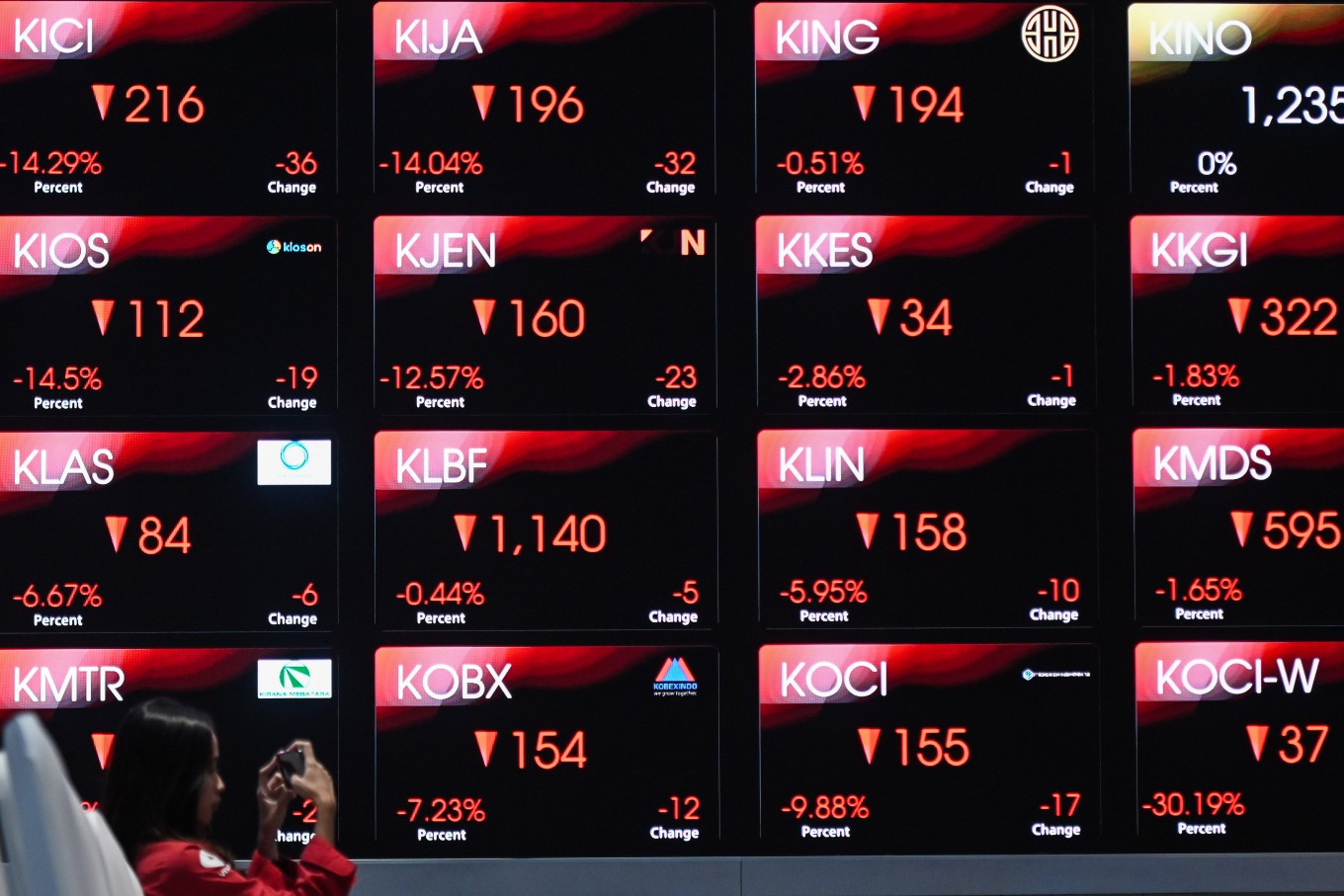 A woman takes a photo of an electronic display showing negative movements across the Indonesia Stock Exchange (IDX) Composite index on Feb. 2, 2026, at the bourse’s South Jakarta headquarters. (Antara/Sulthony Hasanuddin)
W
hile artificial intelligence-fueled equity gains in North Asia have hogged the spotlight this year, select ASEAN markets have quietly staged a breakout of their own. Moving forward, it will likely be local drivers, not broad macro tailwinds, that separate the leaders from the laggards.
Several equity markets in the ASEAN have had a banner year thus far. Thailand's SET Index and Singapore's Straits Times Index have both surged 26 percent and 22 percent respectively in the year to Sept. 18.
But other ASEAN markets have lagged considerably. The Philippines' PSEi and Malaysia's KLCI have posted near-flat returns, while Indonesia, the largest economy in the bloc, has fared far worse, with the Jakarta Composite nosediving 26 percent.
The divergence is particularly surprising given that these markets have many similar performance catalysts.
For example, electronic hardware, energy and industrials have propelled the economic engines of both Malaysia and Thailand, yet have produced contrasting results in other equity markets.
Even macroeconomic drivers do not align neatly with relative market performance.

Thailand and Singapore, ASEAN's second- and third-largest economies, respectively, are both more dependent on Middle Eastern oil and gas than Indonesia, according to International Energy Agency data. One might expect their markets to have taken a bigger hit from this year’s Iran war-driven energy shock. Yet equity markets in both have beaten the bloc’s top economy hands down.
Broad macroeconomic drivers are clearly not the entire story in ASEAN. To spot where the next equity market breakout may occur, investors must therefore look beyond regional generalizations and examine the realities on the ground.
Let us first consider the regional winners.
Singapore has benefited from some broad-based trends, including increased defense spending and, more importantly, the enormous AI capital expenditure that is lifting revenue for the country’s semiconductor companies, data center providers and cooling and power equipment suppliers.
But Singapore’s equity boom has primarily been driven by financials, which account for 63 percent of the market, as well as gains in electronic technology and process industries, according to FactSet.
The top Singaporean banks, such as DBS and OCBC, have benefited from rising fee income in their rapidly expanding wealth-management businesses. The city-state's political neutrality and the stability of the Singapore dollar have helped attract safe-haven capital in an increasingly fragmented geopolitical environment.
It also does not hurt that financials and real estate investment trusts are significant dividend payers. Singapore is currently the region's highest-dividend-yield market.
Thailand, like Singapore, is benefiting from the AI boom, as technology companies are moving their production lines and investments away from China to Thailand, among other destinations. Electric vehicles and components, power utilities, oil and gas exploration, and tourism are additional drivers.
Political stability has also helped. Thailand’s growth outlook improved after the formation of Premier Anutin Charnvirakul’s government in February. The government introduced large-scale relief measures to support consumers and small businesses following the outbreak of the war in the Middle East. The finance ministry in July upgraded its 2026 GDP growth forecast to 2.5 percent, from 1.6 percent, citing stronger trade, investment and consumption.
So can these equity booms continue? The case for Singapore is stronger than that for Thailand. Investors increasingly favor Singapore's high dividend yield in an uncertain economic environment and appreciate its safe-haven status.
Even the upwardly revised growth forecast for Thailand remains below those of its ASEAN peers. Additionally, the Bank of Thailand has warned that households remain under pressure from slowing income growth and the rising cost of living, which could weigh on private consumption once government relief measures are phased out.
The next question is which of the ASEAN equity laggards could start closing the gap.
One obvious option is Malaysia, ASEAN's fifth-largest economy. It is the biggest beneficiary of cloud-computing and data-center investment, which accounted for nearly half of the country's approved investments in the first half of this year. The International Monetary Fund's 4.7 percent growth forecast for 2026 is largely predicated on Malaysia's position as one of the world's top-four net exporters of AI-related hardware.
Yet the KLCI's near-flat performance reflects its weighting toward banks, consumer groups and plantation and petrochemical heavyweights, with the latter sectors squeezed by commodity-driven margin pressure. That masks strong gains in electronic hardware, process industries and industrials.
Well-contained inflation and a strengthening ringgit, supported by soaring exports, have allowed the central bank to hold rates steady, providing a further boost to equities.
Then there is Indonesia, which has the region's strongest forecast for corporate earnings growth and return on equity. Budgetary support for mining, EVs and battery supply chains has underpinned robust growth forecasts for these industries.
However, concerns over a widening fiscal deficit have weakened the rupiah by 6 percent this year and forced Bank Indonesia to raise its benchmark interest rate four times, by a cumulative 100 basis points. The abrupt resignation of BI governor Perry Warjiyo in July also hurt sentiment, as did index provider MSCI's warning that the market could be downgraded from emerging-market to frontier-market status because of opaque shareholding structures at leading companies. In other words, the risk of further equity weakness is significant even after the market's big decline this year.
Southeast Asian equities can no longer be considered a monolith, driven largely by the same macroeconomic forces. In today's fragmented market, hyper-focused, country-by-country analysis of local policy, corporate governance and sector-specific catalysts is required.
---
The writer is founder and CEO of Emmer Capital Partners Limited. The views expressed are personal.