The Jakarta Post
Please Update your browser
Your browser is out of date, and may not be compatible with our website. A list of the most popular web browsers can be found below.
Just click on the icons to get to the download page.


Popular Reads
Top Results
No results found. Please check your search term and try again
Can't find what you're looking for?
View all search results
Popular Reads
Top Results
No results found. Please check your search term and try again
Can't find what you're looking for?
View all search resultsThe sensible roles and harsh realities of KRI Sriwijaya
To justify its steep price tag, Indonesia’s first aircraft carrier must balance realistic support roles against the risk of becoming a costly ceremonial white elephant.
Change text size
Gift Premium Articles
to Anyone
Share the best of The Jakarta Post with friends, family, or colleagues. As a subscriber, you can gift 3 to 5 articles each month that anyone can read—no subscription needed!
 Set as preferred source
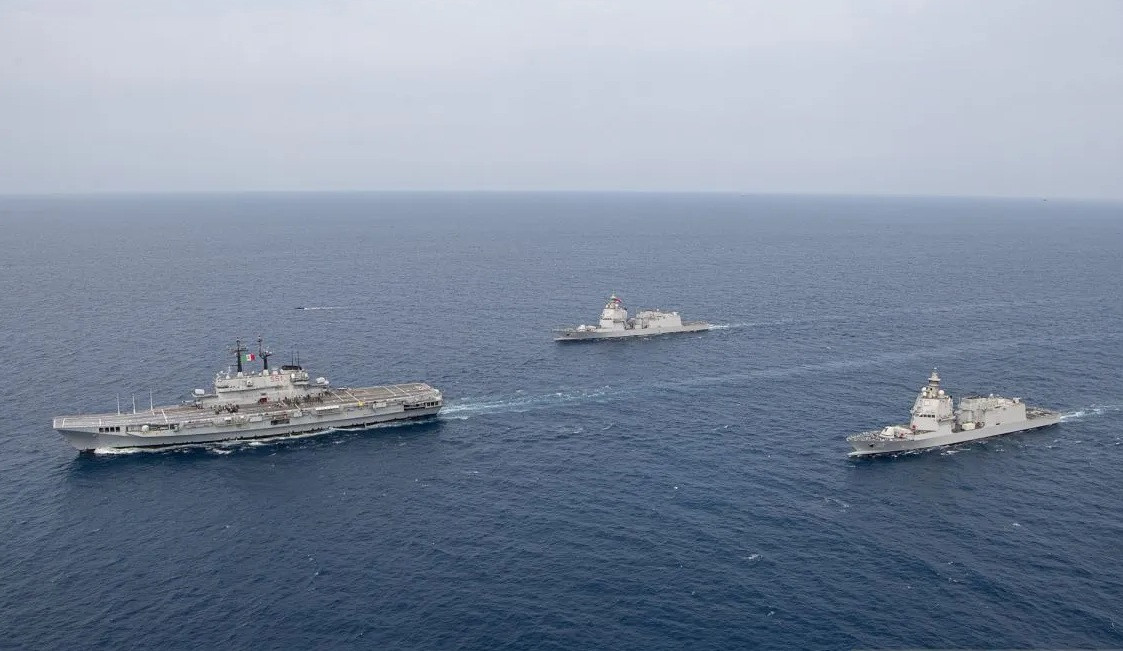 The newly acquired aircraft carrier Giuseppe Garibaldi (left), now KRI Sriwijaya, is accompanied by KRI Brawijaya (center) and KRI Prabu Siliwangi as they sail past Bangka waters on Sept. 17, 2026. (Antara/M Risyal Hidayat)
K
RI Sriwijaya, formerly the Italian Navy’s Giuseppe Garibaldi, has arrived in Indonesia. Its first formal assignment will likely be the fleet review during the Indonesian Military (TNI) anniversary celebration on Oct. 5, where it will take center stage as the nation’s first aircraft carrier.
With the acquisition concluded, the debate over whether Indonesia needs an aircraft carrier is effectively settled. The more pressing question facing the Defense Ministry is how to operate a 45-year-old platform to justify the substantial public investment required to keep it afloat. Realizing that value will require tempering strategic expectations with fiscal reality.
Public expectations, in particular, demand recalibration. Aircraft carriers were once seen as decisive capital ships, largely due to Allied victories in the Pacific theater of World War II. In the initial post-war decades, several middle powers acquired surplus carriers from the United States and the United Kingdom, only to find that their strategic utility rapidly eroded. Hulls displacing 18,000 to 24,000 tonnes, larger than Garibaldi, became increasingly vulnerable to long-range strike weapons.
Historical precedent is instructive. The Royal Netherlands Navy kept HNLMS Karel Doorman near Hollandia (now Jayapura) during Operation Trikora in early 1960s, guarded against Indonesia’s newly acquired anti-ship missile-armed bombers. After its sale to Argentina as ARA Veinticinco de Mayo, the ship sat out the Falklands War against the UK.
Brazil experienced initial operational success with NAeL Minas Gerais, yet during the vessel’s final three decades, it was largely port-bound by spare-parts shortages and chronic budget constraints.
The Defense Ministry must acknowledge that a light carrier displacing 14,000 tonnes, limited to rotary-wing aircraft and medium-sized unmanned aerial vehicles, cannot serve as a credible deterrent in high-intensity modern warfare. Even the US Navy has exercised caution regarding the deployment of supercarriers near the Strait of Hormuz during flare-ups with Iran.

Deploying KRI Sriwijaya as an anti-submarine warfare (ASW) hub matches its original Cold War design, as some defense analysts have recommended. Yet developing a carrier-based ASW capability requires considerable capital expenditure, particularly given the TNI’s limited inventory of dedicated ASW helicopters. Even if airframes were abundant, frigate-based ASW remains a more cost-effective choice for the Indonesian Navy, offering superior agility, speed and sensor integration for littoral submarine tracking.