The Jakarta Post
Please Update your browser
Your browser is out of date, and may not be compatible with our website. A list of the most popular web browsers can be found below.
Just click on the icons to get to the download page.


Popular Reads
Top Results
No results found. Please check your search term and try again
Can't find what you're looking for?
View all search results
Popular Reads
Top Results
No results found. Please check your search term and try again
Can't find what you're looking for?
View all search resultsFiscal rule, self-discipline and the state budget
If the government seeks a better balance between fiscal stability and economic growth, adopting a springboard approach is the path forward.
Change text size
Gift Premium Articles
to Anyone
Share the best of The Jakarta Post with friends, family, or colleagues. As a subscriber, you can gift 3 to 5 articles each month that anyone can read—no subscription needed!
 Set as preferred source
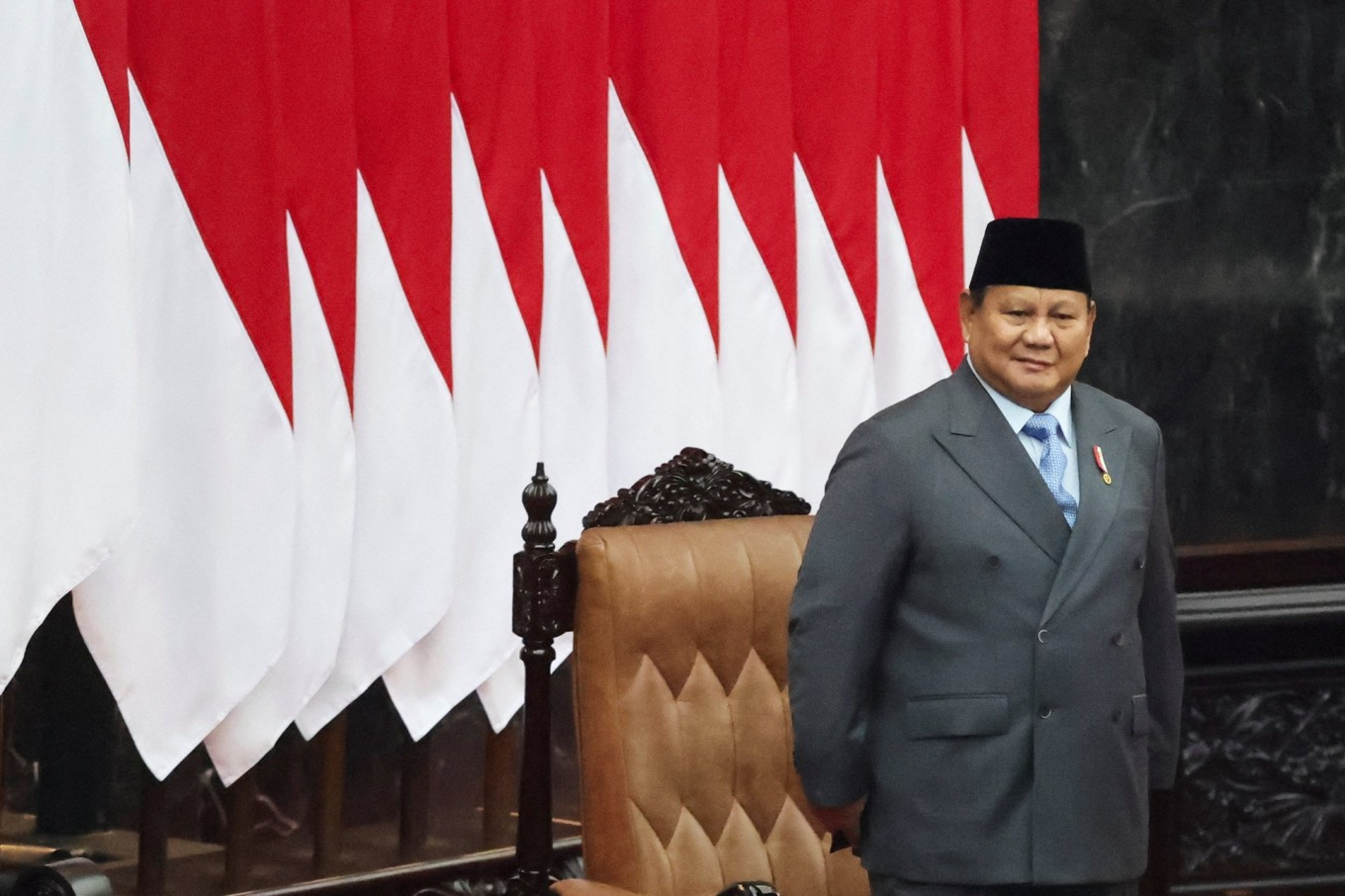 President Prabowo Subianto looks on as he arrives on Aug. 14 at the Senayan Legislative Complex in Central Jakarta for the People's Consultative Assembly (MPR) plenary meeting, in which he delivered the State of the Nation address and the 2027 state budget proposal. (Reuters/Stringer)
L
ast week, I was invited by the House of Representatives’ Commission XI, which oversees financial affairs, for a hearing on revising Indonesia's State Finance Law. While my presentation argued that Indonesia has applied a restrictive "straitjacket" approach since the 1997–1998 Asian Financial Crisis, the discussion remained heavily focused on the 3 percent budget deficit cap.
Let me first distinguish between a straitjacket and a springboard approach. Ideally, state resources should be deployed to maximize economic and social value for society. Citizens (the principal) appoint policymakers (agents) to achieve this objective and must align the policymakers' incentives with the public interest.
A principal-agent problem arises when policymakers prioritize personal gain or corruption over national welfare. In developing countries like Indonesia, where institutional quality remains relatively weak, corruption risks are prevalent.
Under these conditions, the straitjacket approach is adopted to curb corrupt behavior and prevent state loss. While logical at first glance, it suffers from a fundamental flaw: not only does it fail to solve the principal-agent problem but it also shifts the nation’s primary objective from maximizing public value to merely minimizing state loss. This rigid setup has maintained macroeconomic stability for decades, but at the cost of unrealized economic potential. Crucially, the straitjacket fails to reward prudent policy successes while doing little to prevent corruption entirely.
Conversely, a springboard approach emphasizes prudent process-oriented decision-making while preserving the ultimate goal of public value creation. Guided by a clear policy judgment rule, policymakers are held to transparent, accountable standards. This framework allows measured policy experimentation and acknowledges that some policy attempts may fail without implying criminal intent.
Critics often ask: What is the difference between focusing on the decision-making process versus the outcome, given that prosecutors already scrutinize how policies are made?

The distinction lies in the policymaker's mindset. A policymaker in a straitjacket is too risk-averse to leap, whereas a springboard provides a safe platform to reach higher targets. If the government seeks a better balance between fiscal stability and economic growth, adopting a springboard approach is the path forward.