The Jakarta Post
Please Update your browser
Your browser is out of date, and may not be compatible with our website. A list of the most popular web browsers can be found below.
Just click on the icons to get to the download page.


Popular Reads
Top Results
No results found. Please check your search term and try again
Can't find what you're looking for?
View all search results
Popular Reads
Top Results
No results found. Please check your search term and try again
Can't find what you're looking for?
View all search resultsBeyond hectares: The litmus test of the Agrarian Reform Law
Returning a parcel of depleted soil does not heal generational displacement, and measuring land reform by hectares rather than restored human rights only guarantees that history will repeat itself.
Change text size
Gift Premium Articles
to Anyone
Share the best of The Jakarta Post with friends, family, or colleagues. As a subscriber, you can gift 3 to 5 articles each month that anyone can read—no subscription needed!
 Set as preferred source
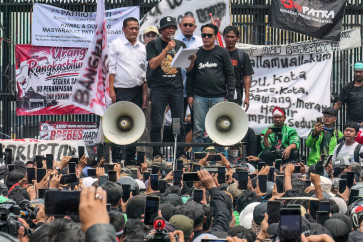
 Common stand: Members of various civil society groups react in the public gallery as the House of Representatives passes the agrarian reform bill during a plenary session on Sept. 22, 2026 at the Senayan Legislative Complex in Central Jakarta. (Antara/Rivan Awal Lingga)
T
he House of Representatives plenary session passed the Agrarian Reform Bill into law on Sept. 22. This is an important milestone for the country’s agrarian reform movement although the new law raises several critical concerns, particularly regarding the extensive powers granted to the Agrarian Reform Implementing Agency (LPRA)—initially National Agrarian Reform Agency (BRAN).
The new legislation offers an opportunity to shift the paradigm of agrarian reform far beyond simple land redistribution, directly addressing structural conflict, restitution, community empowerment, the protection of indigenous peoples, public participation and the correction of past state policies that generated agrarian injustice.
The Agrarian Reform Law adopts a progressive stance by recognizing that agrarian conflicts often stem from unequal control and ownership of land as well as entrenched power imbalances among communities, corporations and the state.
Disputes also escalate when ancestral land, integral to livelihoods and cultural identity, is subject to unilateral government decisions without community consent, frequently culminating in the displacement of local communities.
Recognizing these underlying causes is vital. Agrarian disputes cannot be settled purely by auditing land titles or administrative permits. They involve long histories of land occupation, disrupted livelihoods, cultural heritage, environmental degradation and state interventions that exacerbated tensions: issues routinely documented by the National Commission on Human Rights (Komnas HAM). Between 2020 and 2025, Komnas HAM logged roughly 3,300 complaints concerning agrarian conflicts intersecting with alleged human rights violations.
Agrarian reform must therefore rest firmly on a human rights framework: Individuals and communities serve as rights holders while the state acts as the duty bearer, obligated to respect, protect, fulfill and remedy these rights.

The new law lays this groundwork. Its guiding principles emphasize social justice, human dignity, equality, the social function of land, victim priority and ecological sustainability. Under this framework, state control over land is oriented toward recognizing, restoring and fulfilling the rights of citizens, most notably agricultural laborers, artisanal fishers and indigenous peoples.