The Jakarta Post
Please Update your browser
Your browser is out of date, and may not be compatible with our website. A list of the most popular web browsers can be found below.
Just click on the icons to get to the download page.


Popular Reads
Top Results
No results found. Please check your search term and try again
Can't find what you're looking for?
View all search results
Popular Reads
Top Results
No results found. Please check your search term and try again
Can't find what you're looking for?
View all search resultsArtificial intelligence needs trusted journalism
As people increasingly rely on AI chatbots for news, siphoning traffic and profits from outlets often operating on a shoestring budget, good journalism is at risk of disappearing.
Change text size
Gift Premium Articles
to Anyone
Share the best of The Jakarta Post with friends, family, or colleagues. As a subscriber, you can gift 3 to 5 articles each month that anyone can read—no subscription needed!
 Set as preferred source
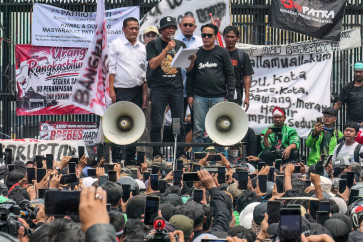
 Protesters during a “Stop the AI Race“ demonstration call for a slowdown in the development of advanced artificial intelligence systems outside City Hall in San Francisco, California, the United States, on Sept. 17, 2026. The world's biggest AI companies are working on creating a standards body, ChatGPT-maker OpenAI said on Sept. 15, as fears rise about the dangers of AI and pressure is on to create a safer version of the technology. (AFP/Karl Mondon)
I
n her 1967 essay Truth and Politics, the political philosopher Hannah Arendt observed that “Freedom of opinion is a farce unless factual information is guaranteed and the facts themselves are not in dispute.” The news supplied by trustworthy journalists has long been an indispensable source of that information, without which democratic societies cannot function effectively. But as people increasingly rely on artificial intelligence chatbots for news, siphoning traffic and profits from outlets often operating on a shoestring budget, good journalism is at risk of disappearing.
The paradox is that trusted news sources are essential to AI’s credibility. Failure to recognize this dependence may result in AI tools further destabilizing the already precarious journalism industry at a moment of profound upheaval and democratic erosion.
Mariya Gabriel, UNESCO’s assistant director general for communication and information, put it well at the World News Media Congress in June: “Support for journalism is not a luxury. It is democratic infrastructure.” Around the same time, UNESCO translated that principle into practice by unveiling its Draft Guidance on Fair Compensation for News, with the final version expected later this year.
AI firms have a responsibility to help sustain the institutions producing the information that their models train on and reproduce, because every AI-generated answer depends on knowledge that someone first had to discover, verify, report, edit and publish.
An analysis of more than 680 million individual citations across popular chatbots such as ChatGPT, Claude and Gemini found that journalism accounts for 27 percent of them, rising to 49 percent for queries about recent events. Without verified information from outside sources, AI systems not only give inaccurate or out-of-date information, but also degrade.
Supporting journalism would also help AI firms win the public’s confidence, as just 20 percent of people globally trust chatbot answers. That caution looks justified. A 2025 study by the European Broadcasting Union and the BBC evaluated over 3,000 responses from leading AI assistants and found that 45 percent contained at least one significant issue, and that 31 percent had serious sourcing failures.

UNESCO’s proposal seeks to address this problem by establishing a framework rooted in shared responsibility while protecting human rights and media freedom. This approach, which regards journalism not simply as an industry but as a public good whose sustainability underpins access to reliable information, advocates the use of bargaining codes, competition remedies, public and platform-financed funds, and collective licensing. These tools would be paired with transparency and attribution obligations and protections for smaller and local media.