The Jakarta Post
Please Update your browser
Your browser is out of date, and may not be compatible with our website. A list of the most popular web browsers can be found below.
Just click on the icons to get to the download page.


Popular Reads
Top Results
No results found. Please check your search term and try again
Can't find what you're looking for?
View all search results
Popular Reads
Top Results
No results found. Please check your search term and try again
Can't find what you're looking for?
View all search resultsIf history belongs to the victors, civilization has no place
A nation cannot build a democratic future on sanitized myths: until Indonesia confronts the violent truths of its past, its history remains an instrument of power rather than a measure of civilization.
Change text size
Gift Premium Articles
to Anyone
Share the best of The Jakarta Post with friends, family, or colleagues. As a subscriber, you can gift 3 to 5 articles each month that anyone can read—no subscription needed!
 Set as preferred source
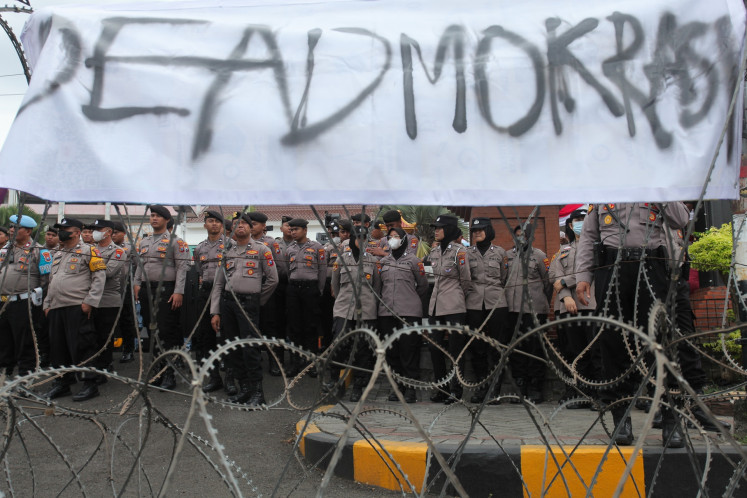
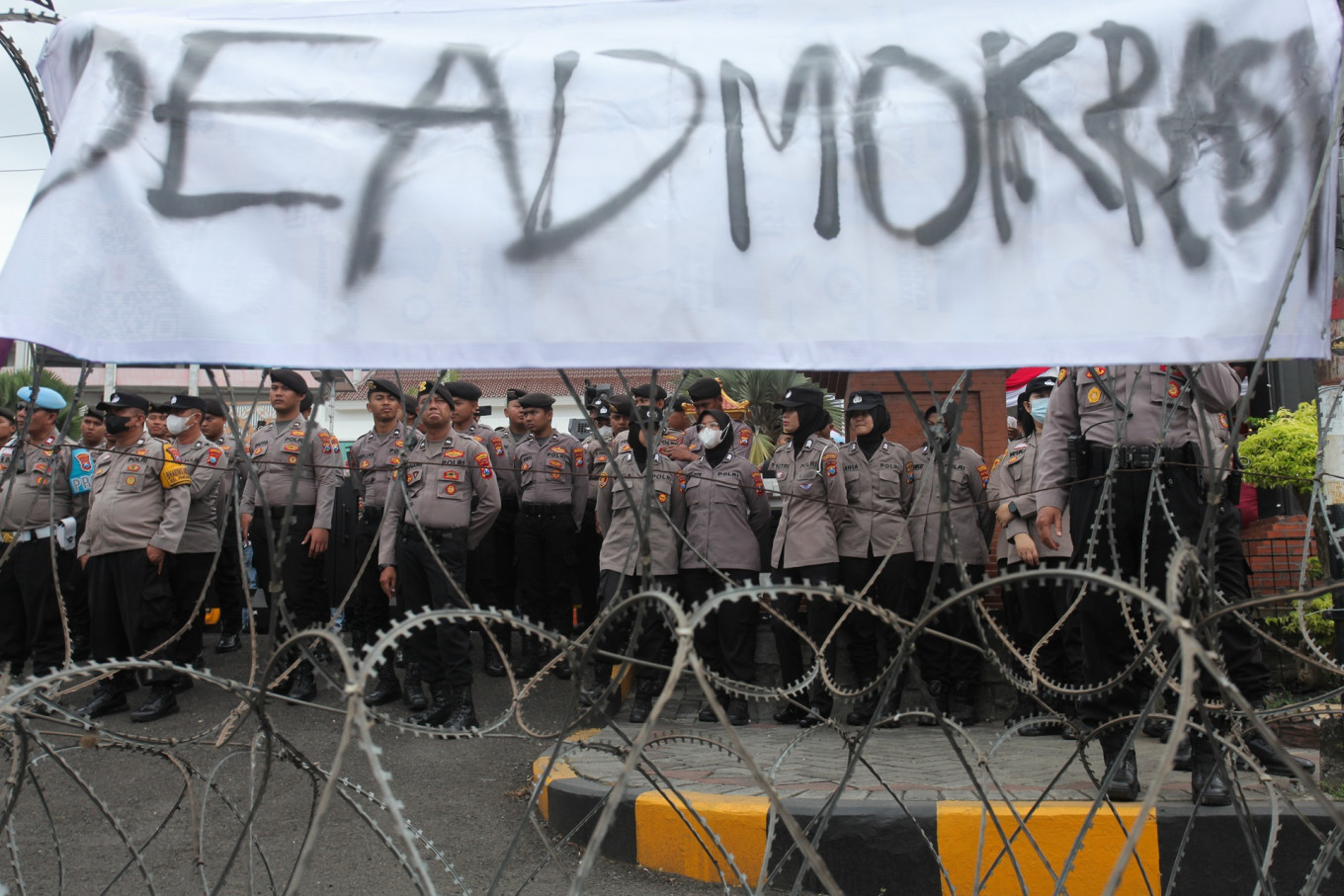 Police officers stand guard during a rally organized by university students on Aug. 19, 2025, in front of the building of East Java Regional Council (DPRD) in Surabaya, East Java. The Surabaya Police deployed nearly 700 personnel to safeguard the rally, during which protestors called for the government to scrap its controversial national history book project and push for protection of freedom of expression. (Antara/Didik Suhartono)
T
he historiography of any nation inevitably confronts opposing factions across conflicting ideological poles. For the victors, history is frequently weaponized to entrench power, glorifying the narrative through which state control was seized.
Yet this dynamic is rarely an absolute monopoly; defeated or marginalized communities are systematically silenced, stripped of their capacity to contribute their lived experiences to the national record.
At this juncture, history as an academic discipline faces its ultimate test of integrity: whether it can remain objective, methodical, systematic and universal. In a broader sense, history should serve as the distillation of a civilization, steering a society toward a shared civic consciousness. This evokes the seminal question posed by French philosopher and historian Ernest Renan: "Qu’est-ce qu’une nation?" (What is a nation?).
Renan altered conventional discourse by rejecting the premise that a nation is defined merely by shared race, language, religion, geography or economic self-interest. Instead, he argued that a nation is a spiritual principle sustained by two pillars: a rich legacy of shared memories and a continuous, present-day moral consensus to coexist, preserve inheritance and build a collective future.
Yet Renan’s thesis harbors a paradox. The collective will to endure as one people requires not only remembering a shared heritage, but also mutually agreeing to forget the internal conflicts and civil atrocities that threaten to fracture social cohesion. Crucially, forgetting can only be legitimate after honest remembrance.
This raises a vital question: Must historical fractures be erased through state-sponsored textbooks that function as white papers for the ruling regime? Such practices trap a society in an endless cycle of retrospective revisionism with every political transition.

Under this model, state orthodoxy dominates, leaving no room for empathy toward the disenfranchised. We must therefore ask whether such manufactured history reflects the conscience of a genuinely civilized nation.