The Jakarta Post
Please Update your browser
Your browser is out of date, and may not be compatible with our website. A list of the most popular web browsers can be found below.
Just click on the icons to get to the download page.


Popular Reads
Top Results
No results found. Please check your search term and try again
Can't find what you're looking for?
View all search results
Popular Reads
Top Results
No results found. Please check your search term and try again
Can't find what you're looking for?
View all search resultsEnsuring the human right to adequate housing in Indonesia
From the sun-starved alleys of Tambora to the sinking shores of Java, Indonesia’s urban future hinges on a vital shift: treating housing not just as four walls, but as a resilient, community-led ecosystem where dignity comes first.
Change text size
Gift Premium Articles
to Anyone
Share the best of The Jakarta Post with friends, family, or colleagues. As a subscriber, you can gift 3 to 5 articles each month that anyone can read—no subscription needed!
 Set as preferred source
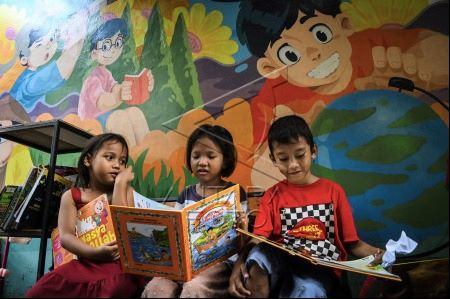
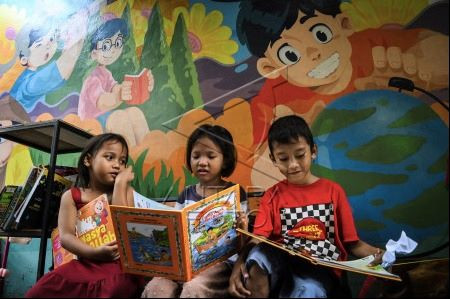 Children read books at Warna-Warni Reading Park in Tambora, West Jakarta, on May 21, 2024. (Antara/Sulthony Hasanuddin)
I
n a riverside pocket of Tambora, West Jakarta, the alleys are so narrow and the buildings so tightly packed that sunlight rarely reaches the ground floor. Many families live in a single rented room, the cheapest accommodation they can afford.
Home to more than 47,000 people per square kilometer, Tambora is among Indonesia’s most densely populated districts and has long been a priority for slum upgrading. Since 2017, the Jakarta provincial government has reduced the city's slum areas by more than half, from 445 to 211. Yet the remaining settlements are still home to hundreds of thousands of residents facing insecure housing, inadequate infrastructure and limited access to basic services.
Tambora is not an outlier; it reflects a broader challenge facing a rapidly urbanizing Indonesia. Jakarta is the world's largest urban agglomeration, home to nearly 42 million people, and the national urban population is projected to grow from 56 percent today to nearly 70 percent by 2045.
Across the country's cities, informal urban villages, kampungs, are the default housing solution for those priced out of the formal market. Many are situated on land without secure tenure and are increasingly exposed to climate risks, leaving residents without either secure housing or stable ground beneath their homes.
This challenge extends beyond Indonesia. Globally, 1.1 billion people live in informal settlements, and the next wave of growth will likely concentrate in secondary cities rather than mega-metropolitan hubs.
According to Statistics Indonesia and the Public Housing and Settlements Ministry, as of March 2026, an estimated 9.29 million households (12.39 percent) do not own a home, while 18.01 million households (roughly 24 percent) live in housing that fails to meet minimum livability standards. While these figures mark an improvement from the previous year, they still indicate that nearly three in every 10 Indonesian households lack either secure homeownership or adequate shelter. Jakarta alone accounts for approximately 824,000 of these households.

On the ground, three compounding pressures drive this crisis. Affordability comes first: land and construction costs continue to outpace income growth, even for low-income households. Tenure insecurity follows, felt most acutely in riverbank and coastal kampungs. The third and fastest-growing pressure is climate risk. Land subsidence is actively reshaping Java's northern coastline, accelerating in Semarang and Demak, in Central Java, where studies have recorded sinking rates of up to 14–19 centimeters per year.