

 Set as preferred source






Enjoy This Gifted Article!
You're reading this thanks to a The Jakarta Post subscriber.
Access is available for 30 days. For unlimited access, consider subscribing.
Please Update your browser
Your browser is out of date, and may not be compatible with our website. A list of the most popular web browsers can be found below.
Just click on the icons to get to the download page.

Can't find what you're looking for?
View all search resultsCan't find what you're looking for?
View all search resultsThe negative energy from anger over haze must be turned into positive action for supporting the people on the front lines battling forest fires and for bringing to account the companies found responsible for starting them.
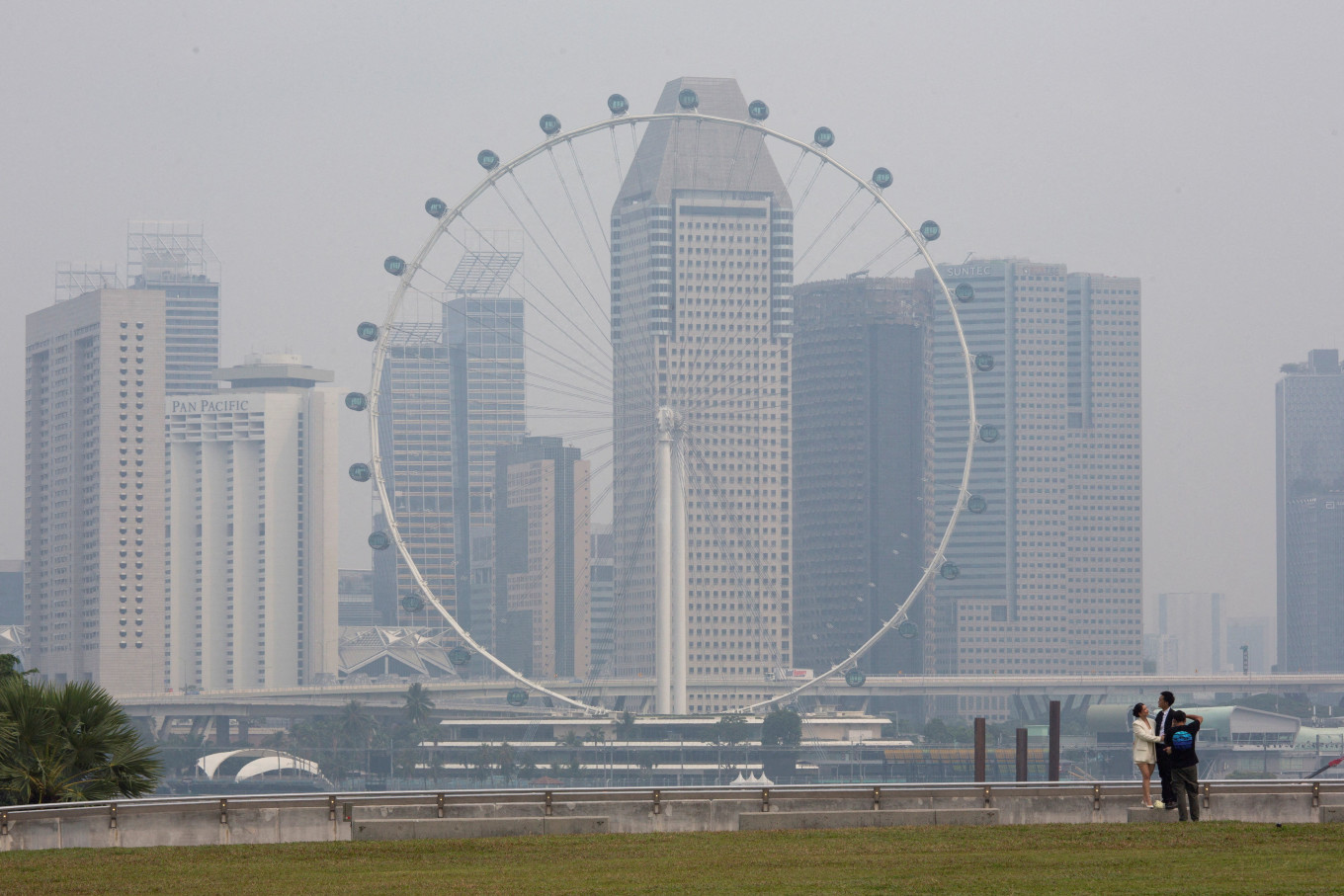 Buildings in the Central Business District loom beyond the Singapore Flyer amid a shroud of haze Sept. 15, 2026, along the island-state’s Marina Bay prime waterfront area. (Reuters/Ore Huiying)
wake up at home to a view of the city skyline. These days, all I see is a murky gray mess. My eyes itch. My throat is sore. And like millions of people across the region, I am infuriated that we are going through this once again.
On social media and in WhatsApp groups, fingers are pointed at agribusiness companies allegedly using fire to clear land for new plantations, with oil palm the most frequently cited.
Some of that anger is deserved, but on the ground in Sumatra and Kalimantan, the reality is more complicated. Communities are living through a severe El Nino drought. In these conditions, any spark from any source can become an uncontrollable fire.

On the peatlands of Kalimantan and southern Sumatra, fires burn deeper and longer and are far harder to put out. The government has recognized this: Under the new presidential instruction on forest and land fires, regional rules that permit burning are being reviewed and revoked where they conflict with national law, and even the narrow customary exception that lets smallholder farmers burn subsistence plots has been suspended until the emergency is declared over.
Are some companies and individuals taking advantage of the situation to clear land with fire? Almost certainly. But facing them are plantation staff, smallholders, villagers and NGO crews who have been battling fires for weeks alongside the government, working in shifts and eating and resting where they can.
As my colleague Aryo Gustomo described in his recent article in business intelligence platform Eco-Business, RSPO Certified members are devoting extensive efforts and resources to fighting these fires alongside their neighbors and government counterparts.

Companies have trained and deployed thousands of emergency response team personnel to respond at a moment’s notice. In areas where rivers have dried up, companies are flying in water by plane and helicopter to protect their own and their neighbors' land.
Our RSPO smallholder groups are also on the front lines, tirelessly patrolling their own farms while working together to aid their neighbors in fighting fires, sometimes many kilometers away from their own villages.
This tireless work on the front lines is only half of the response. The other half is holding those responsible to account.
The RSPO system maintains a firm stance on fires: Certified companies cannot use fire to clear land; deforestation has been prohibited since 2018; member companies must run fire prevention, monitoring and response systems across their concessions and work with surrounding communities to tackle fires when they occur. Under the RSPO Standards, these rules are clear.
Our satellite monitoring system detects hot spots in our members' concessions and alerts the companies, which must then check on the ground if these hot spots indicate real fires. If fires are confirmed, the companies must report how each fire started and what they did about it.
What we do next depends on how it started. A company that uses fire to clear land commits one of the most serious breaches of our standard, and they risk losing their certification or membership. A company that fails to prevent or contain a fire within their plantation may also be in breach, depending on the circumstances.

However, a fire that spreads in from outside during an extreme drought is not automatically a breach. The question, then, is whether the company's prevention and response met the required standard.
A fire inside an RSPO Certified concession always requires an explanation. We ask our members to report on each incident case by case so that the appropriate action can be taken.
Not every company will do the right thing. Local communities and NGOs alert us to potential violations, and anyone who believes an RSPO member has broken our rules can file a formal complaint that is independently investigated and decided.
None of this lessens the damage in Ketapang, West Kalimantan, where fire burned forest set aside for orangutans inside a certified concession. That forest had been protected for years, so the loss cuts deep.
We detected the hot spots in Ketapang, and alerts were sent to affected members almost immediately. The facts there are still being assessed, and I will not prejudge them. If the evidence shows that a certified company started a fire or failed in its duty to prevent one, the RSPO system provides for sanctions up to and including suspension, and the outcomes are made public.
Readers also deserve a sense of scale. The Jakarta Post's own figures of Sept. 4, from Nusantara Atlas, show that oil palm concessions accounted for around 15,000 of the 286,000 hectares burned overall between January and July. Our data show that fires are significantly less likely in RSPO Certified plantations than in other oil palm concessions.
Meanwhile, the battle against the blazes continues. Thousands of plantation workers, smallholders and community residents are out there every day, doing what they can to avert further catastrophe.
I am still angry. I still wake up to that gray mess every morning. But I want to turn that anger into action: holding to account any RSPO members who break our rules while standing behind those who are putting their lives at risk to fight these fires. They deserve our gratitude and our support.
---
The writer is chief executive officer of the Roundtable on Sustainable Palm Oil (RSPO).
Share your experiences, suggestions, and any issues you've encountered on The Jakarta Post. We're here to listen.
Thank you for sharing your thoughts. We appreciate your feedback.
Quickly share this news with your network—keep everyone informed with just a single click!
Share the best of The Jakarta Post with friends, family, or colleagues. As a subscriber, you can gift 3 to 5 articles each month that anyone can read—no subscription needed!
Get the best experience—faster access, exclusive features, and a seamless way to stay updated.


