The Jakarta Post
Please Update your browser
Your browser is out of date, and may not be compatible with our website. A list of the most popular web browsers can be found below.
Just click on the icons to get to the download page.


Popular Reads
Top Results
No results found. Please check your search term and try again
Can't find what you're looking for?
View all search results
Popular Reads
Top Results
No results found. Please check your search term and try again
Can't find what you're looking for?
View all search resultsIndonesia-China: Maritime cooperation without compromising national interests
Maritime cooperation with Beijing cannot come at the expense of sovereign rights: for Indonesia, the smart play is engagement backed by unyielding legal firewalls and a fortified presence in the North Natuna Sea.
Change text size
Gift Premium Articles
to Anyone
Share the best of The Jakarta Post with friends, family, or colleagues. As a subscriber, you can gift 3 to 5 articles each month that anyone can read—no subscription needed!
 Set as preferred source
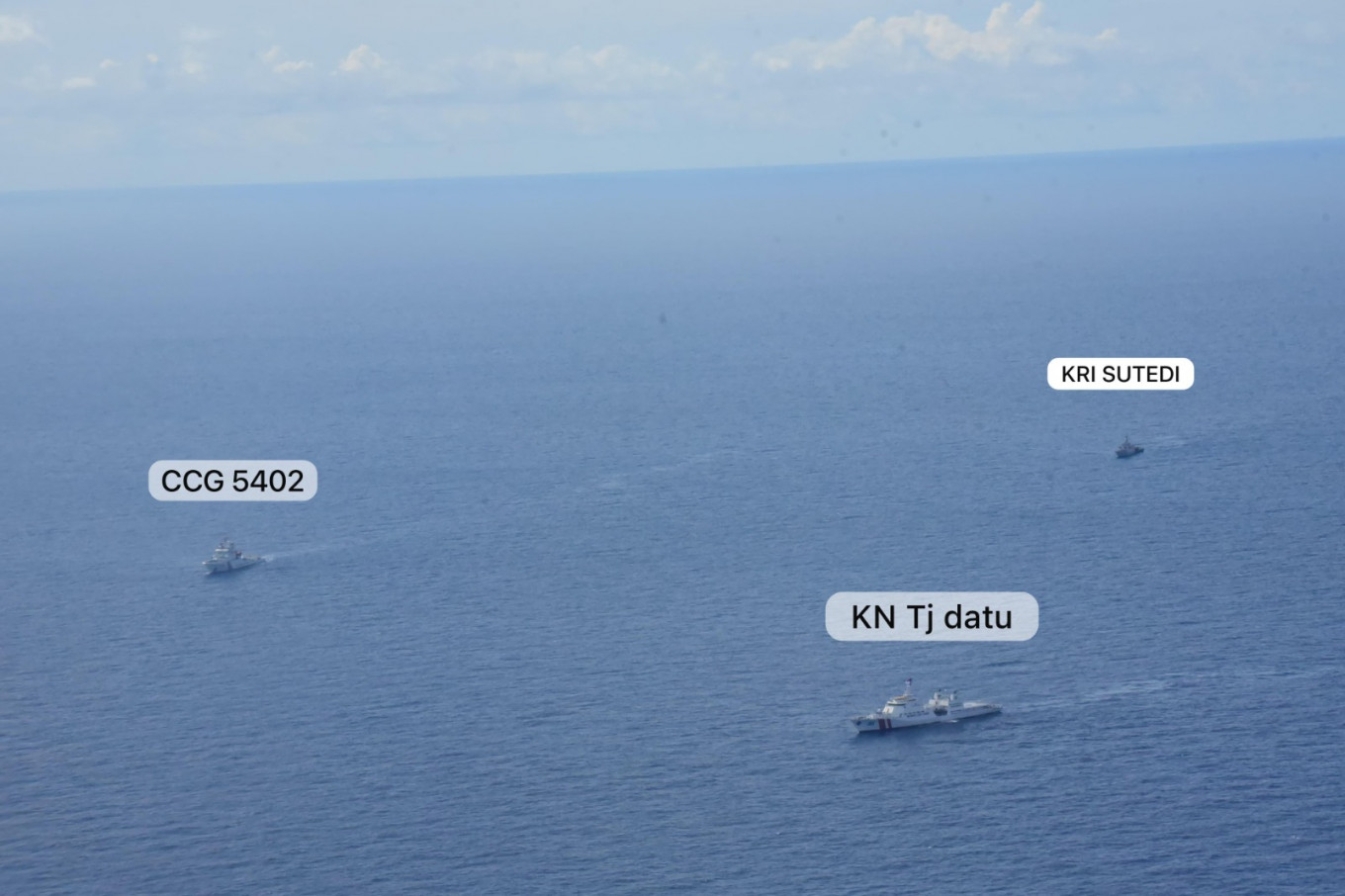 China Coast Guard's (CCG) patrol vessel CCG 5401 (left) is shadowed by Indonesian Maritime Security Agency's (Bakamla) patrol boat KN Tanjung Datu and Indonesian Navy's corvette KRI Sutedi Senoputra inside Indonesian exclusive economic zone (EEZ) on North Natuna Sea on Oct. 21, 2024. (Courtesy of Bakamla/-)
I
ndonesia-China relations have entered an increasingly complex phase. Beijing remains an indispensable economic, investment, and technological partner for Jakarta. Concurrently, it is an assertive maritime power whose expanding operational reach in the South China Sea directly presses against the North Natuna Sea.
For Indonesia, the core strategic question is no longer whether to engage Beijing, but how to ensure that cooperation does not become an instrument that gradually erodes national sovereignty and sovereign rights.
The strategic landscape of 2026 leaves little room for complacent assumptions. The South China Sea is now a focal point of intensified great-power rivalry, where strategic intent is telegraphed through physical posture as much as diplomatic rhetoric.
Satellite imagery analyzed by the Asia Maritime Transparency Initiative revealed that China launched extensive dredging operations at Antelope Reef in the Paracels in October 2025; by March, it had reclaimed roughly 1,490 acres, nearly rivaling Mischief Reef, its largest maritime outpost in the region. In late September, Beijing announced that its joint military support and training facility in Laos had reached operational status, establishing what defense analysts assess as a persistent military foothold in mainland Southeast Asia.
Amid escalating tensions across the Taiwan Strait and surging coast guard assertiveness, regional competition is decisively shifting from contested claims to struggles over access, presence, and structural influence. Against this backdrop, the Aug. 12 passing exercise (PASSEX) between the Indonesian frigate KRI I Gusti Ngurah Rai-332 and the People’s Liberation Army Navy frigate Honghe-523 demands clear-eyed scrutiny.
The Indonesian Navy framed the encounter as routine maritime diplomacy rather than a tactical exercise, fully consistent with Jakarta’s nonaligned doctrine. Operationally, that characterization holds. Geopolitically, the operating theater altered the equation: it marked China’s first bilateral exercise with a foreign navy in the waters east of Taiwan, triggering an immediate protest from Taipei.

The November 2024 Joint Statement demonstrates why loose diplomatic phrasing carries strategic liabilities. The document referenced “joint development in areas of overlapping claims”—a characterization Jakarta has historically rejected vis-à-vis Beijing. While Jakarta moved quickly to clarify that the text compromised neither its sovereignty, sovereign rights, nor jurisdiction in the North Natuna Sea, Beijing operates on a divergent political calculus.