The Jakarta Post
Please Update your browser
Your browser is out of date, and may not be compatible with our website. A list of the most popular web browsers can be found below.
Just click on the icons to get to the download page.


Popular Reads
Top Results
No results found. Please check your search term and try again
Can't find what you're looking for?
View all search results
Popular Reads
Top Results
No results found. Please check your search term and try again
Can't find what you're looking for?
View all search resultsIndonesia's gas export cuts: A costly blow to trust and regional leadership
At stake are Indonesia's credibility as an economic partner, its ability to attract long-term investment and its standing as a regional leader.
Change text size
Gift Premium Articles
to Anyone
Share the best of The Jakarta Post with friends, family, or colleagues. As a subscriber, you can gift 3 to 5 articles each month that anyone can read—no subscription needed!
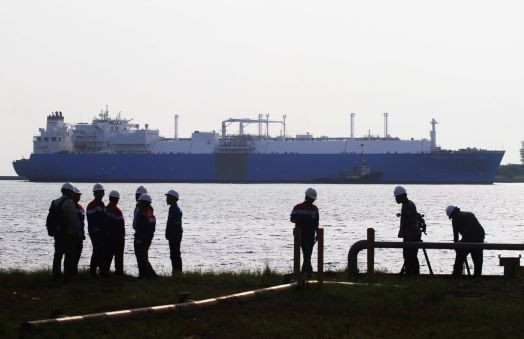 Workers wait for the cargo ship Towuti, carrying 119,000 cubic meters of liquified natural gas (LNG) from Tangguh, West Papua, to moor on Jan. 19, 2015, at the Arun storage and regasification facility in Lhokseumawe, Aceh. (Antara/Akbar Nugroho Gumay)
I
ndonesia's decision to cut natural gas exports to Singapore from Oct. 24 raises questions that go well beyond bilateral energy trade. At stake are Indonesia's credibility as an economic partner, its ability to attract long-term investment and its standing as a regional leader.
Prioritizing domestic energy security is legitimate. Indonesia needs reliable, competitively priced gas for power generation and manufacturing. The real question is whether restricting exports will strengthen energy security or, over time, undermine it. Three issues deserve attention: Indonesia's trust deficit, the economics of gas investment and the cost to its ASEAN leadership.
The timing could hardly be worse, because business confidence is already weak. The Indonesian Chamber of Commerce (Kadin) Business Pulse survey for the third quarter of 2026 found that only 32.4 percent of firms planned to invest in the next six months, down from 47.1 percent in late 2025, while 40 percent had no plans to invest at all. Government policies and programs were the most frequently cited business challenge.

Investment depends not only on expected profits but on confidence that the rules will stay predictable. When uncertainty rises, investors demand higher returns, delay commitments or take their capital elsewhere. Even if the export cut's direct economic impact is modest, its signaling effect could be far larger. The government should therefore clarify whether it negotiated the reductions within existing contractual provisions or imposed them unilaterally.
Indonesia is preparing a new oil and gas law meant to improve legal certainty, strengthen governance and attract investment. The reform is long overdue.
Upstream investment is unlike ordinary manufacturing. Companies commit large sums before knowing whether reserves are commercially recoverable, then spend billions more over many years developing fields and transport infrastructure. Returns may take a decade or longer.

Investors therefore judge projects on cash flows over their full commercial lives, and they need confidence in production-sharing terms, fiscal regimes, market access and contract enforcement. Indonesia competes for this capital with other producing countries; geology alone will not win it.