The Jakarta Post
Please Update your browser
Your browser is out of date, and may not be compatible with our website. A list of the most popular web browsers can be found below.
Just click on the icons to get to the download page.


Popular Reads
Top Results
No results found. Please check your search term and try again
Can't find what you're looking for?
View all search results
Popular Reads
Top Results
No results found. Please check your search term and try again
Can't find what you're looking for?
View all search resultsIs a Chinese implosion looming?
Though few dare to speculate about it publicly, an economic and political perfect storm is bearing down on China.
Change text size
Gift Premium Articles
to Anyone
Share the best of The Jakarta Post with friends, family, or colleagues. As a subscriber, you can gift 3 to 5 articles each month that anyone can read—no subscription needed!
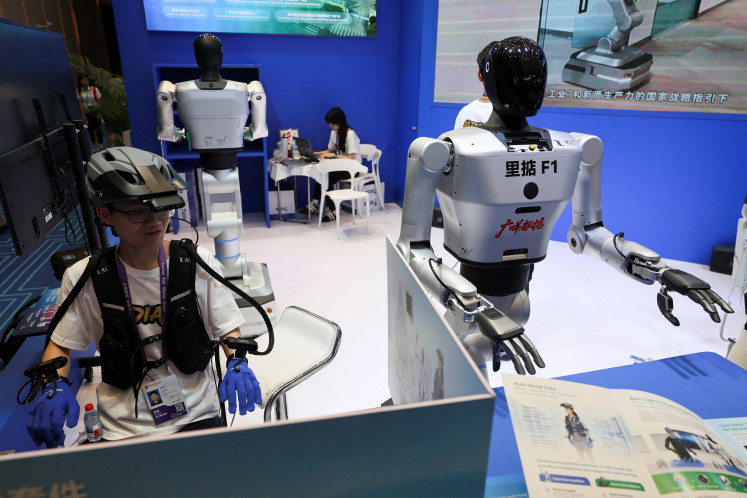
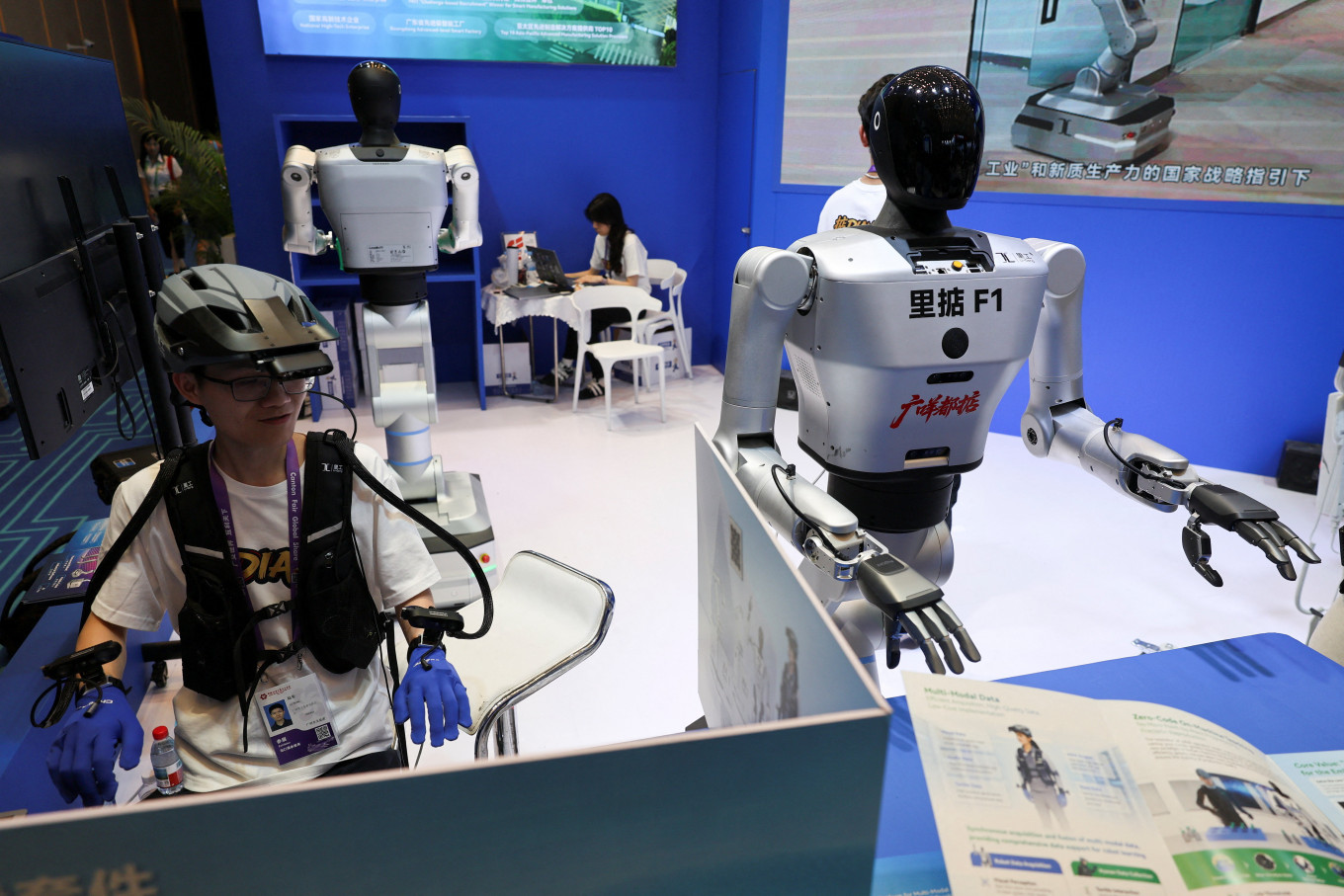 An employee demonstrates the working of a humanoid robot on April 15 during the China Import and Export Fair, commonly known as the Canton Fair, in Guangzhou, Guangdong province, China. (Reuters/Go Nakamura)
T
his has been an era of shocks. In the space of two decades, the world has witnessed globally disruptive wars — from Iraq in the 2000s to Ukraine and Iran today — a global financial crisis, a global pandemic, and a rogue American president upending the global order. Now, yet another potential shock must be addressed: Though few dare to speculate about it publicly, an economic and political perfect storm is bearing down on China.
On the political front, Chinese President Xi Jinping has ruthlessly eliminated all potential opposition and centralized power in his own hands. His decimation of the state, party, provincial and military leadership has left a trail of bodies and resentment, even if the impenetrability of the Communist Party of China (CPC) makes this difficult to establish definitively. With blood and revenge hammering in their heads (to paraphrase Shakespeare), numerous humiliated and disgruntled former officials could make Xi’s succession, whenever it comes, disorderly.
Cycles of apparent calm leading to chaos are not uncommon in Chinese history. They are intrinsic to what Francis Fukuyama has called the country’s “Bad Emperor” problem, with Mao Zedong and Xi representing the bad emperors of the Communist era.
On the economic front, the outlook is mixed, but downside risks are growing. Where some see an all-conquering powerhouse that is marrying technology to mass manufacturing, others see an economy that has been dragged into a structural slowdown by population aging, a prolonged property market slump, rising youth unemployment and growing hostility to private enterprise. Making matters worse, the longstanding source of Chinese dynamism — exports — is vulnerable to policy responses from the United States and Europe, which are under immense pressure to address the latest China Shock.
But perhaps even more worrying is China’s fraying fiscal capacity. Warnings about unsustainable public debt are growing louder everywhere, but the situation in China is distinctive, owing to how it manages — or, rather, fails to manage — taxation.
Few states are as successful as China when it comes to surveilling and controlling the population. But taxes represent a reciprocal bargain with citizens, who accept expropriation as legitimate on the understanding that they will get something in return: stability, public goods, improved standards of living, redistribution, and so forth. That is why wars and even empires can be lost when a state loses its capacity to tax its citizens.

The fate of the Ming and Qing dynasties is telling in this respect. Even discounting the obvious historical differences, these episodes have faint echoes in developments today. We recently mapped China’s taxes and revenues since 1952. Two features stand out. First, and somewhat surprisingly, the CPC has not presided over a particularly strong fiscal state. Instead, it has raised a substantial share of resources without explicitly taxing its people. Until the late 1970s, about half the resources raised came from profits of state-owned enterprises (SOEs); and in the last two decades, about one-sixth (and as much as one-quarter at its peak in 2020) has come from land sales.