The Jakarta Post
Please Update your browser
Your browser is out of date, and may not be compatible with our website. A list of the most popular web browsers can be found below.
Just click on the icons to get to the download page.


Popular Reads
Top Results
No results found. Please check your search term and try again
Can't find what you're looking for?
View all search results
Popular Reads
Top Results
No results found. Please check your search term and try again
Can't find what you're looking for?
View all search resultsJakarta should not lower the bar for Myanmar
As a member of the Financial Action Task Force, Indonesia can help ensure Myanmar is judged by enforcement results, not by its new civilian title.
Change text size
Gift Premium Articles
to Anyone
Share the best of The Jakarta Post with friends, family, or colleagues. As a subscriber, you can gift 3 to 5 articles each month that anyone can read—no subscription needed!
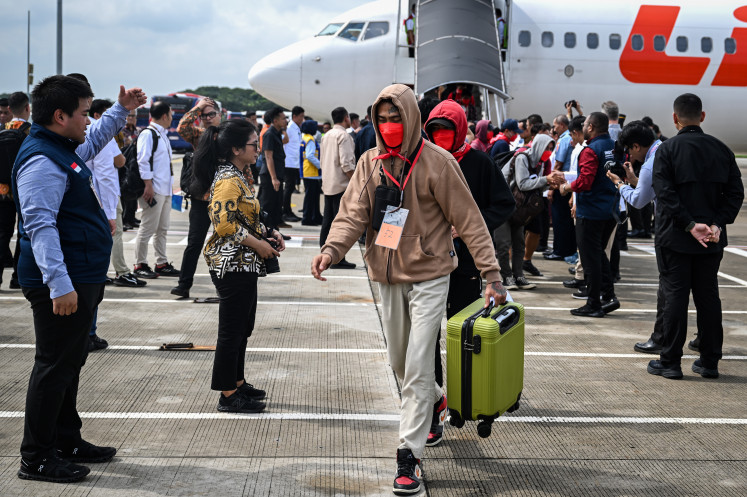
 Indonesian nationals who had worked at scam centres in Myanmar are greeted by officials upon arrival from Thailand, at the Soekarno-Hatta International Airport in Tangerang, Banten near Jakarta on March 18, 2025. Indonesia on March 18 began repatriating more than 500 of its nationals freed from online scam centres in Myanmar, officials said, bringing them home from grim holding camps in Thailand where many have languished for weeks. (Antara Foto/Bayu Pratama S)
I
n March 2025, more than 500 Indonesians came home from scam compounds in Myawaddy, on Myanmar’s border with Thailand, where many had been trafficked and forced to defraud strangers online (The Jakarta Post, March 19, 2025). Another 54 were brought home in December, according to Antara. This week, Indonesia has a chance to address the system that made those compounds profitable.
On Oct. 26-30, the Financial Action Task Force (FATF), the global anti-money-laundering standard-setter, meets in Paris to decide whether to escalate measures against Myanmar. The country has been on the FATF blacklist since 2022, alongside only Iran and North Korea, and was warned that countermeasures would be considered if there was no further progress by October, according to South Africa Financial Intelligence Centre.
Indonesia sits at that table. It was admitted by acclamation as the FATF’s 40th member in 2023, recognition of years of reform led by its financial intelligence unit, the Financial Transaction Reports and Analysis Center (PPATK).
The timing is delicate. Min Aung Hlaing, the coup leader who became president in April, is expected to make an official visit to Jakarta, according to The Diplomat. At the ASEAN summit in Manila in May, then-Indonesian foreign minister Sugiono said leaders saw “positive gestures” worth appreciating, including prisoner releases and a change in Aung San Suu Kyi’s detention status.
Releases are welcome. But more than 15,000 political prisoners remain in detention, according to the Assistance Association for Political Prisoners (AAPP). And none of these gestures answer the question before the FATF: Is dirty money being stopped?
Myanmar’s failings are not a capacity gap. They come from an economic model that military rule has protected for decades. Private banks were, in the words of Sean Turnell, an economist who advised the civilian government, “little more than corporate cash boxes” for connected conglomerates. From 2017, the civilian-era central bank began requiring standard loan accounting, and the International Monetary Fund warned that bank capital was “already weak”. The 2021 coup removed the government committed to enforcing those rules.

Since then, the World Bank says, the deficit has been financed mainly by the central bank and, more recently, by commercial banks holding the public’s deposits. With inflation near or above 20 percent for years, the real value of old crony debts has melted away while savers and wage earners absorbed the loss.