The Jakarta Post
Please Update your browser
Your browser is out of date, and may not be compatible with our website. A list of the most popular web browsers can be found below.
Just click on the icons to get to the download page.


Popular Reads
Top Results
No results found. Please check your search term and try again
Can't find what you're looking for?
View all search results
Popular Reads
Top Results
No results found. Please check your search term and try again
Can't find what you're looking for?
View all search resultsRedefining corruption: Protection for economic power?
Narrowing corruption down to bribery may protect state investors from criminalized business losses, but without strict checks, it risks turning legal certainty into a shield for oligarchic power.
Change text size
Gift Premium Articles
to Anyone
Share the best of The Jakarta Post with friends, family, or colleagues. As a subscriber, you can gift 3 to 5 articles each month that anyone can read—no subscription needed!
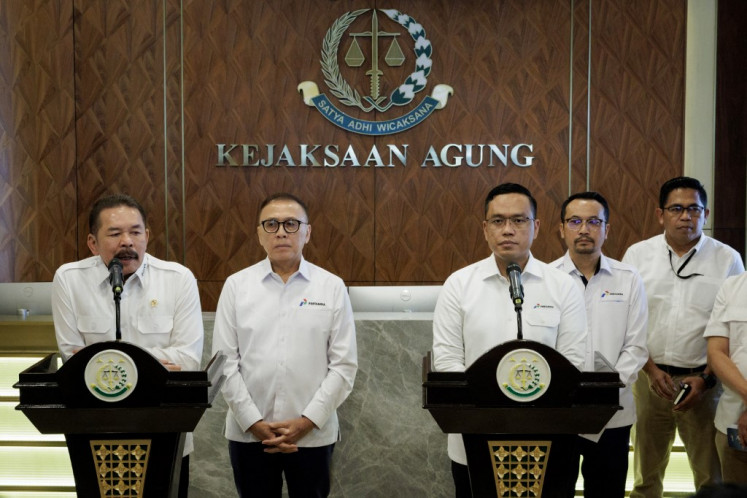
 Attorney General Sanitiar Burhanuddin (front, left) and state energy holding firm Pertamina executive director Simon Aloysius Mantiri (front, right) attend a press briefing to assure the public that Pertamina's current fuel meets standards and is unaffected by the 2018-2023 fuel supply corruption case at Pertamina subsidiaries at the Attorney General's Office building in Jakarta on March 6, 2025. (AFP/Yasuyoshi Chiba)
N
ational Economic Council (DEN) Chairman Luhut Pandjaitan said recently that President Prabowo Subianto has agreed in principle to a study a potential shift in the legal definition of corruption, moving the primary focus toward bribery rather than state losses.
The proposal is intended, in part, to provide legal certainty for executives managing state investment institutions, including Danantara, ensuring that legitimate commercial losses do not automatically trigger criminal investigations. Even though such approval does not constitute amendment to the Corruption Eradication Law, the proposal warrants closer scrutiny than a routine effort to harmonize domestic legislation with international standards.
It directly affects the trajectory of anticorruption enforcement, the institutional framework for holding public officials accountable and the structural relationship between the state and capital.
Two competing imperatives must be reconciled. First, the legitimate need to protect commercial risk-taking from unwarranted criminalization. Second, the danger of narrowing enforcement tools at a time when political and economic power is increasingly concentrated. In Indonesia, where oligarchic dynamics continue to shape the nexus between wealth and governance, the latter concern cannot be minimized.
Under an oligarchic framework, economic power is sustained not solely through capital accumulation, but through the continuous conversion of wealth into political influence. Financial resources are deployed to construct power networks, finance political parties and candidates and secure access to state decision-making apparatuses. Political power, in return, unlocks economic advantages through preferential regulations, public procurement contracts, natural resource concessions, licensing regimes, and bespoke policy interventions.
These gains replenish the financial base required to sustain political leverage. This dynamic shapes a self-reinforcing cycle: wealth secures political power, political authority yields economic rents and those rents consolidate ongoing political influence.

Critically, this transmission mechanism rarely requires blatant, provable bribery. Influence routinely operates through legal campaign financing, joint ventures with political elites, systemic conflicts of interest, regulatory capture, or transactions engineered to appear fully compliant on paper. In an environment characterized by oligarchic features, corruption cannot be conceptualized merely as cash exchanged across a desk for an official favor.