The Jakarta Post
Please Update your browser
Your browser is out of date, and may not be compatible with our website. A list of the most popular web browsers can be found below.
Just click on the icons to get to the download page.


Popular Reads
Top Results
No results found. Please check your search term and try again
Can't find what you're looking for?
View all search results
Popular Reads
Top Results
No results found. Please check your search term and try again
Can't find what you're looking for?
View all search resultsBuilding resilient generation beyond law enforcement
Indonesia’s next great crime-prevention weapon isn't a heavier badge or a faster patrol car - it’s a generation of digitally savvy teenagers trained to outsmart scams, bypass brawls and defuse radicalization from the palm of their hand.
Change text size
Gift Premium Articles
to Anyone
Share the best of The Jakarta Post with friends, family, or colleagues. As a subscriber, you can gift 3 to 5 articles each month that anyone can read—no subscription needed!
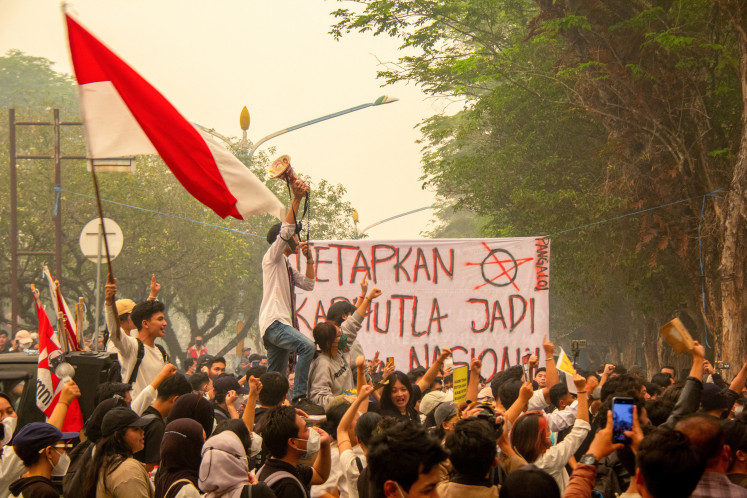
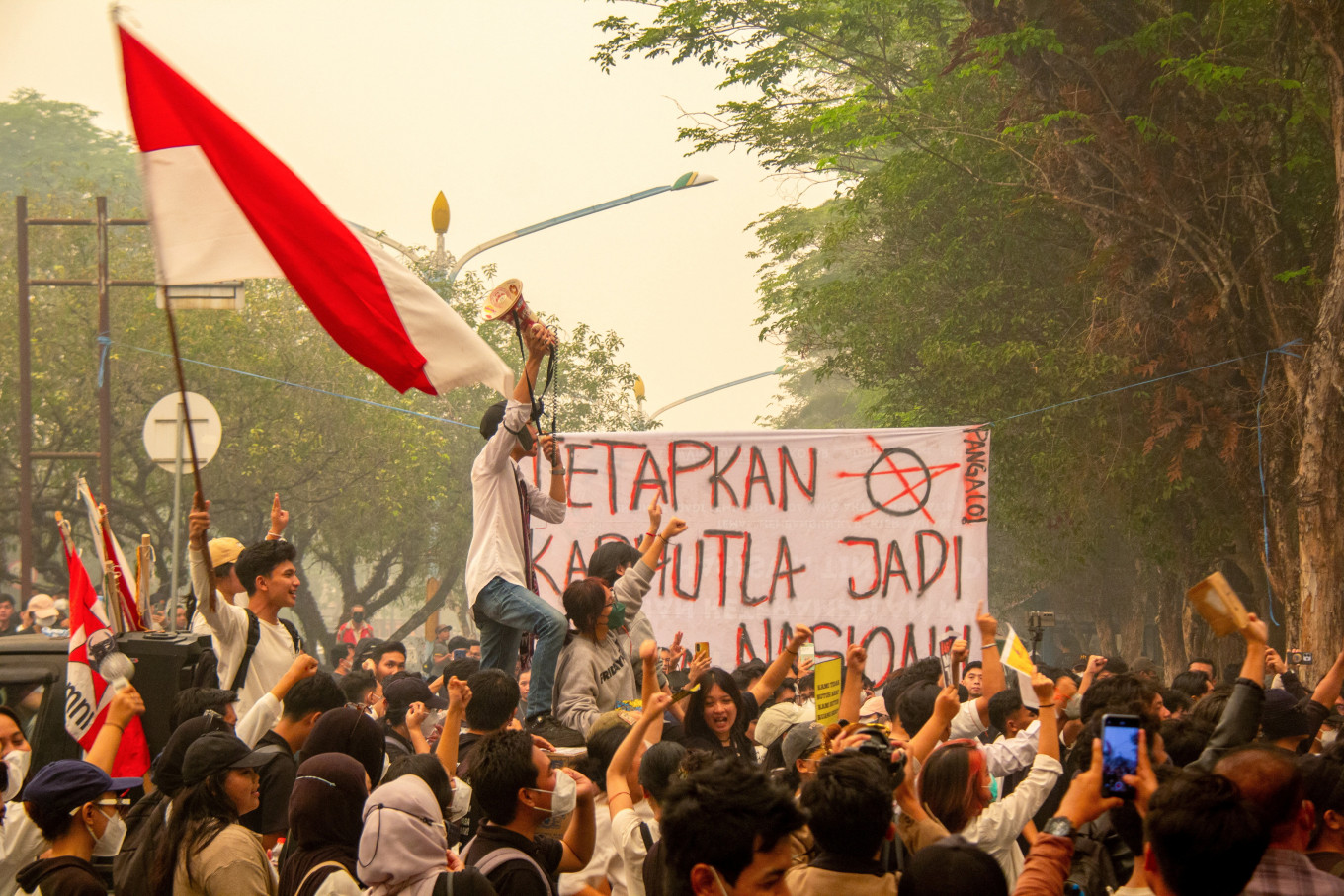 University students protest against the government's handling of haze and wildfires on Friday outside the Central Kalimantan Governor's office in Palangka Raya, Central Kalimantan. (Reuters/Arief Rahman Septian Prathama)
I
ndonesia’s most important crime-prevention tool in the coming decade will not be a patrol car or an officer on every street corner; it will be a teenager who can spot a scam, question fake news and walk away from a brawl.
The country stands at the peak of its demographic dividend. Generation Z makes up nearly 28 percent of the population and, combined with millennials, accounts for more than half of all Indonesians. Yet this generation also bears the weight of a decade of compounding shocks.
The World Economic Forum’s (WEF) Global Risks Reports map this trajectory clearly: in 2016, experts were primarily concerned with migration and extreme weather; by 2021, the WEF warned that young people were navigating their second global crisis in a decade, designating youth disillusionment a critical blind spot; and by 2024 and 2025, misinformation dominated short-term concerns.
In its Global Risks Report 2026, the WEF notes that half of surveyed experts foresee a turbulent two-year horizon, warning that educated youth displaced by artificial intelligence could be drawn toward extremism.
Indonesia’s domestic indicators are equally stark. In 2024, the Financial Transaction Reports and Analysis Center (PPATK) identified nearly 200,000 minors engaged in online gambling. UNICEF reported that 45 percent of Indonesian youth have experienced cyberbullying.
Student brawls remain a recurring problem across the archipelago, while teenagers are increasingly radicalized behind screens without ever meeting an operative in person. Furthermore, the street protests of August 2025 - echoing youth-led movements across the region - demonstrated how swiftly online grievances can manifest as civil unrest.

Economist Frank Knight famously distinguished measurable risk from radical uncertainty. What young Indonesians face today is profound uncertainty, an environment no amount of traditional enforcement can resolve alone. Recognizing this, the National Police (Polri) has begun shifting its paradigm: the most durable crime prevention is not a heavier hand, but a generation resilient enough to absorb systemic shocks and emerge stronger.