The Jakarta Post
Please Update your browser
Your browser is out of date, and may not be compatible with our website. A list of the most popular web browsers can be found below.
Just click on the icons to get to the download page.


Popular Reads
Top Results
No results found. Please check your search term and try again
Can't find what you're looking for?
View all search results
Popular Reads
Top Results
No results found. Please check your search term and try again
Can't find what you're looking for?
View all search resultsThe Thucydides Trap obscures the choices of power
Commentators should drop the Thucydides Trap because it is both banal and dangerous.
Change text size
Gift Premium Articles
to Anyone
Share the best of The Jakarta Post with friends, family, or colleagues. As a subscriber, you can gift 3 to 5 articles each month that anyone can read—no subscription needed!
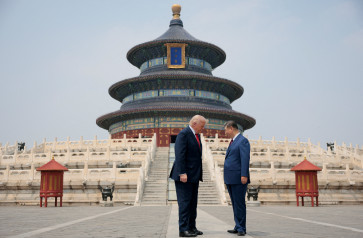
 United States President Donald Trump and Chinese President Xi Jinping stand together as they tour the Temple of Heaven in Beijing, China, May 14, 2026. (Reuters/Evan Vucci)
W
henever Washington and Beijing edge toward confrontation, pundits reach for Thucydides. They invoke the “Thucydides Trap”, popularized by Harvard political scientist Graham Allison’s 2015 essay in The Atlantic. According to this rather simple idea wrapped in a fancy-sounding Greek name, war becomes likely when a rising power challenges an established one.
The Thucydides Trap is now a cliché in United States-China rivalry discourse. However, the model is not useful for understanding the exercise of American power in the second Donald Trump administration. To paraphrase Obi-Wan Kenobi, this is not the Thucydides you are looking for.
Commentators should drop the Thucydides Trap because it is both banal and dangerous. First, it is a painfully obvious concept and does not require a reference to Thucydides’ The History of the Peloponnesian War, an oft-cited but rarely read fifth-century text.
The book is an account of a prolonged conflict (431- 404 BC) between the Peloponnesian League, led by hyper-militaristic Sparta, and the Delian League, led by Athens, an alleged democracy. The account, which runs some 600-plus pages, does not cover the full war, ending mid-sentence in 411 BC. Its daunting size, intense detail and Byzantine complexity mean that few have mastered, let alone made it through a significant portion of, the text.
However, deploying a reference to Thucydides in contemporary discourse is likely to impress an audience, especially if they have not read it. More concerning is that the concept of the Thucydides Trap turns war into a geopolitical accident. In this model, war is the regrettable outcome of shifting power structures rather than a specific course of action chosen by individual leaders who made decisions that sacrifice lives and damage social structures. It eschews human agency from history, thus allowing actors to avoid accountability.
For understanding Trump’s foreign policy, there is a specific episode in The History of the Peloponnesian War that is more revealing. We should look to the Melian Dialogue.

In 416 BC, Athens (a democratic city-state which was running much of Greece in an imperial fashion) demanded that the small island of Melos submit to Athenian wishes and join its alliance against Sparta. Rejecting Athens’ “with-us-or-against-us” logic, the Melians wanted to remain neutral. The Athenian superpower refused to accept a smaller state's sovereignty.