The Jakarta Post
Please Update your browser
Your browser is out of date, and may not be compatible with our website. A list of the most popular web browsers can be found below.
Just click on the icons to get to the download page.


Popular Reads
Top Results
No results found. Please check your search term and try again
Can't find what you're looking for?
View all search results
Popular Reads
Top Results
No results found. Please check your search term and try again
Can't find what you're looking for?
View all search resultsDrone proliferation: Reflection for Airspace Management Law
From the trenches of Ukraine to the skies above Jakarta, the rise of cheap, weaponized drones is upending modern warfare, and forcing a high-stakes rewrite of global aviation law.
Change text size
Gift Premium Articles
to Anyone
Share the best of The Jakarta Post with friends, family, or colleagues. As a subscriber, you can gift 3 to 5 articles each month that anyone can read—no subscription needed!
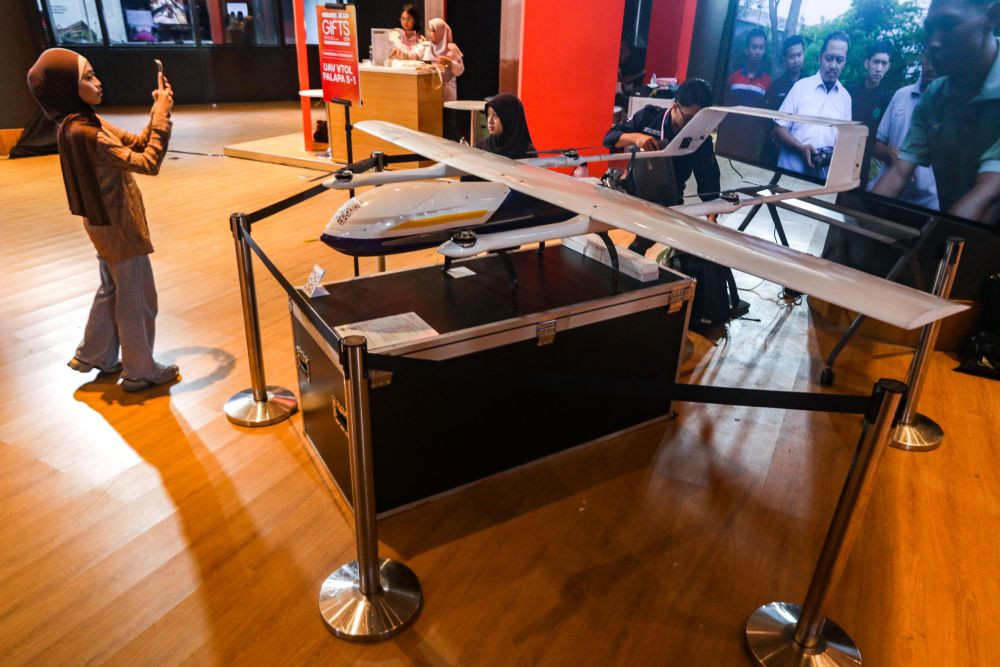 Show of creativity: A visitor takes a photo of an unmanned aerial vehicle on Oct. 22, 2026 at the Global Innovation and Future Technology Summit (GIFTS) 2026 at the Innovation and Creativity Center of Gadjah Mada University (UGM) in Sleman, Yogyakarta. (Antara/Rahid Putra Laksana)
T
he use of unmanned aircraft in warfare traces back to the 19th century, notably with the deployment of balloons for aerial reconnaissance and bombardment during the American Civil War. These early endeavors predated the Wright brothers’ historic 1903 flight at Kitty Hawk and established the enduring doctrine of modern air combat: surveil from afar, strike from above.
As aviation technology matured, military unmanned aerial vehicles (UAVs) grew larger, more sophisticated and prohibitively expensive, concentrating advanced capabilities within a few powerful states. NATO forces, for instance, relied heavily on multi-million-dollar platforms such as the MQ-1 Predator and MQ-9 Reaper for prolonged intelligence, surveillance, reconnaissance (ISR) and precision-strike missions across theaters like Afghanistan and Iraq.
However, the war in Ukraine has fundamentally altered this paradigm. The long-standing doctrine that "bigger is better" has yielded to low-cost, highly scalable attrition warfare. Loitering munitions, or "kamikaze" drones, now dominate the contested airspace. Designed to loiter over an operational area, these systems merge real-time target acquisition and kinetic strike capabilities into a single expendable weapon, exemplified by platforms such as the Iranian Shahed series and the American Switchblade.
Parallel to purpose-built munitions is the weaponization of commercial, off-the-shelf (COTS) technology. Commercially available drones require minimal technical modification or operator training to deploy lethal payloads, such as dropping modified grenades directly into trench networks. Consequently, modern unmanned systems have rendered warfare cheaper, more precise and exponentially more lethal, fundamentally reshaping tactical operations.
This transformation has quickly reverberated across other theaters. In the Middle East, Iran’s widespread deployment of Shahed-type drones has saturated air defenses, presenting severe interdiction challenges due to sheer swarm volume. This operational pressure reportedly prompted the United States to seek Ukrainian technical insight, underscoring Kyiv’s hard-won tactical and technical expertise in counter-unmanned aircraft systems (C-UAS).
In Europe, the challenge has breached active war zones. Russian drone incursions have disrupted NATO airspace over Estonia, Germany, Poland and Romania. Beyond frontier airspaces, non-cooperative drones have targeted critical civilian infrastructure, highlighted by widespread sightings around major European hubs in September 2025 that prompted immediate airspace closures and flight suspensions.

The acute threat that non-cooperative drones pose to civil aviation and surface infrastructure has spurred global regulatory intervention. In 2023, the International Civil Aviation Organization (ICAO) released its advisory framework, Protection of Civil Aviation Infrastructure Against Unmanned Aircraft, urging member states to adopt synchronized protective measures tailored to local operational realities.