The Jakarta Post
Please Update your browser
Your browser is out of date, and may not be compatible with our website. A list of the most popular web browsers can be found below.
Just click on the icons to get to the download page.


Popular Reads
Top Results
No results found. Please check your search term and try again
Can't find what you're looking for?
View all search results
Popular Reads
Top Results
No results found. Please check your search term and try again
Can't find what you're looking for?
View all search resultsThe Youth Pledge and the future of the Indonesian language
From an audacious anti-colonial pledge to a global language fighting for relevance abroad, Indonesian proves that a national tongue is never just spoken—it must be continually fought for.
Change text size
Gift Premium Articles
to Anyone
Share the best of The Jakarta Post with friends, family, or colleagues. As a subscriber, you can gift 3 to 5 articles each month that anyone can read—no subscription needed!
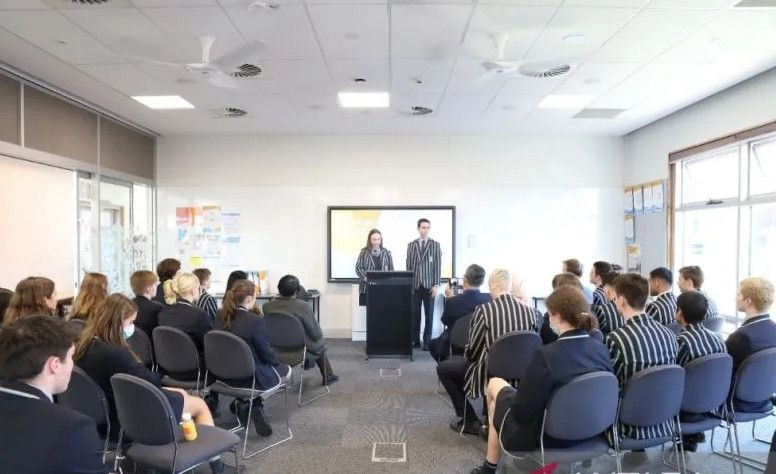 Apa kabar? Canberra Grammar School (CGS) students join an Indonesian language class attended by Indonesian Ambassador to Australia Siswo Pramono (center right) on May 17, 2022, in Canberra. (Antara/Indonesian Embassy in Canberra)
E
very Oct. 28, Indonesia commemorates Youth Pledge Day. In 1928, 98 years ago, an assembly of young nationalists proclaimed three foundational commitments: one motherland, one nation and one unifying language—Indonesian. It was a profoundly political act, projecting the idea of an Indonesian nation years before the state itself existed.
The history of the Indonesian language illustrates that language policy is inherently ideological. Selecting a national tongue, canonizing what qualifies as standard, and elevating one variety over others are choices deeply entangled with power and cultural values.
As Manns, Cole and Goebel observe, Indonesian is rooted in a variety of Malay chosen by nationalists in 1928 despite its limited reach at the time. Sneddon notes that only about 5 percent of the archipelago’s population spoke this variety in 1928. The pledge made by those youths was not the ratification of an established reality, but a speculative wager on an idiom that had yet to unite the archipelago. That wager paid off only through decades of state-sponsored standardization and deliberate language planning.
Yet this triumph came at the expense of regional languages. As Indonesian became inextricably linked with formal education, modern statehood and bureaucratic life, regional languages were increasingly relegated to tradition and domestic intimacy. This functional division entrenched a sociolinguistic hierarchy within everyday communication.
During the New Order era, the nexus between language and political hegemony grew explicit. Soeharto’s persona as the “father of development” paralleled the codification of standard Indonesian as the “language of development”—an official medium tethered to state authority and sanctioned truth. Simultaneously, regional diversity was depoliticized and tamed, exemplified by cultural projects such as Taman Mini Indonesia Indah (Indonesian Miniature Park), which reframed ethnic complexity as folkloric spectacle. State euphemisms—such as diamankan (secured), pembangunan (development) and stabilitas (stability)—cloaked authoritarian control in the veneer of administrative neutrality.
The post-1998 reform era created unprecedented space for citizens to assert regional identities and adapt language to informal, everyday registers. Contemporary Indonesian has since evolved through dynamic friction among the standard variety, regional languages, youth slang and global loanwords, illustrating that a national language is continually negotiated on the ground. On digital platforms, younger speakers routinely blend standard Indonesian with regional dialects—echoing East Javanese campursari, a hybrid style once marginalized from public discourse that only gained national broadcast legitimacy after the 1990s. Today, even state officials and public figures adopt this colloquial register to project accessibility and solidarity.

This stylistic fluidity frequently provokes anxiety over linguistic degradation, particularly when compounded by concerns regarding toxic online discourse. However, ethical questions surrounding communicative behavior must be untangled from natural processes of language variation and change. Innovative youth vernaculars and code-switching do not inherently signify linguistic incompetence. Rather, they reflect adaptive strategies to construct community and participate in public life, challenging the orthodoxy that a national language must remain monolithic.