The Jakarta Post
Please Update your browser
Your browser is out of date, and may not be compatible with our website. A list of the most popular web browsers can be found below.
Just click on the icons to get to the download page.


Popular Reads
Top Results
No results found. Please check your search term and try again
Can't find what you're looking for?
View all search results
Popular Reads
Top Results
No results found. Please check your search term and try again
Can't find what you're looking for?
View all search resultsTimor-Leste, Indonesia and the meaning of ASEAN membership
The ASEAN membership now will reinforce Indonesia-Timor-Leste partnership, but will also make it easier for the governments to leave the past unaddressed.
Change text size
Gift Premium Articles
to Anyone
Share the best of The Jakarta Post with friends, family, or colleagues. As a subscriber, you can gift 3 to 5 articles each month that anyone can read—no subscription needed!
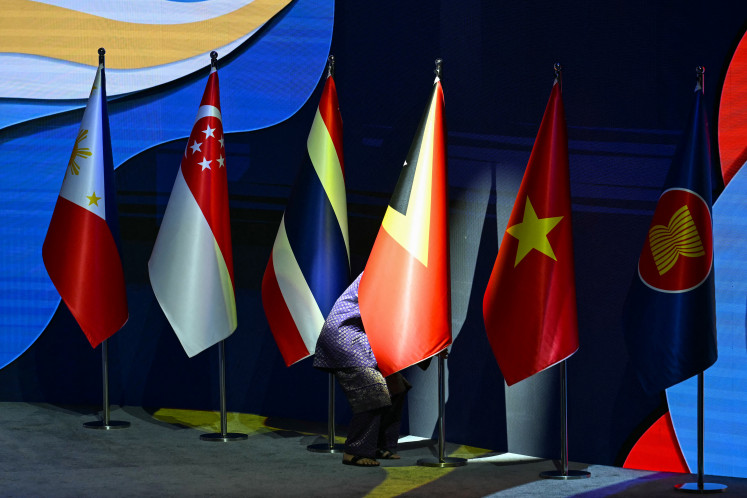
 An attendant adjusts the flag for Timor-Leste after the country formally joined the ASEAN the ASEAN Summit on Oct. 26, 2025, in Kuala Lumpur. (AFP/Mohd Rasfan)
T
imor-Leste’s admission to ASEAN in October 2025 brought to an end a long wait that began with its application in 2011. For Indonesia and Timor-Leste, though, the significance goes beyond accession itself.
Their relationship has changed dramatically over the past few decades. Indonesia occupied East Timor from 1975 to 1999. The popular consultation that ended Indonesian rule was followed by violence, separation and a difficult transition to independence.
Yet within a relatively short period, Dili and Jakarta had begun to build a close working relationship, with Jakarta becoming one of the strongest advocates of Timor-Leste’s ASEAN bid. Timor-Leste now sits in ASEAN alongside the country from which it separated little more than a generation ago. The ASEAN membership now will reinforce that partnership, but will also make it easier for the governments to leave the past unaddressed.
After the restoration of independence in 2002, relations between Dili and Jakarta gradually became more settled, even as demands for justice over past abuses remained unresolved.
Geography and economic interdependence gave both governments strong reasons to maintain stable relations. Timor-Leste shares a border with Indonesia, while trade, movement and family ties continue across it.
Timorese leaders also made a deliberate choice: Xanana Gusmão, among others, initiated a discreet but steady rapprochement towards Indonesia. Frequent high-level contact and the establishment of the 2005 Commission of Truth and Friendship (CTF) brought the two governments closer, although accountability remained limited. As both governments focus much on functional cooperation on trade, connectivity, border management, the violence of 1999 now seems to recede from much of the official agenda.

ASEAN membership now places that relationship within a wider regional setting. Timor-Leste no longer approaches Southeast Asia as an applicant dependent on the consent of existing members. It participates in ASEAN institutions, ministerial meetings and regional negotiations in its own right. Indonesia remains its largest and most important neighbor, and the imbalance in size, resources and influence remains considerable.