The Jakarta Post
Please Update your browser
Your browser is out of date, and may not be compatible with our website. A list of the most popular web browsers can be found below.
Just click on the icons to get to the download page.


Popular Reads
Top Results
No results found. Please check your search term and try again
Can't find what you're looking for?
View all search results
Popular Reads
Top Results
No results found. Please check your search term and try again
Can't find what you're looking for?
View all search resultsAttacking Iran amid Turkish, Saudi opposition is a strategic mistake
Attacking Iran against the explicit warnings of Turkey and Saudi Arabia risks a catastrophic regional war where military superiority delivers neither stability nor a viable political endgame.
Change text size
Gift Premium Articles
to Anyone
Share the best of The Jakarta Post with friends, family, or colleagues. As a subscriber, you can gift 3 to 5 articles each month that anyone can read—no subscription needed!
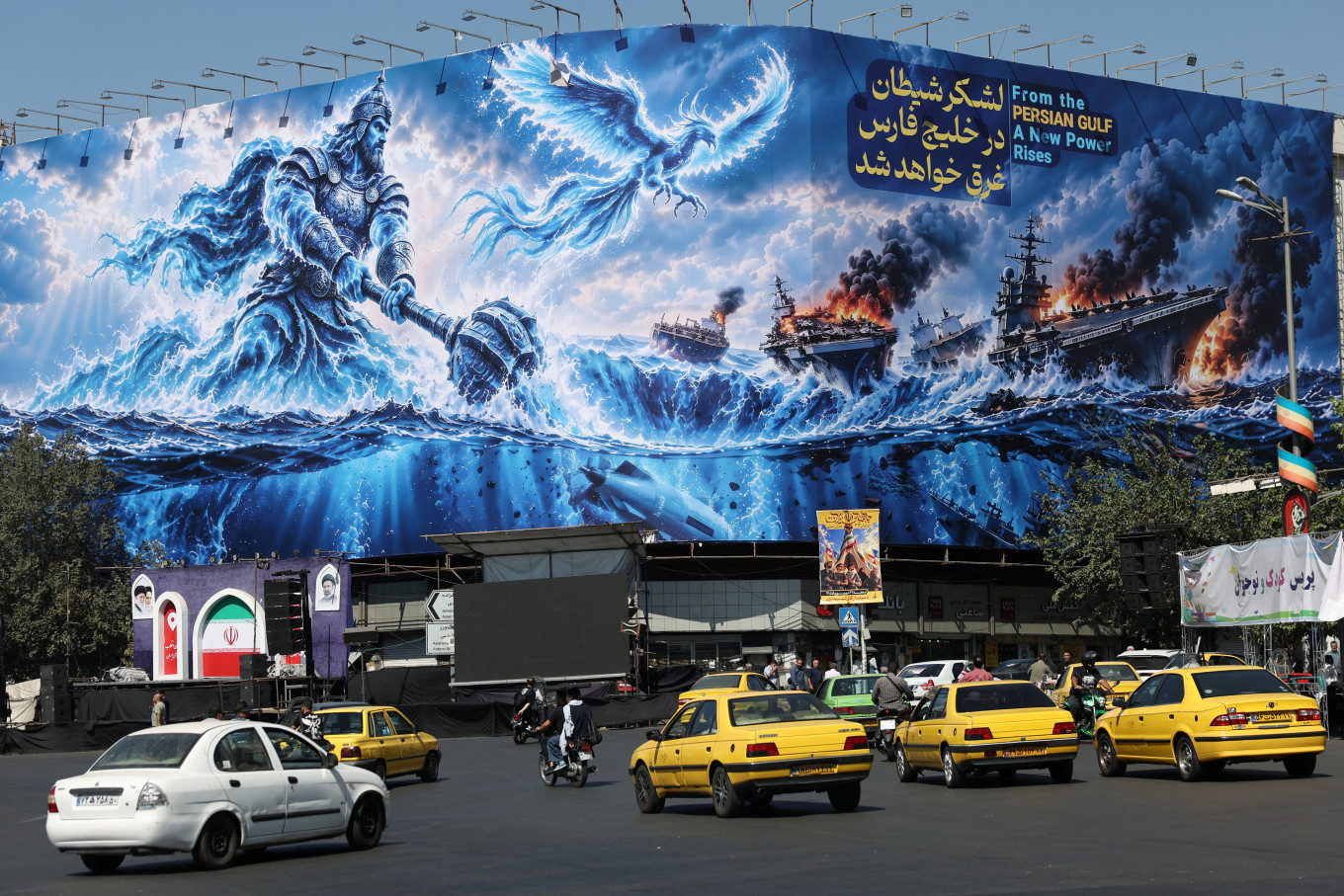 Motorist drive past a building in Tehran with a massive billboard about the Strait of Hormuz on Sept. 16, 2026. (Reuters/West Asia News Agency/Majid Asgaripour)
T
he ongoing military confrontation involving the United States, Israel and Iran has exposed a fundamental contradiction in the strategic architecture of West Asia: Military superiority does not automatically translate into political legitimacy, regional acceptance or lasting stability. This contradiction becomes especially pronounced when two of the region’s most consequential powers, Turkey and Saudi Arabia, explicitly oppose further escalation.
Turkey is a pivotal NATO member with one of the alliance’s largest standing militaries, occupying an indispensable position bridging Europe, the Black Sea, the Caucasus and West Asia. Saudi Arabia remains central to Gulf security, global energy markets and the diplomatic architecture of the Islamic world. Neither state can be sidelined as strategically negligible.
Their resistance to further strikes raises a fundamental question: Can continued military operations against Iran produce an acceptable political settlement, or will they merely entrench a catastrophic conflict whose fallout extends far beyond the region?
In this context, the diplomatic gathering in Istanbul on Oct. 23 carries undeniable weight. Convening European and Middle Eastern foreign ministers, the meeting reflected mounting international alarm that renewed strikes on Iran would widen the confrontation rather than resolve it.
What makes this development particularly notable is the convergence of states that do not share identical strategic interests. Historically, Ankara and Riyadh have approached Tehran through divergent geopolitical lenses: Turkey has sought to balance competition with pragmatic economic engagement, whereas Saudi Arabia has viewed Iranian power projection through the critical lens of Gulf security and regime survival.
Yet both powers grasp the severe perils of allowing West Asia to descend into an open, systemic war. Their opposition to escalation is not an endorsement of Iranian conduct; rather, it reflects a clear distinction between military deterrence and strategic recklessness.

Furthermore, the Mecca defense understanding involving Turkey, Saudi Arabia and Pakistan introduces an additional layer to this evolving security landscape, underscoring regional ambitions to consolidate strategic autonomy amid growing doubts over the predictability and collateral consequences of external military intervention.
This diplomatic realignment does not make Ankara and Riyadh allies of Tehran. Turkey remains wary of regional vacuum effects, militant non-state actors and border instability along its southern periphery, while Saudi Arabia continues to confront severe security threats stemming from Houthi attacks originating in Yemen. Crucially, however, both recognize that degrading Iran militarily without establishing a viable political settlement creates conditions far more volatile than the status quo.
This is precisely where strategic realism must take precedence. Kinetic operations can dismantle infrastructure, degrade missile stockpiles and disrupt command and control networks, but they cannot manufacture political legitimacy, foster regional reconciliation or guarantee that a battered Iran will emerge as a compliant neighbor.
On the contrary, sustained military pressure will almost certainly incentivize asymmetric retaliation, strikes on critical energy infrastructure and maritime sabotage. The Strait of Hormuz remains acutely vulnerable; any prolonged disruption to this choke point immediately threatens global crude supplies, shipping corridors and industrial productivity across world markets.
The economic fallout would fall with particular severity on Asia. China, Japan, South Korea, India and ASEAN member states are exceptionally sensitive to fluctuations in hydrocarbon pricing and freight insurance.
Malaysia cannot assume that geographic distance insulates it from these shocks. As an open trading nation, Malaysia, as well as the wider ASEAN bloc, faces heightened risks of imported inflation, elevated freight costs and supply chain shocks whenever Persian Gulf stability falters. Even if temporary spikes in petroleum prices generate marginal revenue gains for hydrocarbon exporters, these windfalls are routinely erased by widespread economic contraction.
There is also a broader, multilateral dimension to consider. European capitals, including London, Paris, Berlin and Rome, harbor legitimate concerns regarding Tehran’s nuclear trajectory, ballistic missile program and regional proxy networks. Nonetheless, their willingness to engage regional stakeholders demonstrates the necessity of keeping diplomatic tracks open even amid acute friction.
This diplomatic convergence should not be misinterpreted as an anti-Western or anti-Israeli coalition. It simply reflects an objective realization that the compounding costs of a regional conflagration dwarf any temporary tactical gains.
For Washington, the strategic equation must move beyond whether advanced arms can suppress Iranian defenses to address the more decisive question: What governance and security architecture will remain in the aftermath?
Israel, too, possesses legitimate defense requirements in countering hostile capabilities and armed regional proxies. However, the application of force without an achievable political endgame inevitably breeds new security dilemmas even as old capabilities are degraded.
Tehran, for its part, cannot demand international restraint while condoning threats to commercial navigation or attacks by regional proxies.
The obligation of restraint must be universal. Any sustainable framework must simultaneously guarantee Iranian sovereignty, Gulf territorial integrity, Israeli security and uninhibited maritime transit through binding agreements encompassing nuclear verification, missile proliferation and crisis de-escalation protocols.
Turkey and Saudi Arabia possess the diplomatic leverage, geographic weight and cross-bloc credibility to serve as indispensable mediators where direct channels are broken. Complementing these regional efforts, the United Nations and the International Atomic Energy Agency remain essential to providing technical verification and multilateral legitimacy.
For Southeast Asia, the parallel is evident. The ASEAN Outlook on the Indo-Pacific places primary emphasis on dialogue, consensus building and peaceful dispute resolution over unilateral militarism; principles that hold equal validity in West Asia. Malaysia should actively endorse diplomatic frameworks aimed at preventing an all-out regional war while maintaining an uncompromising defense of international law, civilian protection, state sovereignty and open sea-lanes.
The final goal cannot be a fragile, temporary pause in hostilities. A ceasefire must serve as the foundation for an enduring regional security architecture built on the recognition that absolute security cannot be achieved through the perpetual insecurity of one’s neighbors. When regional anchors of the stature of Turkey and Saudi Arabia issue explicit warnings against escalation, their assessments demand serious consideration.
Military campaigns can be launched in an afternoon; their geopolitical, economic and human destruction endures for generations. The immediate imperative must be a verified ceasefire and a comprehensive regional dialogue, not another spiral into a conflict no power can reliably manage.
***
The writer is professor of ASEAN Studies and director of the Institute of International and ASEAN Studies (IINTAS) at International Islamic University Malaysia (IIUM).