The Jakarta Post
Please Update your browser
Your browser is out of date, and may not be compatible with our website. A list of the most popular web browsers can be found below.
Just click on the icons to get to the download page.


Popular Reads
Top Results
No results found. Please check your search term and try again
Can't find what you're looking for?
View all search results
Popular Reads
Top Results
No results found. Please check your search term and try again
Can't find what you're looking for?
View all search resultsWhen new technology launches outrun learning
Driven by the allure of novel tech and flashy inaugurations, Indonesian institutions risk chasing performative modernization at the cost of deep operational competence and lasting institutional memory.
Change text size
Gift Premium Articles
to Anyone
Share the best of The Jakarta Post with friends, family, or colleagues. As a subscriber, you can gift 3 to 5 articles each month that anyone can read—no subscription needed!
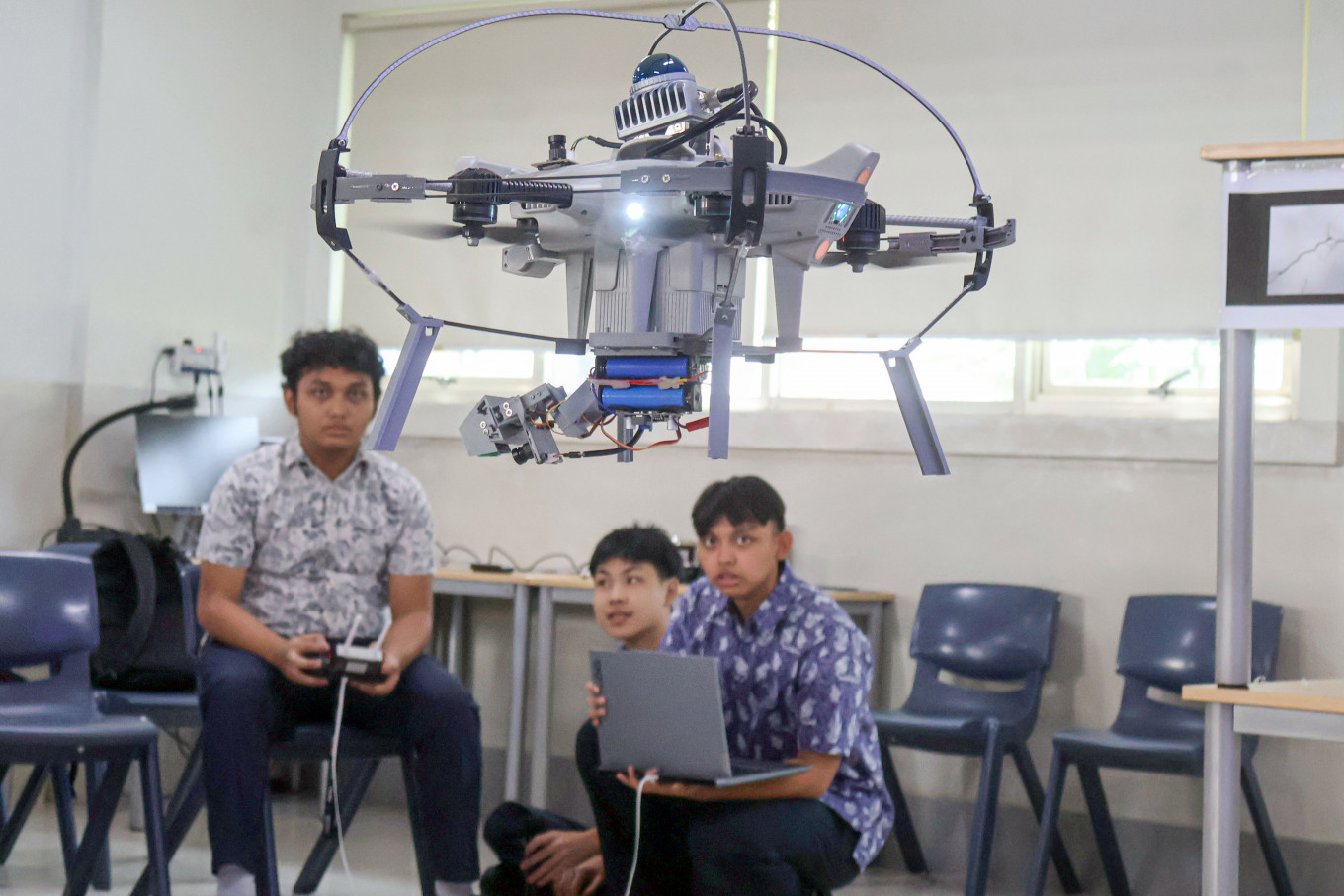 Robots to the rescue: Three Indonesian students from Team Bayu Sakti, Arga Wibawa (left), Owen Tay Jia Hao (center) and Ksatria Wibawa Putra Murti demonstrate how the Rajawali drone works on Dec. 15, 2025, at the ACS Jakarta School in East Jakarta. (Antara/Yulius Satria Wijaya)
T
echnology can work well in an advanced economy, but for an Indonesian institution it can be a poor investment. Leaders may receive recognition for adopting it before their staff establish whether it improves the work. Then, what has that recognition rewarded?
The Javanese warning aja gumunan cautions against being too easily impressed. Gumun means astonishment, while gumunan describes someone readily impressed.
Gumun culture illustrates how institutions adopt advanced technologies performatively - chasing recognition by signaling modernity before assessing internal fit or building capability. Since the 1990s, Indonesian institutions have channeled substantial resources into successive tech waves, from internet businesses and digital start-ups to smart cities, blockchain and artificial intelligence.
How much of that work remains useful, and how much knowledge have subsequent initiatives inherited? Answering those questions requires following the people, investments and operating results beyond the announcements.
My doctoral work on corporate-backed university-based entrepreneurial ecosystems in Indonesia sharpened my interest in the relationship between institutional purposes and actual outcomes. These experiences motivate my concern; they do not establish how commonly Indonesian institutions interrupt useful work to pursue another technology.
Koentjaraningrat illustrated a related concern in Rintangan2 Mental Dalam Pembangunan Ekonomi di Indonesia (Mental Barriers to Economic Development in Indonesia). He described attention to the publicly visible parts of a house while its kitchen and toilet remained neglected (1971, p. 38). His account offers an analogy for examining the rewards attached to public appearance. Applying it to technological institutions requires evidence about what their leaders recognize, fund and maintain.

Bromley and Powell (2012) distinguish policy - practice decoupling, where commitments go unimplemented, from means-ends decoupling, where activities occur but their connection to intended outcomes remains uncertain. A university can operate a laboratory and conduct training without demonstrating that either improves the technical competence it promised to develop. Its administrators therefore need evidence of what researchers and students can accomplish through those investments. Counting facilities and participants cannot establish that result.