The Jakarta Post
Please Update your browser
Your browser is out of date, and may not be compatible with our website. A list of the most popular web browsers can be found below.
Just click on the icons to get to the download page.


Popular Reads
Top Results
No results found. Please check your search term and try again
Can't find what you're looking for?
View all search results
Popular Reads
Top Results
No results found. Please check your search term and try again
Can't find what you're looking for?
View all search resultsThe Nepal lesson: Warning systems, not solar panels
The real lesson of the Nepal disaster is that economic development and early warning systems protect human lives—not empty summit pledges.
Change text size
Gift Premium Articles
to Anyone
Share the best of The Jakarta Post with friends, family, or colleagues. As a subscriber, you can gift 3 to 5 articles each month that anyone can read—no subscription needed!
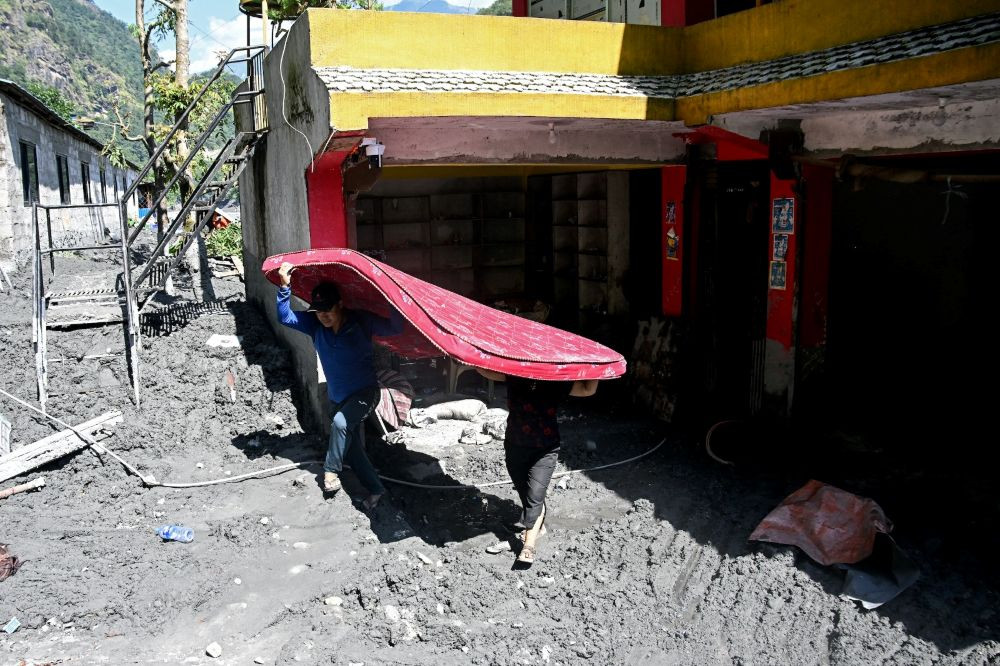 Sense of belonging: Flood victims Ajaya Gurung (left) and Sapana Gurung salvage belongings from a sludge-ridden house on Oct. 14, 2026 along the banks of the Budhi Gandaki River at Soti Bazar in Nepal's Gorkha district following a flash flood. (AFP/Prakash Mathema)
T
he upcoming United Nations climate summit, COP31, in Turkey will once again exploit a catastrophe to seize the spotlight. This year, the summit will center on the tragedy in Nepal, where an ice-and-rock avalanche tore through the country’s north in late August.
The disaster left more than 1,400 dead, 5,000 missing and a recovery bill of nearly US$5 billion, roughly an eighth of the nation's gross domestic product. The catastrophe carries a crucial lesson for the world, but not the one that campaigners are peddling: ever-larger climate budgets.
Days after the disaster, UN climate chief Simon Stiell asserted that climate change is making such tragedies “much more likely, frequent and severe”. Activist Bill McKibben echoed the sentiment, writing that Nepalis “are not causing the crisis that is killing them: we are”.
Climate change may well have played a role. The World Weather Attribution initiative, an organization hardly prone to understatement, found that human-induced warming raised Himalayan summer temperatures by about 1.5 degrees Celsius. Yet even this group concluded that climate change was “a destabilising factor acting on a pre-existing geological predisposition, rather than the fundamental cause”.
Furthermore, the most comprehensive study of snow avalanches across High Mountain Asia, published this year after mapping 60 million events since 1990, detected no long-term trend across 85 percent of the region's catchments.
Regardless, carbon cuts offer no remedy. Even if every nation at the summit pledged deeper emissions reductions and honored them, the glaciers of Langtang would not refreeze. Trillions of dollars spent abating carbon will yield a barely measurable temperature reduction by century’s end.

What the Trishuli valley needed is clear. A flash flood becomes a mass-casualty disaster when communities in its path receive no warning. While some settlements were too close to the source to be alerted in time, others had 40 minutes or more. Downstream in Bidur, school principal Rajendra Dawadi managed to evacuate and save roughly 900 students minutes before the torrent washed his school away. His alert came through word of mouth, not an official siren.