The Jakarta Post
Please Update your browser
Your browser is out of date, and may not be compatible with our website. A list of the most popular web browsers can be found below.
Just click on the icons to get to the download page.


Popular Reads
Top Results
No results found. Please check your search term and try again
Can't find what you're looking for?
View all search results
Popular Reads
Top Results
No results found. Please check your search term and try again
Can't find what you're looking for?
View all search resultsMaritime cooperation gives Act East policy a new boost
From joint naval patrols to subsea cables and digital payments, the Manila summits offer India and ASEAN a crucial opportunity to turn regional rhetoric into lasting strategic and economic muscle.
Change text size
Gift Premium Articles
to Anyone
Share the best of The Jakarta Post with friends, family, or colleagues. As a subscriber, you can gift 3 to 5 articles each month that anyone can read—no subscription needed!
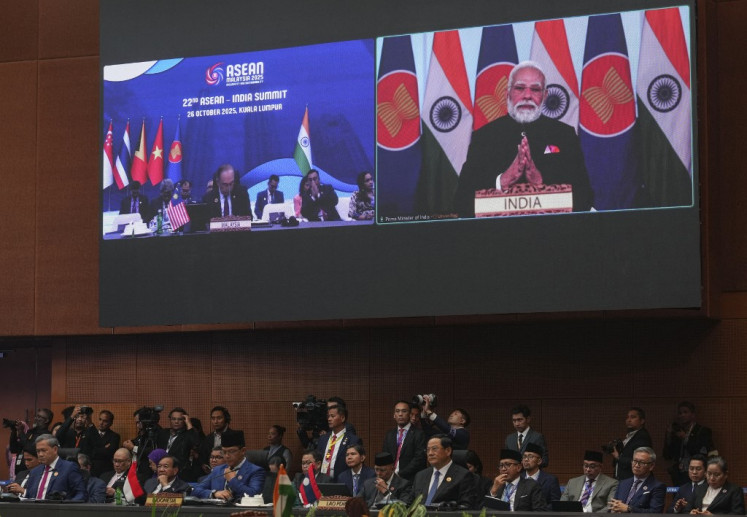
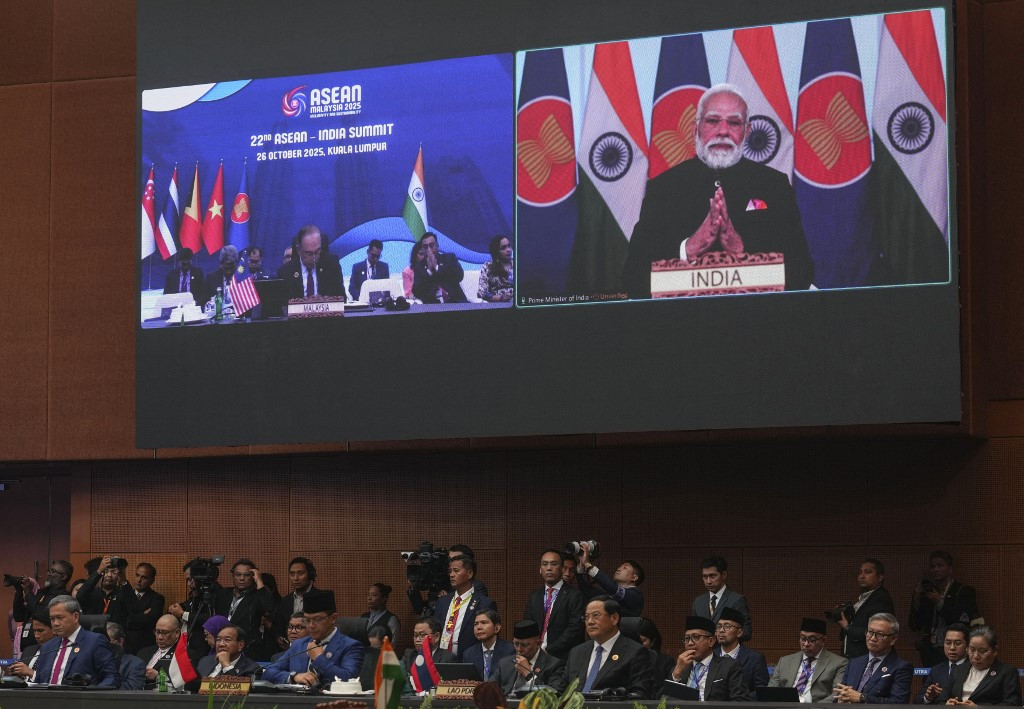 India's Prime Minister Narendra Modi appears on a screen to deliver a speech remotely as other leaders attend the 22nd ASEAN - India Summit during the 47th ASEAN Summit in Kuala Lumpur on Oct. 26, 2025. (AFP/Pool/Rafiq Maqbool)
I
ndian Prime Minister Narendra Modi’s participation in the ASEAN and East Asia summits in Manila later this month provides a timely opportunity to take stock of a partnership that has acquired fresh momentum. Despite protracted negotiations over the review of the ASEAN-India Trade in Goods Agreement (AITIGA), persistent global economic volatility, and intensifying strategic competition across the Indo-Pacific, India and ASEAN have continued to broaden their shared horizon.
The designation of 2026 as the ASEAN-India Year of Maritime Cooperation has lent this engagement a distinct operational focus, translating longstanding geographical affinity into practical initiatives across security, connectivity, commerce and the blue economy.
The strategic significance of this moment lies less in an isolated breakthrough than in the widening alignment of mutual interests. India’s Act East policy increasingly intersects with ASEAN’s emphasis on maritime security, supply-chain resilience, digital transformation and regional strategic autonomy. The Comprehensive Strategic Partnership established in 2022 provides the institutional foundation, while the Plan of Action for 2026-2030 charts a road map for sustained engagement. As geopolitical alignments shift, both sides recognize the utility of strengthening an equilibrium-oriented partnership that does not demand total convergence on every external issue. Notably, five Southeast Asian leaders attended the recent BRICS Summit in New Delhi, including Philippine President Ferdinand Marcos Jr., who participated as ASEAN chair.
Maritime cooperation represents the most visible expression of this renewed engagement. The second ASEAN-India Maritime Exercise, conducted in the Philippines during September and October 2026, brought Indian naval vessels INS Sahyadri and INS Kulish together with regional navies under the banner “Anchored in Trust, United at Sea”.
Encompassing complex operational coordination, humanitarian assistance, disaster relief drills, and visit, board, search, and seizure procedures, the exercise moved beyond declaratory intent toward tactical familiarity and operational interoperability. The venue was particularly salient given that maritime security, domain stability and adherence to international maritime law remain paramount strategic priorities for Manila and the wider archipelagic neighborhood.
The immediate imperative is to embed this momentum within lasting operational frameworks. Information sharing, white-shipping awareness, fisheries protection, counter-trafficking operations and coordinated search and rescue offer tangible paths forward. In this regard, India’s Information Fusion Centre–Indian Ocean Region (IFC-IOR) in Gurugram serves as an established catalyst, currently engaging six ASEAN member states, four of which maintain resident international liaison officers. The broader institutional objective must be the creation of an integrated maritime domain architecture that bridges the eastern Indian Ocean and the approaches to the Malacca Strait, complementing ASEAN-led mechanisms while respecting sovereign national sensitivities.

Connectivity constitutes a parallel strategic pillar. The vital sea corridors connecting India’s eastern seaboard with Singapore, Malaysia, Thailand and Indonesia carry both dense merchant shipping and the critical digital infrastructure underpinning contemporary economic security. Subsea data cables have emerged as strategic lifelines comparable to traditional navigation channels.