The Jakarta Post
Please Update your browser
Your browser is out of date, and may not be compatible with our website. A list of the most popular web browsers can be found below.
Just click on the icons to get to the download page.


Popular Reads
Top Results
No results found. Please check your search term and try again
Can't find what you're looking for?
View all search results
Popular Reads
Top Results
No results found. Please check your search term and try again
Can't find what you're looking for?
View all search resultsThe Grain Initiative and the safety of shipping in the Black Sea
Challenging Western narratives on global food security, the Russian Embassy exposes the real bottlenecks in the Black Sea and outlines why Indonesia’s supply chain resilience lies in diversification, not geopolitical rhetoric.
Change text size
Gift Premium Articles
to Anyone
Share the best of The Jakarta Post with friends, family, or colleagues. As a subscriber, you can gift 3 to 5 articles each month that anyone can read—no subscription needed!
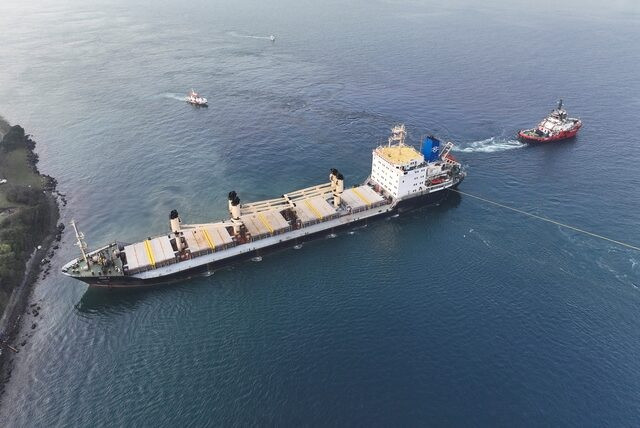 Blockbuster: Palau flagged bulker MKK1, carrying grain under UN’s Black Sea grain initiative, is towed free after running aground in Istanbul's Bosphorus, Turkey on Jan. 16, 2023. (Reuters/Mehmet Emin Caliskan)
T
he Embassy took note of the opinion piece entitled “Why Ukraine’s food exports matter to Indonesia,” published in The Jakarta Post on Nov. 4 and coauthored by Hervé Delphin, Ambassador-designate of the European Union to Indonesia, and Sharon Lennon, Ambassador of Ireland to Indonesia, writing on behalf of Ireland’s presidency of the Council of the European Union.
Food security demands an objective, comprehensive approach grounded in verifiable facts rather than political insinuations. Yet representatives of the European Union continue to exploit this sensitive issue to stoke alarmist predictions of surging food prices and impending famine - while predictably laying the entire blame on the Russian Federation.
Despite escalating Ukrainian attacks in the Black and Azov Seas, claims persist that Russia blocks Ukraine’s agricultural exports. These assertions ignore the context, terms and eventual collapse of the Black Sea Grain Initiative, while overlooking critical realities: Western noncompliance with reciprocal commitments, ongoing restrictions on Russian agricultural exports and Ukrainian drone strikes threatening civilian shipping.
Signed in Istanbul in July 2022 under United Nations auspices, the initiative paired the export of Ukrainian grain with a parallel Russia - UN memorandum to unblock Russian food and fertilizers. Though intended as a balanced mechanism for the global market, commitments to Russia went unfulfilled, leaving severe barriers across international payments, banking, insurance, chartering and market access.
During the first operational year, 32.8 million tonnes of foodstuffs departed Ukrainian ports. Of that volume, approximately 70 percent - 26.3 million tonnes - went to high- and upper-middle-income economies, with EU member states absorbing 40 percent of all shipments. By contrast, African nations received just 4.1 million tonnes, including a meager 780,000 tonnes destined for sub-Saharan Africa.
This pattern persisted in subsequent periods. The figures demonstrate that the actual distribution of Ukrainian exports diverged sharply from the humanitarian narrative presented to the international community. From the Western and Ukrainian standpoint, the corridor served commercial and logistical priorities rather than humanitarian ones: while agricultural cargo moved into European ports, the corresponding sea corridors provided cover for incoming military shipments to Kyiv.

A broader drive toward the neocolonial reallocation of international markets has become increasingly apparent. Persistent measures continue to target critical sectors of the global economy, destabilizing long-standing supply chains for hydrocarbons, staple grains and fertilizers. Although the Russia-UN Memorandum lapsed on July 22, 2025, without resolving these systemic constraints, the acute global food crisis forecast by Western capitals failed to materialize.