The Jakarta Post
Please Update your browser
Your browser is out of date, and may not be compatible with our website. A list of the most popular web browsers can be found below.
Just click on the icons to get to the download page.


Popular Reads
Top Results
No results found. Please check your search term and try again
Can't find what you're looking for?
View all search results
Popular Reads
Top Results
No results found. Please check your search term and try again
Can't find what you're looking for?
View all search resultsThe weakest link: How the US is testing Indonesia’s nonalignment
By trading costly concessions for scant returns with Washington while deepening ties with Beijing and Moscow, Prabowo risks turning Indonesia’s storied bebas aktif foreign policy from genuine nonalignment into unilateral accommodation.
Change text size
Gift Premium Articles
to Anyone
Share the best of The Jakarta Post with friends, family, or colleagues. As a subscriber, you can gift 3 to 5 articles each month that anyone can read—no subscription needed!
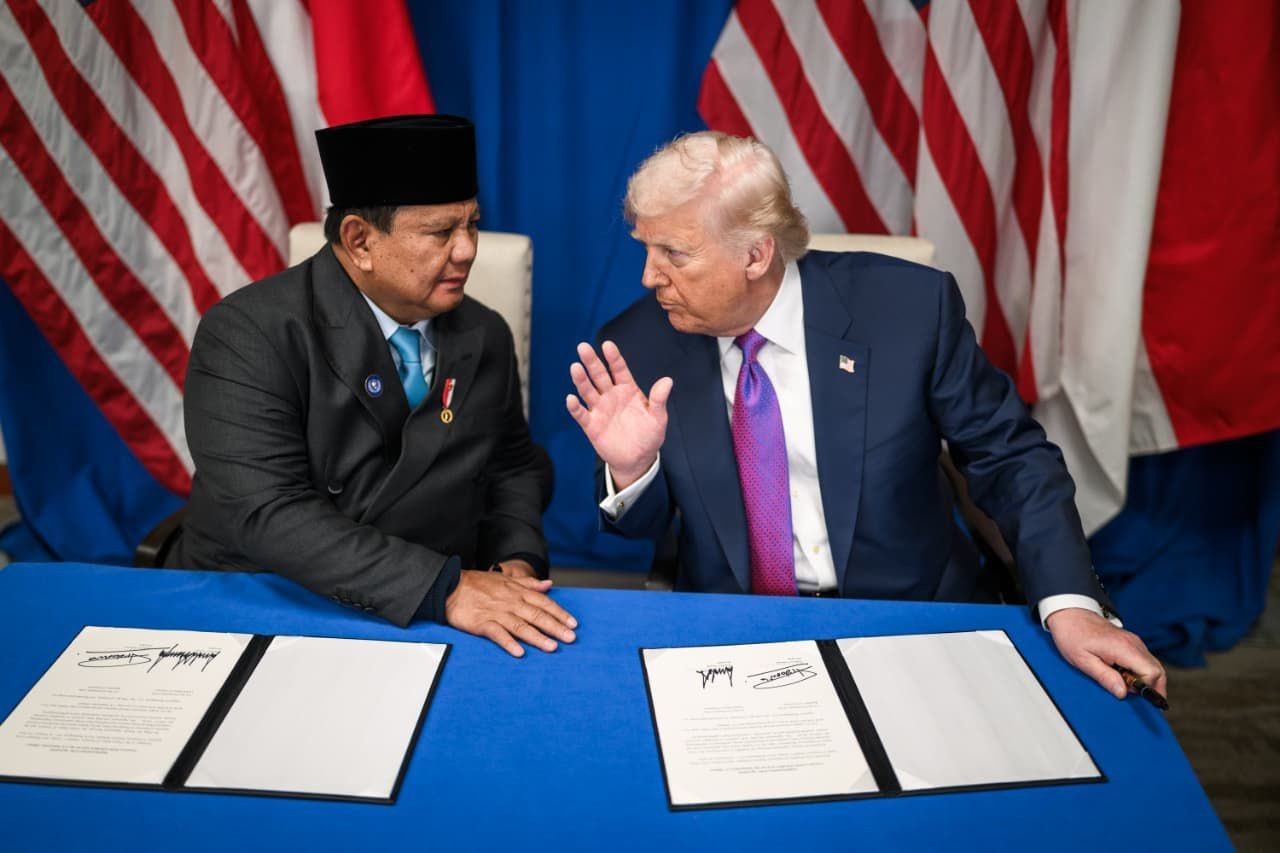 President Prabowo Subianto (left) listens as United States President Donald Trump speaks on Feb. 19, 2026, during the signing ceremony for the US-Indonesia Agreement on Reciprocal Trade (ART) in Washington, DC. (Courtesy of Presidential Secretariat/White House)
F
or decades, Indonesia has wrapped its foreign policy in the bebas aktif (free and active) doctrine. Jakarta likes to project the image of an independent middle power: equidistant from competing great powers, unwilling to take sides and determined to chart its own course. Under President Prabowo Subianto, however, that posture increasingly looks less like strategic balancing and more like strategic accommodation.
Nowhere is this more evident than in the relationship with the United States. While Prabowo has been received warmly in Beijing and Moscow, his engagement with Washington has produced modest results. In courting Washington under President Donald Trump, Jakarta has stretched its nonaligned tradition, accepted costly concessions and gained little visible leverage in return.
Despite months of signaling, Prabowo has yet to secure a full bilateral state visit to the White House. His interactions with Trump have remained peripheral: brief exchanges on the sidelines of summits, United Nations gatherings and ceremonial events such as the launch of the US-led Board of Peace (BoP). Repeated encounters without a substantive breakthrough raise questions about Indonesia’s place in Washington’s priorities.
The concessions, however, have been significant. Indonesia moved swiftly to join the board, pledged as many as 8,000 personnel to the UN-mandated International Stabilization Force and accepted US tariff demands that risk imposing costs on parts of the domestic economy.
The symbolism has been equally uncomfortable. A hot mic reportedly caught Prabowo asking about meeting one of Trump’s sons, and photographs from the BoP launch event showed him carrying folders for the US leader. Whatever the practical explanations, the images sat uneasily with Indonesia’s cultivated identity as a confident, nonaligned power, and no clear quid pro quo from Washington accompanied them.
Meanwhile, Prabowo has found greater receptiveness elsewhere. His visits to China have yielded trade, infrastructure and maritime agreements that reinforce Beijing’s position as Indonesia’s most consequential economic partner, while direct engagement with Russian President Vladimir Putin signals Jakarta’s comfort in a multipolar landscape.

This points to an uncomfortable reality: The relationship with Washington has become the weakest link in an otherwise diversified strategy.