The Jakarta Post
Please Update your browser
Your browser is out of date, and may not be compatible with our website. A list of the most popular web browsers can be found below.
Just click on the icons to get to the download page.


Popular Reads
Top Results
No results found. Please check your search term and try again
Can't find what you're looking for?
View all search results
Popular Reads
Top Results
No results found. Please check your search term and try again
Can't find what you're looking for?
View all search resultsOutlook on Indonesian coal exports amid weakening demand in pandemic
There were small increases year on year in exports to China, but exports to India were lower as coal imports into the country were impacted by COVID-19 lockdown closures of ports during April.
Change text size
Gift Premium Articles
to Anyone
Share the best of The Jakarta Post with friends, family, or colleagues. As a subscriber, you can gift 3 to 5 articles each month that anyone can read—no subscription needed!
T
he coal industry can be split into two broad sectors - namely coal-mined that is burnt domestically; and the seaborne market, where coal is mined and exported to countries that need to import energy. For coal used in energy, Indonesia produces and exports three types of coal: high energy bituminous, lower energy sub-bituminous, and very low energy lignite coal. Power stations that burn coal for electricity want to buy a fuel that is energy-efficient and cheap. Indonesian coal production is skewed towards lower energy and cheaper sub-bituminous and lignite coals.
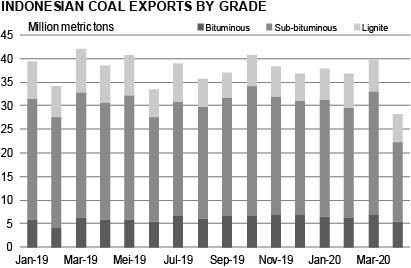
Indonesia’s thermal coal exports reached a record 453 million metric tons (mt) in 2019, mainly comprising sub-bituminous coal, whereas demand, which was flat year on year in 2019 has further deteriorated in 2020. In seeking to address the oversupply in the seaborne market in 2020, there is a need for Indonesian coal producers to reduce sub-bituminous exports.
Latest coal production and export data suggests there will be additional declines, especially as prices near marginal cost of supply. S&P Global Platts Analytics believes weak coal demand, mainly due to reduced demand from India and China, as well as narrow price spreads between high- and low-energy coals have pushed Indonesian low energy coal prices to a floor and should recover with demand.
Indonesian coal exports in April, including lignite, were 27 percent lower year on year, its lowest level since February 2017. There were small increases year on year in exports to China, but exports to India were lower as coal imports into the country were impacted by COVID-19 lockdown closures of ports during April.
For the January to April period, total coal exports were 7 percent lower year on year mt, after first quarter of 2020 exports were flat relative to year-ago volumes.
We have talked about an oversupply of sub-bituminous coal in the seaborne market, and a supply response is required to bring the market back to balance.
We believe COVID-19 lockdown measures impacting demand, particularly in India, has forced Indonesian producers to reduce exports. Declines in sub-bituminous coal exports accounted for the vast majority of the fall in total thermal coal and lignite exports. The fall in prices, due to the oversupply and the poor demand, has likely also contributed to this decline in lower CV coal exports.