The Jakarta Post
Please Update your browser
Your browser is out of date, and may not be compatible with our website. A list of the most popular web browsers can be found below.
Just click on the icons to get to the download page.


Popular Reads
Top Results
No results found. Please check your search term and try again
Can't find what you're looking for?
View all search results
Popular Reads
Top Results
No results found. Please check your search term and try again
Can't find what you're looking for?
View all search resultsH2 of 2020: Hoping for one engine to revive economic growth
On the flip side, positive support came from the shift of the rice harvest season from Q1 of 2020 to Q2 of 2020, this was one the reasons why 1Q20 performance was unexpectedly lower than most of the forecasts.
Change text size
Gift Premium Articles
to Anyone
Share the best of The Jakarta Post with friends, family, or colleagues. As a subscriber, you can gift 3 to 5 articles each month that anyone can read—no subscription needed!

A
s expected, Indonesia’s economic growth contracted 5.3 percent in the second quarter, following significant deceleration in the previous quarter. It was lower than our forecast of a 6.1 percent contraction but higher than the market consensus. Most of the contraction came from sectors that have been hit heavily by the COVID-19 pandemic as well as the large-scale social restrictions (PSBB), such as transportation, retail and wholesale trade.
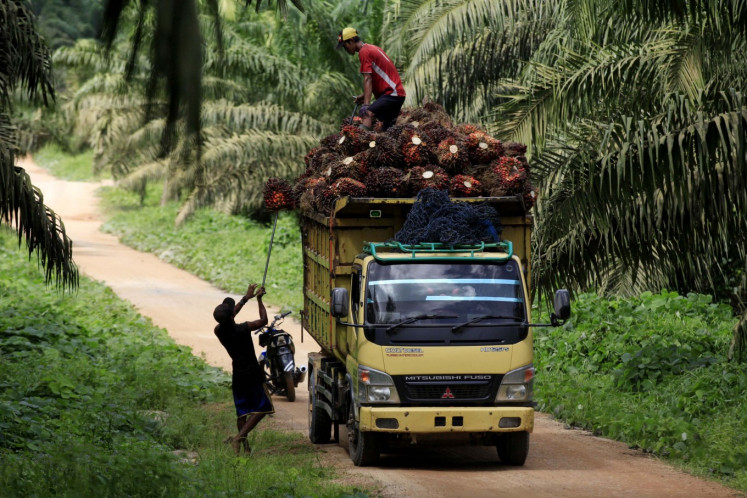
On the flip side, positive support came from the shift of the rice harvest season from Q1 of 2020 to Q2 of 2020, this was one the reasons why 1Q20 performance was unexpectedly lower than most of the forecasts. The harvest shift drove a 2.19 percent year-on-year (yoy) increase in the agriculture sector, which contributes around 15 percent of Indonesia’s GDP. It is worth noting that manufacturing and agriculture are the biggest contributors to Indonesia’s economy, with a combined share of around 30 percent. Furthermore, both account for around 44 percent of the total workforce in Indonesia. Thus, seasonally the harvesting period will have a positive impact on the quarterly performance as well as the purchasing power of the farmer during that period.
From the expenditure side, household spending plummeted 5.51 percent yoy (vs 2.83 percent yoy in Q1 of 2020 and 5.18 percent yoy in Q2 of 2019) as a consequence of the implementation of PSBB limiting personal spending, particularly for transportation and recreation during Idul Fitri.
Moreover, government spending decelerated by 6.9 percent yoy as declining tax revenues amid the pandemic hampered the government’s economic stimulus realization, and gross fixed capital formation (GFCF) or investment plunged 8.61 percent yoy (vs 1.7 percent yoy in Q1 of 2020 and 4.55 percent yoy in Q2 of 2019) due to lower demands which forced many businesses to halt their investment activities, especially in vehicles and equipment.
Declining investment activity caused imports to contract 16.96 percent yoy (vs -2.19 percent yoy in Q1 2020 and -6.84 percent yoy in Q2 2019) as a huge chunk of imports (around 90 percent) were raw material and capital goods. This also caused service imports such as shipping to fall. Exports decelerated by 11.66 percent yoy (vs 0.23 percent yoy in 1Q20 and -1.73 percent yoy in 2Q19) amid the global lockdowns, lowering the global demand. The decline, however, was less than imports, thus a trade surplus was still recorded.
Now, the million-dollar question will be: What is the outlook for the second half? We believe that, at this juncture, the recovery to the pre-COVID-19 performance level will take a long time. The only game changer will come if a vaccine is found and proven. Prior to that, the recovery will heavily depend on how fast government spending can be disbursed in the third quarter.
Indonesia still has room to have full-year positive growth despite all of the global challenges that affect two engines of growth, investment and trade.