The Jakarta Post
Please Update your browser
Your browser is out of date, and may not be compatible with our website. A list of the most popular web browsers can be found below.
Just click on the icons to get to the download page.


Popular Reads
Top Results
No results found. Please check your search term and try again
Can't find what you're looking for?
View all search results
Popular Reads
Top Results
No results found. Please check your search term and try again
Can't find what you're looking for?
View all search resultsInsight: Building comprehensive protection against unemployment
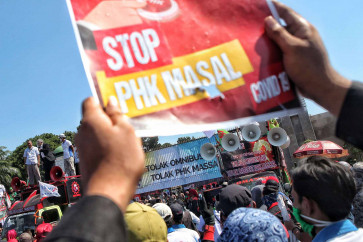
In Indonesia alone, the National Development Planning Agency (Bappenas) has just announced an increase of the unemployed by 3.72 million. This figure, of course, excludes the workers whose wages are cut due to reduced working hours.
Change text size
Gift Premium Articles
to Anyone
Share the best of The Jakarta Post with friends, family, or colleagues. As a subscriber, you can gift 3 to 5 articles each month that anyone can read—no subscription needed!
 Set as preferred source

B
eing able to work from home and receiving a full salary is a privilege for some groups of people during the COVID-19 pandemic. Millions of people in the world have lost their jobs. Others are obliged to take the risk of virus infection by working outside the home for the sake of their family’s survival.
In Indonesia alone, the National Development Planning Agency (Bappenas) has just announced an increase of the unemployed by 3.72 million. This figure, of course, excludes the workers whose wages are cut due to reduced working hours.
Meanwhile, the government has just announced economic growth of minus 5.3 percent in the second quarter of 2020 and is predicted to remain negative in the third quarter. The World Bank in last July predicted that the recovery would take quite a long time. In fact, many studies show that long-term unemployment can affect individuals, society and the national economy. Those who have been unemployed for a long period of time tend to find it more difficult to find new jobs, earn lower wages, and are late in moving up their career ladder.
The government has provided emergency protection through various stimulus packages, one of which is the Pre-employment Card. Through this program, workers affected by termination of employment can receive cash benefits and online training. However, is that sufficient? What will be their future after their training?
When people are unemployed, there are at least two items they need. The first is a substitute for their lost income because they and their families have to continue their life. The second need is to find a new job which matches with their skills and qualifications. Comprehensive and integrated support systems for the unemployed, combining unemployment insurance, public employment services and training, help meet these needs.
In fact, the International Labor Organization through Convention No. 168 on Employment Promotion and Protection against Unemployment recommends partial and temporary income replacement through unemployment insurance schemes and promotion of productive employment through vocational training and job placement. A set of policies towards labor market reintegration of the unemployed is called active labor market policy (ALMP).
This system has been widely adopted by most of advanced economies and has proven to be effective in supporting workers affected by termination of employment due to COVID-19. Having joined the rank of upper-middle income countries, it is time for Indonesia to consider ALMP.