The Jakarta Post
Please Update your browser
Your browser is out of date, and may not be compatible with our website. A list of the most popular web browsers can be found below.
Just click on the icons to get to the download page.


Popular Reads
Top Results
No results found. Please check your search term and try again
Can't find what you're looking for?
View all search results
Popular Reads
Top Results
No results found. Please check your search term and try again
Can't find what you're looking for?
View all search resultsWhat the pandemic teaches us
Education Ministry data revealed that students in 12,000 schools in far-flung, outermost and underdeveloped regions have no access to the internet, while students in 48,000 schools face poor internet connections.
Change text size
Gift Premium Articles
to Anyone
Share the best of The Jakarta Post with friends, family, or colleagues. As a subscriber, you can gift 3 to 5 articles each month that anyone can read—no subscription needed!
 Set as preferred source

I
t is no exaggeration to call the recent suicide of a senior high school student in the South Sulawesi regency of Gowa a tragedy. The death of the teenager, who killed himself on Oct. 17 allegedly as a result of unbearable mental distress caused by his inability to cope with the demands of online learning, should be a wake-up call for all the country’s education stakeholders.
The state school to which the boy went, his principal and teachers as well as the Gowa Education Agency are now being investigated, as if they should be held responsible for the death. The Indonesian Child Protection Commission (KPAI) has gone so far as to ask the provincial education agency to grill the headmaster and teachers to find out if they violated the guidelines for conducting distance learning, in which teachers are expected to take into consideration problems that students may face in accessing the internet during the course of teaching.
The boy’s classmates have told the police that their friend had complained about burdensome home assignments, while his internet connection was unreliable. The local education agency, however, has dismissed speculation that his workload lay behind the boy’s decision to take his life. Instead, agency officials have linked the incident to the boy’s private life.
Notwithstanding the suicide, students and teachers have had to grapple with the new ways of learning since the government issued the study-from-home policy following a spike in COVID-19 infection cases in March. Distance learning is aimed at protecting students and teachers alike from contracting the coronavirus.
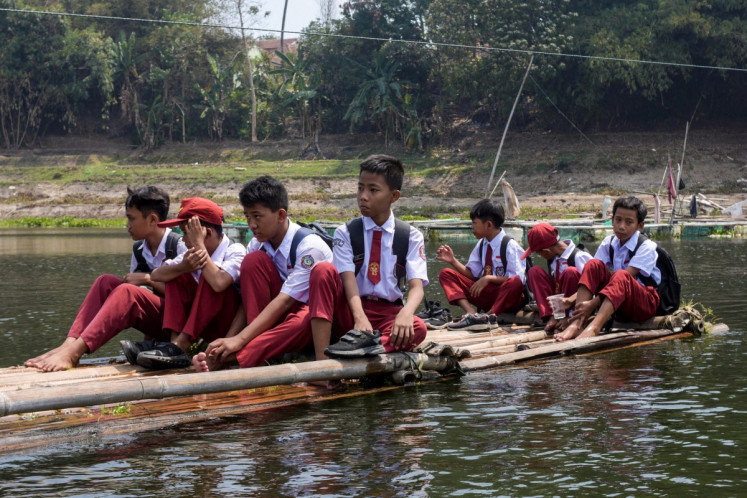
A digital divide was revealed as soon as the online learning took effect, as many students and teachers, especially in remote areas, do not have decent internet access, much less high-speed access. As recently as last week Education Ministry data revealed that students in 12,000 schools in far-flung, outermost and underdeveloped regions have no access to the internet, while students in 48,000 schools face poor internet connections.
The ministry has allocated Rp 7.2 trillion (US$490 million) to provide internet quota to students and teachers in all education levels.
But while technical problems are relatively easy to deal with, neither students nor teachers are ready for the drastic shift from face-to-face to virtual learning. This problem is ubiquitous, although at various levels of severity. In such different circumstances, teachers have to improvise and innovate methods that enable a seamless transfer of knowledge.