The Jakarta Post
Please Update your browser
Your browser is out of date, and may not be compatible with our website. A list of the most popular web browsers can be found below.
Just click on the icons to get to the download page.


Popular Reads
Top Results
No results found. Please check your search term and try again
Can't find what you're looking for?
View all search results
Popular Reads
Top Results
No results found. Please check your search term and try again
Can't find what you're looking for?
View all search resultsWhy nonviolent protests work better
Instead, research show nonviolent civil resistance is an effective means for policy-change goals.
Change text size
Gift Premium Articles
to Anyone
Share the best of The Jakarta Post with friends, family, or colleagues. As a subscriber, you can gift 3 to 5 articles each month that anyone can read—no subscription needed!
 Set as preferred source
T
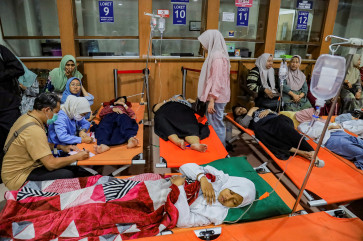
he omnibus Job Creation Law, which aims to disentangle the complex web of investment business and create more job opportunities, has waged protests in many parts of the country. Thousands of students and labor union members resist the "big bang" law, saying it will decouple the labor rights and harm the environment.
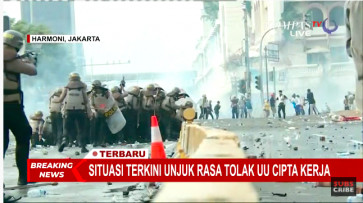
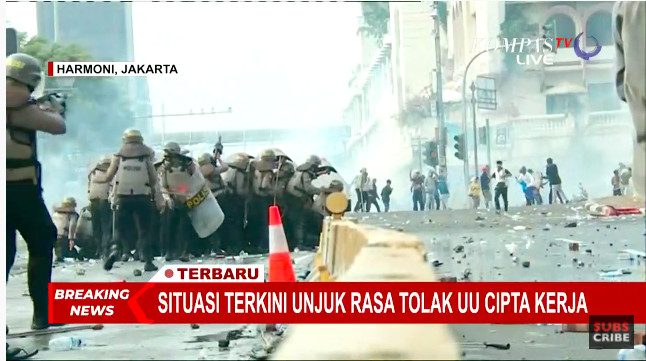
The protests have turned violent, with demonstrators throwing rocks, burning Transjakarta shelters and public facilities, while police have fired tear gas to "tame" protesters. Two weeks since the bill was approved, the protests and violence have continued.
People protest for a lot of reasons, but we don't know if they, especially the violent ones, lead to policy changes.
From research on social psychology, protests are linked to several variables such as grievances, efficacy, politicized identity and anger. Research from Stekelenburg and Klandermans (2013) in The Social Psychology of Protest, suggests that grievance and efficacy would predict protest participation.
At the very core of every protest are grievance, the feeling of illegitimate inequality, and the feeling of relative deprivation. Research suggests feeling part of a group that you perceive as deprived is especially important in protest engagement. We could see in the narratives of the protest against the omnibus law the shared grievances over the unjust clauses targeting workers as the deprived group.
Another variable predicting protest participation is the efficacy, which refers to individual expectation for the possibilities to alter conditions or policies through protest. A study from Van Zomeren et al., (2008) shows that feeling of efficacy, especially in politics, are highly correlated with participation in a protest, and the relationship proves to be meta-analytically important.
Another variable that correlates with protests is politicized identity. Normally, politicization of identities begins with the awareness of shared grievances and collective identities must be politicized to become the energy of a collective action. Metaanalysis by Van Zomeren et al., (2008) shows that the more politicized group members are the more likely they will engage in collective actions directed at the government or general public.