The Jakarta Post
Please Update your browser
Your browser is out of date, and may not be compatible with our website. A list of the most popular web browsers can be found below.
Just click on the icons to get to the download page.


Popular Reads
Top Results
No results found. Please check your search term and try again
Can't find what you're looking for?
View all search results
Popular Reads
Top Results
No results found. Please check your search term and try again
Can't find what you're looking for?
View all search resultsIndonesia must anticipate post-US election foreign policy changes
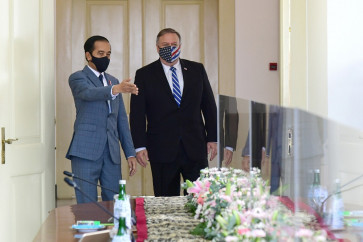
Biden has pledged to reinvigorate the US as a Pacific power by increasing its naval presence in the Asia-Pacific and deepening its ties with allies and other countries, including Australia, Japan, South Korea and Indonesia.
Change text size
Gift Premium Articles
to Anyone
Share the best of The Jakarta Post with friends, family, or colleagues. As a subscriber, you can gift 3 to 5 articles each month that anyone can read—no subscription needed!
 Set as preferred source

T
he United States election [on Nov. 3, 2020] will impact global and regional politics, including for Indonesia, particularly on policies regarding the South China Sea and Papua. Therefore, Indonesia needs to prepare foreign and national security policies that will apply in any situation, whether Donald Trump is reelected or Joe Biden wins the US presidency.
To formulate these policies, we can refer to a quote by Sun Tzu: "Know thy enemy, know thyself." Democrats and Republicans have conflicting views on several important issues, with the main differences found in the political orientation. Democrats are left-leaning, liberal and usually associated with progress and equality. In contrast, Republicans rely on propriety, tradition, justice and economic freedoms, and the idea of "survival of the fittest."
If Biden wins the election, the US’ foreign policy approach will shift from Republican to Democrat morality, which centers on the more liberal Kantian values that uphold democratic values, human rights and a liberal economy. Although Biden will still maintain a hardline stance against China, like Trump, we might see a US-China deal. The shift will benefit Indonesia in some cases, including its economic and security interests in terms of national and regional stability, especially in the South China Sea.
A Biden administration will be more internationalist and traditionalist in its foreign policy approach. This implies that in restoring the US role and interest in global politics, Biden and Kamala Harris will be more open and use diplomacy in the Indo-Pacific and with its allies. We could see a potential part 2 to the “Pivot to Asia” strategy that emulates the Obama-Biden policy.
Biden has pledged to reinvigorate the US as a Pacific power by increasing its naval presence in the Asia-Pacific and deepening its ties with allies and other countries, including Australia, Japan, South Korea and Indonesia. A Biden presidency may make more demands on Indo-Pacific states in a more sustainable and systematic manner than the US under Trump.
Another critical note to make is the central point of Biden's speech at the Democratic National Committee, in which he said his administration “will take immediate action to repair the damage President Trump’s reckless policies have done to American farmers, by working with our allies to stand up to China and negotiate from the strongest possible position.” This says much about Biden's approach toward China, at least in 2020-2024.
We will see a significant rise in partnership and strategic cooperation between the US and its allies to counter China. This time, it may include Taiwan and Japan, and possibly Vietnam, to win the “battle” over the South China Sea as part of the US’ geostrategic intentions against China. Newly installed Japanese Prime Minister Yoshihide Suga’s visit to Vietnam might say a lot about the US allies' position and interests in the South China Sea.