The Jakarta Post
Please Update your browser
Your browser is out of date, and may not be compatible with our website. A list of the most popular web browsers can be found below.
Just click on the icons to get to the download page.


Popular Reads
Top Results
No results found. Please check your search term and try again
Can't find what you're looking for?
View all search results
Popular Reads
Top Results
No results found. Please check your search term and try again
Can't find what you're looking for?
View all search resultsRizieqism casts a shadow on Indonesia’s fragile democracy
Both Rizieq and Trump are now seen as a symbol of a politics of resistance in a bitterly polarized society—Trump for the right wing extremists against the left and Rizieq against the President Joko “Jokowi” Widodo regime
Change text size
Gift Premium Articles
to Anyone
Share the best of The Jakarta Post with friends, family, or colleagues. As a subscriber, you can gift 3 to 5 articles each month that anyone can read—no subscription needed!
R
izieq Shihab is no Donald Trump. The former is a Muslim cleric, while the latter a star of a reality show, and, also, an outgoing United States president. Supporters of both men would howl at this comparison. But there is no denying they do share some similarities.
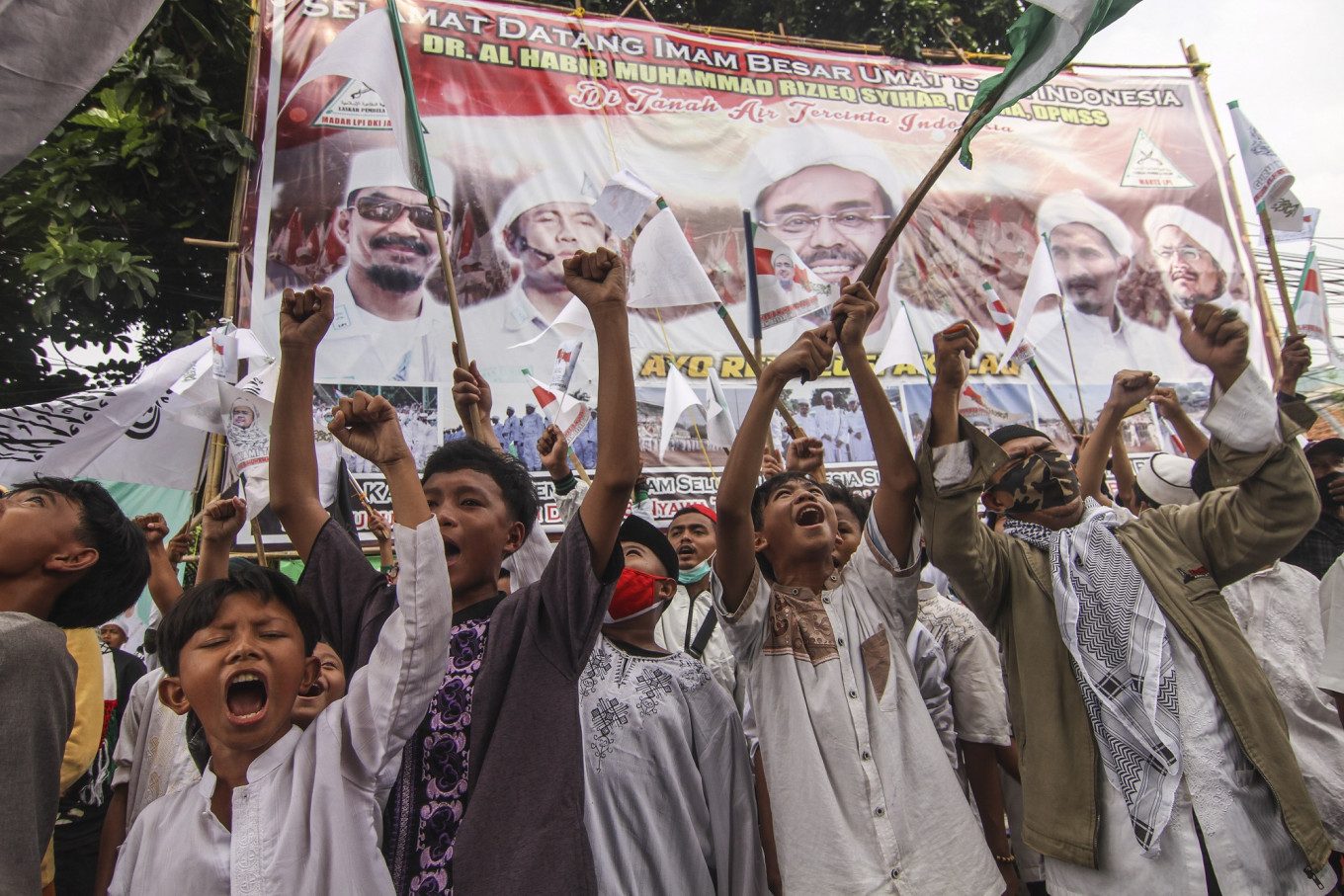
Both Rizieq and Trump are now seen as a symbol of a politics of resistance in a bitterly polarized society—Trump for the right wing extremists against the left and Rizieq against the President Joko “Jokowi” Widodo regime. Furthermore, the two men have been successful in bringing a fringe ideology with its non-decorum, if not violent and vulgar, rhetoric onto the center stage of the Indonesian political universe.
Speculations are rife that Rizieq made a deal with certain elements within the Jokowi administration before his return to Indonesia from Saudi Arabia—though it remains unclear what the deal is.
Rizieq may not have yet achieved what Trump has done in America in the past four years. But the current political climate has served as a springboard for the Islam Defenders Front (FPI) leader to expand his clout and gather more supporters. The consequence of such a scenario would be disastrous for Indonesian democracy.
To be clear, Rizieq will not be president anytime soon. While the man is becoming more palatable to many Muslims, his brand of Islamic populism relies heavily on the idea of a united Muslim ummah (community). It is unlikely that he would join any of the existing Islamic parties, and it is even more unlikely that he would create his own party. For such a move would only create divisions among his growing supporters.
University of Melbourne scholar Vedi Hadiz has offered a compelling argument why Islamic populism in Indonesia is far from an electoral triumph. It is highly fragmented and lacks the material support of the bourgeoisie for it to mobilize a large number of voters. Even Rizieq is known for his enmity against some “divisive” Salafi clerics who condemn Islamic traditions such as the celebration of the Prophet’s birthday as heresy.
It is not about the person, but more about what he represents—let’s call it Rizieqism.