TheJakartaPost
Please Update your browser
Your browser is out of date, and may not be compatible with our website. A list of the most popular web browsers can be found below.
Just click on the icons to get to the download page.


Popular Reads
Top Results
No results found. Please check your search term and try again
Can't find what you're looking for?
View all search results
Popular Reads
Top Results
No results found. Please check your search term and try again
Can't find what you're looking for?
View all search resultsRed tape stalls remote area electrification
The government prioritizes PLN, the country’s legally monopolistic but cash-strapped power distributor, while crowding out private enterprises.
Change text size
Gift Premium Articles
to Anyone
Share the best of The Jakarta Post with friends, family, or colleagues. As a subscriber, you can gift 3 to 5 articles each month that anyone can read—no subscription needed!
 Set as preferred source
P
rivate companies across the country are struggling against government regulations as they attempt to provide isolated regions with clean energy, partly due to strict government policies that often prioritize state-owned electricity firm PLN, despite the latter’s limited funds.
In Sumatra, start-up PT Surya Utama Nuansa (SUN) and region-owned enterprise (BUMD) PT Bungo Dani Mandiri Utama planned to electrify 19 villages in West Tanjung Jabung, the second-most impoverished regency in Jambi, according to Statistics Indonesia.
SUN and Bungo Dani planned to sell electricity at Rp 3,500 (25 US cents) and Rp 4,000 per kilowatt hour (kWh), much cheaper than the Rp 6,000 per kWh that most villagers were paying for diesel-generated electricity.
The companies had secured approval from various regional bodies but then, on Nov. 7, in a letter seen by The Jakarta Post, the Energy and Mineral Resources Ministry rejected their application for an area electrification permit.
The ministry wrote that PLN would connect all 19 villages by June this year but that only happened on Nov. 12. Furthermore, the regency capital Kuala Tungkal PLN head Rizki Tungguan said the electricity had not yet been turned on, due to politicization concerns amid ongoing regional elections, and that the grid’s electricity was insufficient to meet demand.
“It’s like PLN is being forced to electrify the villages. Would it not be better to reconsider?” SUN’s Verry told the Post, recollecting the companies’ plea to the energy ministry.
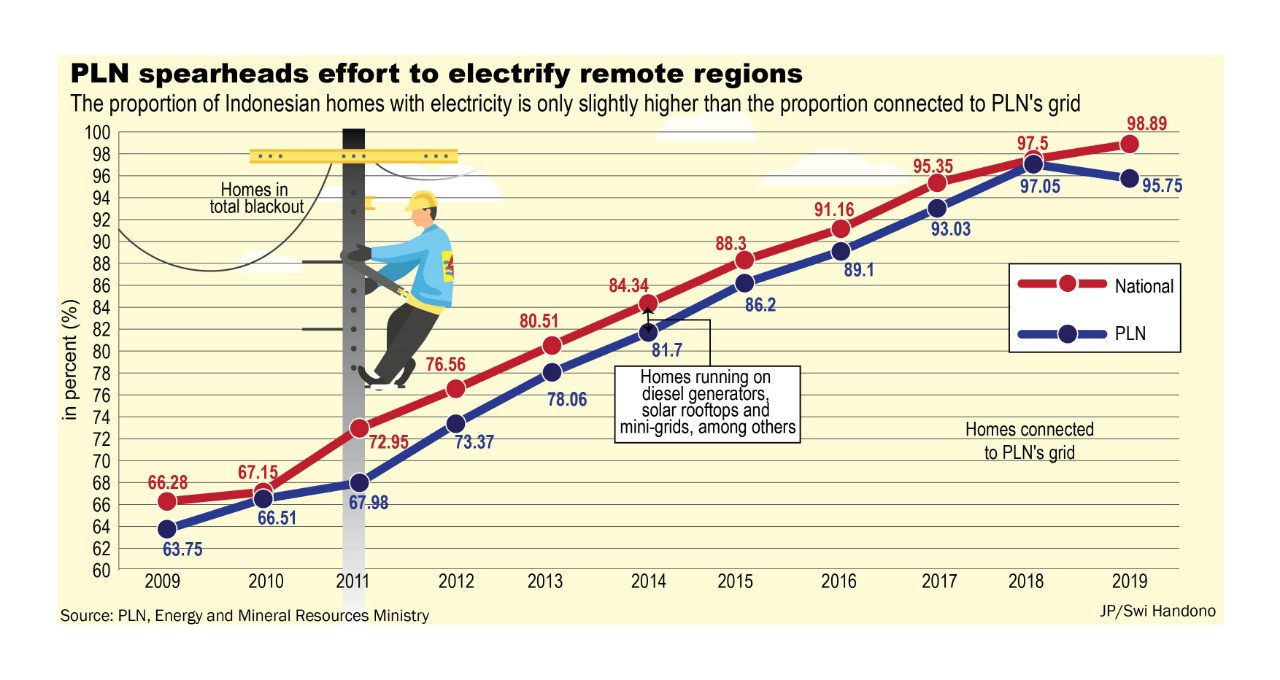
SUN’s case reflects the government’s approach to electrifying remote areas that, many experts say, risks undermining the country’s ability to empower millions of off-grid, low-income homes – the proverbial “last mile”.