The Jakarta Post
Please Update your browser
Your browser is out of date, and may not be compatible with our website. A list of the most popular web browsers can be found below.
Just click on the icons to get to the download page.


Popular Reads
Top Results
No results found. Please check your search term and try again
Can't find what you're looking for?
View all search results
Popular Reads
Top Results
No results found. Please check your search term and try again
Can't find what you're looking for?
View all search resultsBeyond 100 percent: Redefining energy access in Indonesia
Indonesia showed a significant increase in electricity access, from 67.2 percent in 2010 to 98.89 percent at the end of 2019.
Change text size
Gift Premium Articles
to Anyone
Share the best of The Jakarta Post with friends, family, or colleagues. As a subscriber, you can gift 3 to 5 articles each month that anyone can read—no subscription needed!
 Set as preferred source
A
ccess to modern and reliable energy, including electricity, is an essential service and an important prerequisite for sustainable development. People's access to modern energy services for powering productive activities will drive socioeconomic improvements, opening access to better information, education, health and jobs. Conversely, lack of energy access can have adverse effects on people's ability to improve their wellbeing.
According to the International Energy Agency (IEA), 770 million people globally still had no electricity access in 2019, mostly in Africa. Meanwhile, Asian countries recorded significant growth: 96 percent of the continent's population had access to electricity in 2019, compared to only 67 percent in 2000. Indonesia showed a significant increase in electricity access, from 67.2 percent in 2010 to 98.89 percent at the end of 2019. This progress surpassed the 2019 target of 96.6 percent electrification set by the National Medium-Term Development Plan (RPJMN) 2015-2019.
However, there is a problem in Indonesia's definition for "electricity access". We use the electrification ratio as an indicator, which is calculated by dividing the number of households with electricity access by total households in the country. Statistics Indonesia (BPS) uses lighting sources to determine this “electricity access”, whereas the Energy and Mineral Resources Ministry adds together the number of state electricity company (PLN) customers and the customers of other electricity services, including recipients of solar-powered energy saving lights, or LTSHE. Another indicator is the "electrified village", which is more inexplicable because a village could be deemed “electrified”, even if only one house is connected to the national electricity grid.
Since our current indicators for electricity access are binary – connected or not connected – and focus on only one aspect of electricity – lighting – they do not indicate the reliability, quality and expected impacts of electricity access in Indonesia.
It is a common understanding that those connected to the PLN grid do not necessarily receive a full 24/7 electricity supply with stable voltage. The real-time monitoring set up in 2017-2018 by the IESR showed that PLN customers in Kupang, the capital of East Nusa Tenggara, experienced outages averaging 13 hours per month, compared to only 2 hours per month in the nation’s capital, Jakarta. The monitoring program also found that houses in densely populated areas of Jakarta had unstable voltages in contrast to suburban areas. The lack of voltage stability can cause damage to electronic appliances or induce higher power consumption.
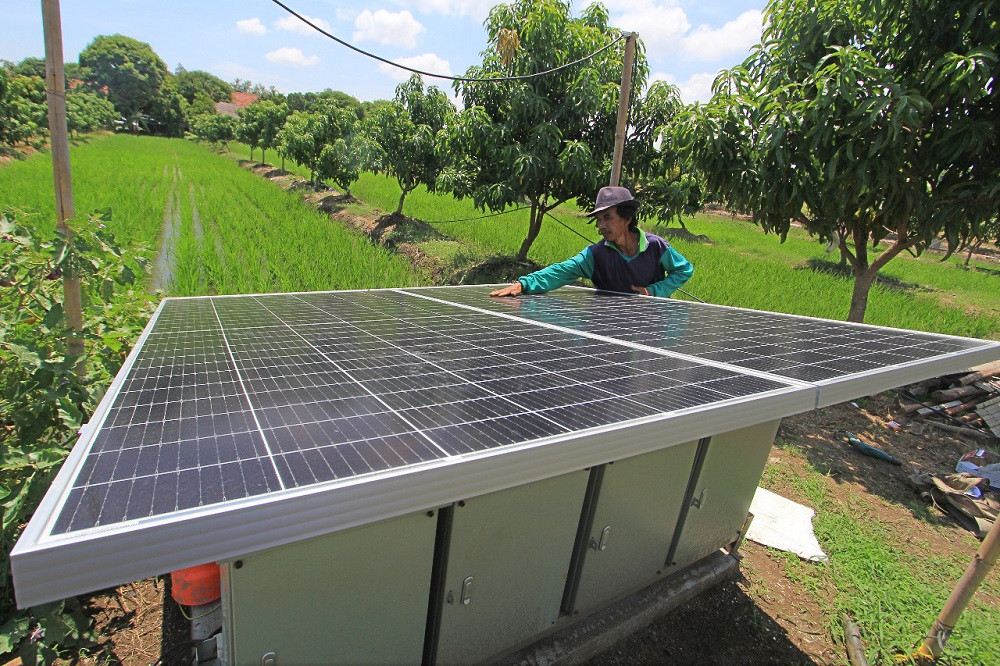
The deliberate inclusion of LTSHE recipients in calculating the electrification ratio also highlights the gap in energy quality. The LTSHE program only provides essential lighting for 10-12 hours (low lumens) and charging mobile phones; it was also designed for optimal use over just three years. Yet, no clear plan has been developed for providing better electricity access to LTSHE recipients after the program ends.
Time is pressing for the government to evaluate and redefine electricity access. Multidimensional indicators of energy access are required that incorporate quality and minimum capacity, as well as the projected and expected impacts for end-users on all energy sources and systems.