The Jakarta Post
Please Update your browser
Your browser is out of date, and may not be compatible with our website. A list of the most popular web browsers can be found below.
Just click on the icons to get to the download page.


Popular Reads
Top Results
No results found. Please check your search term and try again
Can't find what you're looking for?
View all search results
Popular Reads
Top Results
No results found. Please check your search term and try again
Can't find what you're looking for?
View all search results‘Revolusi’, a reappraisal of Indonesia’s awakening history
The whole trajectory led the writer to name the years around 1914 as the early awakening moment of the indigenous society.
Change text size
Gift Premium Articles
to Anyone
Share the best of The Jakarta Post with friends, family, or colleagues. As a subscriber, you can gift 3 to 5 articles each month that anyone can read—no subscription needed!
 Set as preferred source
W
hen then-Dutch prime minister J.P. Balkenende urged the Parliament in 2006 to recall the Golden Age of the Dutch East India Company (VOC), there was some indignant booing.
“[We need] VOC mentality!” the PM replied angrily.
That was a moment that fed into the narrative of the “pride and shame, emancipation and humiliation, hope and violence” of Dutch history, the Belgian historian David van Reybrouck wrote. The VOC, after all, was responsible for genocide there.
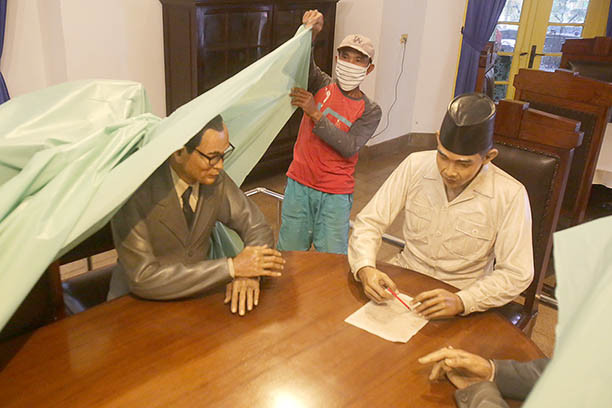
Van Reybrouck’s new book Revolusi, Indonesie en het ontstaan van de moderne wereld (Revolution, Indonesia and the emergence of the modern world) has been widely praised in the Netherlands – much as his earlier work on the Congo.
The book (637 pages) is an attempt to review Indonesian history by exploring how Dutch colonialism was more disastrous than other European powers elsewhere. Van Reybrouck describes colonial policies and emphasizes the way the indigenous society responded from the early decades of the last century, only to conclude that it emerged as the first independent country that called ex-colonies elsewhere to arise.
He, thus, describes how the archipelago radically changed from mere a small VOC spice warehouse in Ambon, Maluku, to become the world’s fourth-largest nation. When the company that collected huge profits by forging a violent monopoly went bankrupt, the islands fell prey to European colonialism: the British, the French and the Dutch. It ultimately led to the great Java War (1825-1830) that took some 200,000 human lives and devastated the land.
Interestingly, the writer dealt with Dutch colonialism, the Japanese period and the independence struggle along the themes of violence, militancy and diplomacy. Although the Japanese were welcomed at first and the occupation was truly decisive in releasing the leaders of the nation who were captured by the Dutch, they made millions suffer and hungry as never before. Yet it helped raise the militancy and violence of the people militia’s during the independence struggle.