The Jakarta Post
Please Update your browser
Your browser is out of date, and may not be compatible with our website. A list of the most popular web browsers can be found below.
Just click on the icons to get to the download page.


Popular Reads
Top Results
No results found. Please check your search term and try again
Can't find what you're looking for?
View all search results
Popular Reads
Top Results
No results found. Please check your search term and try again
Can't find what you're looking for?
View all search resultsStrategy to promote electric vehicles in Indonesia: Start with commercial transport
Indonesia may want to focus on electrifying commercial vehicles as it heads toward a more energy secure and environmentally friendly future with the adoption of EVs.
Change text size
Gift Premium Articles
to Anyone
Share the best of The Jakarta Post with friends, family, or colleagues. As a subscriber, you can gift 3 to 5 articles each month that anyone can read—no subscription needed!
I
recently saw a large advertisement for an electric passenger car (EPC) on a Jakarta thoroughfare and I thought, it’s finally here. I am a big supporter of electric vehicles (EVs).
Some might still ask hesitantly, will using EVs instead of fossil fuel vehicles (FFV) really be environmentally friendly for Indonesia? The answer is, “Yes.” We have a grid carbon factor of around 0.80 kilograms of carbon dioxide emissions per kilowatt-hour (kWh) because of our reliance on coal.
Even with this relatively high carbon grid factor, EVs are still more environmentally friendly than FFVs. EVs can reduce greenhouse gas (GHG) emissions from 20 percent to 35 percent compared to FFVs and could significantly help improve Jakarta’s air quality. As we move toward the goal of decarbonizing our energy sector, switching to EVs will help Indonesia meet our Paris Agreement targets.
In addition, EVs could help reduce Indonesia’s negative oil trade balance and transform our automotive industry.
Although Indonesia has been lagging behind its global peers in promoting EVs and underlying industrial developments, the government has made significant progress in the past two years. The Energy and Mineral Resources Ministry announced last month that Indonesia would have around 2.2 million EPCs and 13 million electric motorcycles (e-motorcycles) by 2030. Further, there would be 31,800 charging stations and 67,000 battery swapping facilities to support the projected number of EVs.
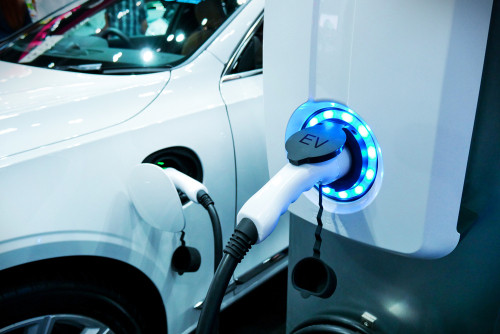
At first glance, one might think that the number of charging stations would not be sufficient to cater to the estimated number of EVs. However, EVs are different from FFVs in terms of how they are powered. FFVs rely on gas stations to fill up their tanks, but EVs do not need charging stations for energy.
Charging EVs is decentralized, so can improve Indonesia’s energy security. EV users can charge their cars at home overnight. Based on user experience in other countries, charging EVs is as simple as plugging in our laptops, although an EV charger is around 220 volts. Overnight charging at home would give a driving range of around 200 kilometers, even if users don’t have a wall-mounted charger. Therefore, the number of charging stations does not necessarily correspond directly to the number of EVs in the country.