The Jakarta Post
Please Update your browser
Your browser is out of date, and may not be compatible with our website. A list of the most popular web browsers can be found below.
Just click on the icons to get to the download page.


Popular Reads
Top Results
No results found. Please check your search term and try again
Can't find what you're looking for?
View all search results
Popular Reads
Top Results
No results found. Please check your search term and try again
Can't find what you're looking for?
View all search resultsBetween women, the dictionary and society
What saddens me more is that our misogynist society includes people who are religious.
Change text size
Gift Premium Articles
to Anyone
Share the best of The Jakarta Post with friends, family, or colleagues. As a subscriber, you can gift 3 to 5 articles each month that anyone can read—no subscription needed!

P
osts on social media about the word perempuan (woman) drove me mad last month. The subentries of this word in the Great Dictionary of the Indonesian Language (KBBI) include perempuan geladak (prostitute), perempuan jalang (bitch), perempuan nakal (bad girl) and perempuan simpanan (mistress), which are all derogatory and may stigmatize women
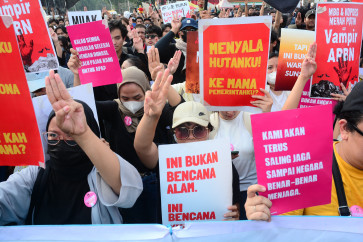
Many protesters have accused the dictionary’s drafting team of being blatantly misogynists. They assume the team has the authority to choose only positive phrases to be listed in the subentries. The Language Development and Fostering Agency, the composer and publisher of the dictionary, was held responsible.
I almost joined the chorus of criticism, until I related it to my own experience in conducting linguistics research. As a researcher who gathers data from what is produced by speakers of a language in society, I have to make sure that I deliver the language phenomena found as genuine as they are, without taking into account morality or any other issues.
Researchers are supposed to uphold integrity. They do not have the privilege to change or choose their findings — neither does the dictionary’s drafting team. It conducted corpus-based linguistics research and found out that the usage of those negative phrases in our society was very high. As a consequence, the phrases have to be listed in the subentries of the word perempuan.
Because the team simply displays what it found in Indonesian society, it is not fair to label its members as misogynists or sexists.
It is safe to say that the KBBI is a factual representation of what is uttered and written by speakers of the language. So, if there is a side to be held responsible for what is listed under the word perempuan, it is our society — our misogynist society.
What saddens me more is that our misogynist society includes people who are religious. Religions have been trusted as institutions of capable and expected to elevate women’s value in society. However, the case of the dictionary implies that our religious-yet-misogynist society is keen on stigmatizing women.