The Jakarta Post
Please Update your browser
Your browser is out of date, and may not be compatible with our website. A list of the most popular web browsers can be found below.
Just click on the icons to get to the download page.


Popular Reads
Top Results
No results found. Please check your search term and try again
Can't find what you're looking for?
View all search results
Popular Reads
Top Results
No results found. Please check your search term and try again
Can't find what you're looking for?
View all search resultsArtists in Bali respond to NFT craze
The revolutionary development of digital technology within contemporary art is taking the world by storm. It is not aesthetic distinctions that characterize the latest art trend, but a new term associated with the distributed ledger technology that allows for artworks to be easily tracked and traded. The Jakarta Post talks with two Bali-based artists about the crypto art craze.
Change text size
Gift Premium Articles
to Anyone
Share the best of The Jakarta Post with friends, family, or colleagues. As a subscriber, you can gift 3 to 5 articles each month that anyone can read—no subscription needed!
 Set as preferred source
A
non-fungible token (NFT) can authenticate digital assets like JPEG, GIF or MP4 files on a blockchain and thereby certify their originality and ownership. Royalties can be locked into contracts, so that artists receive cryptocurrency payments each time the NFT is resold after the initial sale.
The NFT phenomenon has spread to Bali, and the The Jakarta Post talks with two artists quick to respond to what has been referred to as the crypto art craze. Ida Bagus Ratu Antoni Putra, - Monez - is a Balinese artist and design studio proprietor who has created digital illustrations for 15 years. His clients include Apple, Starbucks and Walt Disney Indonesia. “Piracy and the need to protect my work is one of the main reasons I got into NFTs,” said the Bachelor and Masters of Arts graduate of the Indonesian Art Institute (ISI) Denpasar. In 2018, Monez was embroiled in a publicized plagiarism case when another artist copied his mural in a Denpasar eatery onto walls in two other city restaurants.
"As a designer, I follow changes and trends. I have finally uploaded two crypto artworks, Dream Valley and Circus Clown, one a lighthearted Bali nature-inspired scenario, the latter an intimidating monster beating a drum. It's hard to imagine why people would buy these files. Yet, they buy, not only for good art but also as an investment. The development of NFT offers new hope for digital artists," said Monez, who has an international Instagram following and has exhibited physical artworks in Indonesia, Singapore, Malaysia and the United States.
‘Circus Clown’ by Balinese NFT artist Monez is a Jpeg file illustration.The circus
monster taps his drum around the villages to announce the beginning of the death
parade. (JP/Courtesy of Monez)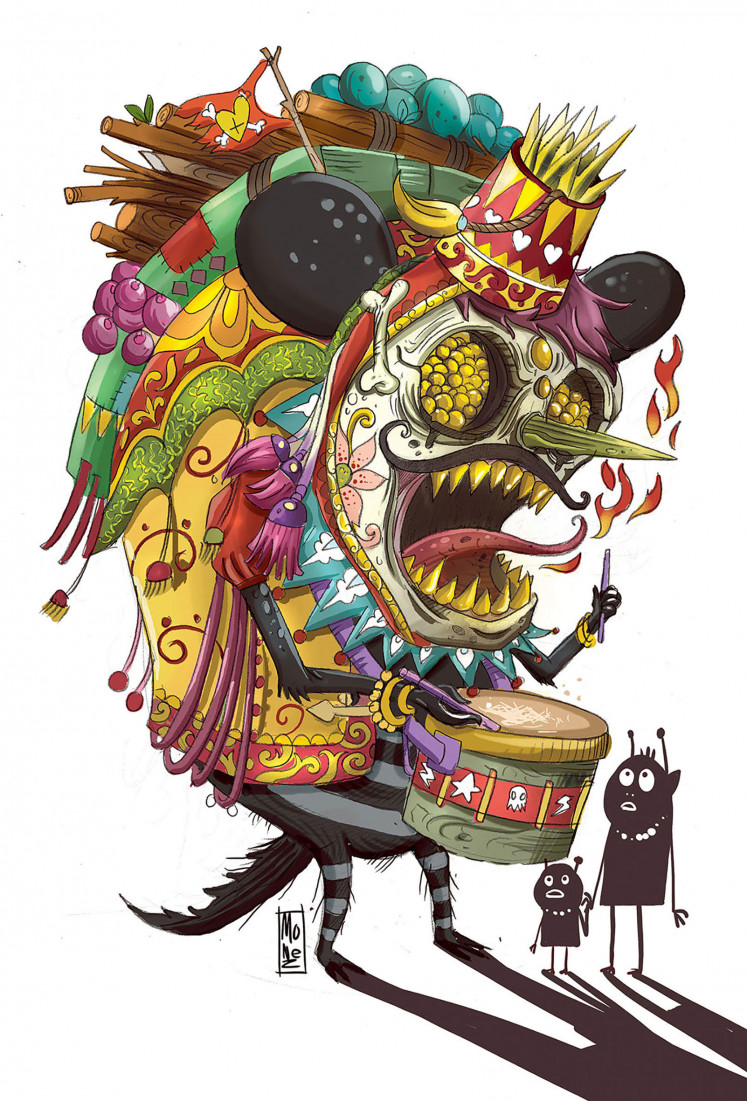
"NFTs are a phenomenon, because people can sell works at fantastic prices to a whole new market. They are a prevalent topic of discussion in the local design community. There is, however, no legal umbrella in the NFT world. Piracy often occurs, and there are few solutions open to you when your work is online and appears in someone else's screenshot and is then sold as an NFT."
A collage of 5,000 individual images, Everydays — The First 5000 Days by American artist Beeple, has intensified the meteoric rise of NFTs. The first to be sold by a major auction house, Christie's, it changed hands for US$69.4 million on March 11. Beeple is now among the top-three most valuable living artists in any medium, alongside Jeff Koons and David Hockney. This sale represents a landmark vanguard action confirming creatives utilizing peer-to-peer digital platforms may bypass the artworld gatekeepers and raise the financial stakes to dizzy heights.
"Many illustrator friends wish to participate. The terrain, however, is very [new], requiring time to understand through watching YouTube videos and joining forum discussions. I now have an NFT-savvy partner who is responsible for uploading the files and the platform transactions. I provide the artworks," said Monez.