The Jakarta Post
Please Update your browser
Your browser is out of date, and may not be compatible with our website. A list of the most popular web browsers can be found below.
Just click on the icons to get to the download page.


Popular Reads
Top Results
No results found. Please check your search term and try again
Can't find what you're looking for?
View all search results
Popular Reads
Top Results
No results found. Please check your search term and try again
Can't find what you're looking for?
View all search resultsIndonesia’s huge solar power potential still going to waste
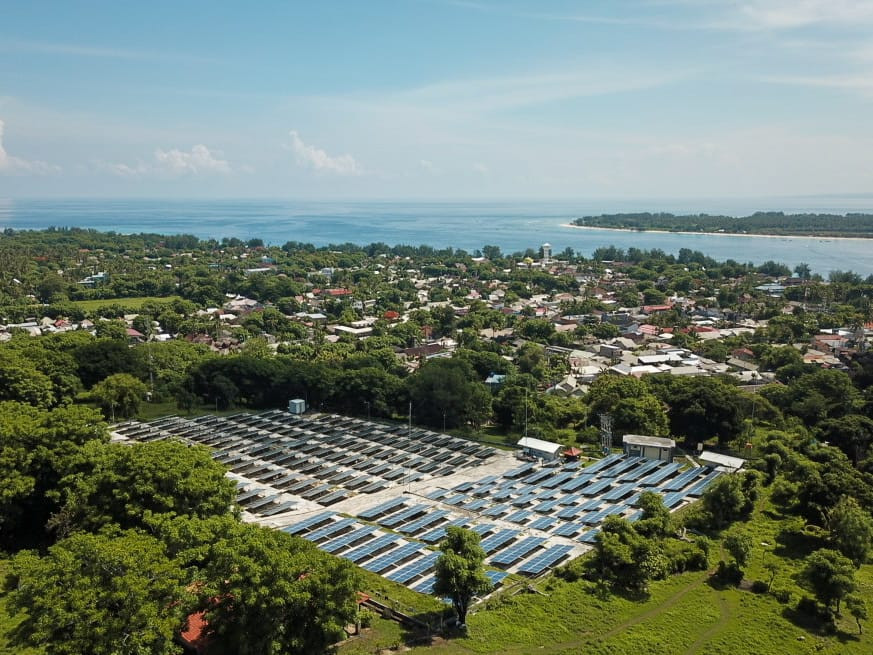
Floating solar power installations are perceived as more attractive since no land is required and grid interconnections are available for certain dams.
Change text size
Gift Premium Articles
to Anyone
Share the best of The Jakarta Post with friends, family, or colleagues. As a subscriber, you can gift 3 to 5 articles each month that anyone can read—no subscription needed!
 Set as preferred source
R
enewables have proven their resilience amid the pandemic. The International Energy Agency (IEA) recorded an all-time high of added renewable energy capacity in the first half of 2020, with 30 gigawatts of the total 50 GW coming from solar.
Vietnam is the new solar celebrity, after a long dependence on coal. An apparent energy crisis, technological advancement in solar photovoltaic, the declining price of solar power and the climate crisis have created a turning point in Vietnam. At the end of 2020, after growing 2,400 percent within a year, solar installations in Vietnam produced 16.5 GW of electricity, which compares to virtually none in 2017.
Indonesia pales in comparison. If examples from European or Middle Eastern countries are often perceived as less relevant to the Indonesian context – Vietnam's success should be cherished. A fellow Southeast Asian country has succeeded with no secret recipe, just strong government commitment, a long-term power development plan favoring renewables, effective pricing policies and a long list of incentives (e.g., land-fee exemptions), as well as a one-stop-service with state-owned utility EVN.
Here in Indonesia, a presidential decree on the renewable energy price has yet to be issued after more than a year of preparation. The 10-year electricity plan (RUPTL) of state-owned power company PLN will be released soon. An additional capacity of 3.7 GW of "various renewables" is said to be included, but the solar energy share is still unclear. A "grand strategy" for renewables to achieve the National Energy Plan target of 23 percent renewables by 2025 and more by 2035 has been made public by the Energy and Mineral Resources Ministry, in which solar energy is given priority with more floating solar projects, a replacement of diesel generators with solar power plants and a planned solar park in eastern Indonesia.
But until there is strong commitment for a long-term expansion of solar power with a clear development plan, including supporting regulations and incentives, Indonesia will always be on the sidelines. This situation is exacerbated by growing doubts over the role of solar energy in Indonesia. Solar has entered Indonesia's mainstream energy discourse – now come all the doubts, including from utilities and solar power skeptics.
The first of those doubts concerns the energy yield. While solar irradiation in Indonesia (3.4- 6.2 kilowatt hours (kWh)/m2/day) is evidently lower than in the United Arab Emirates (5.5-6.3 kWh/m2/day) but comparable to India (3.2-6.4 kWh/m2/day), our photovoltaic electricity potential is not bad, ranging from 2.8 to 4.8 kWh/kWp/day. Indeed, monsoon, water vapor, air pollution and the local climate may affect the solar power output, but at the end, it is the power output from solar modules that matters.
Our study in 2019 estimated that the generation potential translates into a levelized cost of electricity of 5.84-10.28 US cent/kWh for utility-scale solar, quite on-par with coal-generated electricity.