The Jakarta Post
Please Update your browser
Your browser is out of date, and may not be compatible with our website. A list of the most popular web browsers can be found below.
Just click on the icons to get to the download page.


Popular Reads
Top Results
No results found. Please check your search term and try again
Can't find what you're looking for?
View all search results
Popular Reads
Top Results
No results found. Please check your search term and try again
Can't find what you're looking for?
View all search resultsColonial legacy: The (un)making of the Criminal Code
With the proposed amendment of the Criminal Code, there is no guarantee that everyone will be free from being criminalized for practicing their cultural beliefs.
Change text size
Gift Premium Articles
to Anyone
Share the best of The Jakarta Post with friends, family, or colleagues. As a subscriber, you can gift 3 to 5 articles each month that anyone can read—no subscription needed!
 Set as preferred source
O
ur founding fathers were too busy defending and establishing allies after the independence of Indonesia. Their strategic visions for the nation’s freedom from all forms of colonial power were cut short.
They may have physically gotten rid of the Dutch and Japanese and established a new nation, but they were of the view that it was perfectly acceptable to adopt the Dutch Criminal Code in 1958 to avoid a legal vacuum.
Our founding fathers took the view that legal dualism embedded in the practice of 200 years of Dutch colonialism had proved that the Dutch Criminal Code we inherited could live in tandem with our distinctly unique living law.
This view of legal dualism has shaped generations and has become onerous now. The concept of bhinneka tunggal ika (unity in diversity), although it is seen as Indonesia’s version of democracy, reinforces the colonial creation in the form of a labyrinth of legal systems: the Criminal Code and the variety of indigenous legal systems.
They segregated the colonists, their subjected natives and everyone in between. There is more unity in that term than the actual diversity.
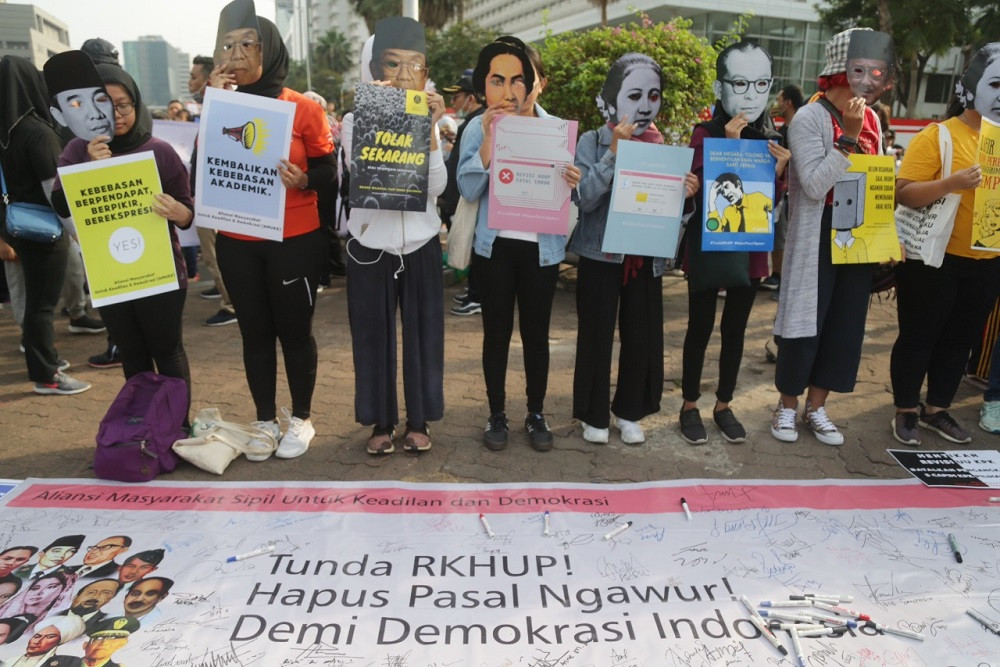
The current proposed revision of the colonial Criminal Code pertaining to the living law section has triggered a widespread outcry from civil society. Article 2(1) and Article 598 of the draft, which recognize that traditional criminal justice system that has been in place in societies, violates the doctrine of legality and is instinctively draconian. Civil society members believe that leaving the legal interpretation of what constitutes living law to decentralized governments will not only diminish the rights of indigenous peoples but will also be at risk of being applied inconsistently and discriminatively.
Ironically, it criminalizes our bhinneka tunggal ika, which glues us together regardless of our understanding of the genealogy of the term.