The Jakarta Post
Please Update your browser
Your browser is out of date, and may not be compatible with our website. A list of the most popular web browsers can be found below.
Just click on the icons to get to the download page.


Popular Reads
Top Results
No results found. Please check your search term and try again
Can't find what you're looking for?
View all search results
Popular Reads
Top Results
No results found. Please check your search term and try again
Can't find what you're looking for?
View all search resultsThe economics of stunting: Provide food not brochures
To cure children who have already been diagnosed with stunting we should admit that promotions, trainings and campaigns will be less effective or even useless.
Change text size
Gift Premium Articles
to Anyone
Share the best of The Jakarta Post with friends, family, or colleagues. As a subscriber, you can gift 3 to 5 articles each month that anyone can read—no subscription needed!
 Set as preferred source
W
hen I traveled to three different Indonesian provinces earlier this month, I realized they had an unusual resemblance. Their roads were decorated with huge billboards, where photos of their local leaders were placed, ornamented with their popular tourist spots and a statement: “Eliminate stunting before 2025.”
Indeed, the elections are just about to start. Providing information related to stunting can be used as a campaign tool, especially with increasing public health policy expectations from society after the COVID-19 pandemic. However, what are the proposed policies from these advertisements?
A Statistics Indonesia (BPS) survey in 2021 shows that the population of children aged under five reached 30.83 million. Unfortunately, 24.4 percent of children or around 7.5 million are stunted (the Indonesian Nutritional Status Survey, 2021). Hence, Indonesia only succeeded in reducing 6 percent of stunting in this age group in the past three years (in 2018, 30.8 percent of children aged under five were stunted).
The Medium-Term National Development Plan has targeted further cutting of the stunting rate to 14 percent in 2024. The government aims to eradicate stunting in children through five pillars, namely commitment, communication, convergence in all stakeholder levels, food security and strengthening innovation in research.
In my personal opinion, these pillars have been widely implemented except for the fourth one. The health training, inter-agency meetings, grassroot campaigns and academic conferences have been routinely conducted. However, only limited discussions and interventions in food security have emerged.
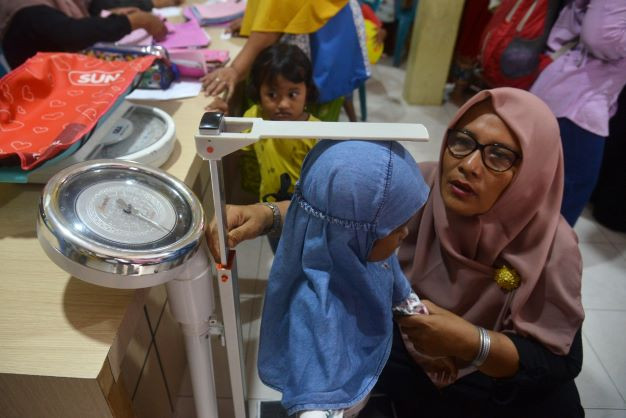
A simple proof can be seen in our Posyandu (integrated healthcare center) programs. They explain a lot about stunting initiatives, but what kind of food do they provide during the program? Is the food aimed for the children or the caregiver? Does the food consist of balanced macro and micronutrients?
Similarly, we are still struggling to find documented data about food security and specific nutrition intervention programs in the country. The majority of our stunting-related studies are focusing on its social determinants.