The Jakarta Post
Please Update your browser
Your browser is out of date, and may not be compatible with our website. A list of the most popular web browsers can be found below.
Just click on the icons to get to the download page.


Popular Reads
Top Results
No results found. Please check your search term and try again
Can't find what you're looking for?
View all search results
Popular Reads
Top Results
No results found. Please check your search term and try again
Can't find what you're looking for?
View all search resultsIran leader Khamenei killed in massive US and Israeli attack, Trump says
Iran responded to the attack with a flurry of missile and drone strikes across the Middle East, killing at least one person in Abu Dhabi and another in Tel Aviv as explosions rocked the showcase cities of Gulf Arab monarchies.
Change text size
Gift Premium Articles
to Anyone
Share the best of The Jakarta Post with friends, family, or colleagues. As a subscriber, you can gift 3 to 5 articles each month that anyone can read—no subscription needed!
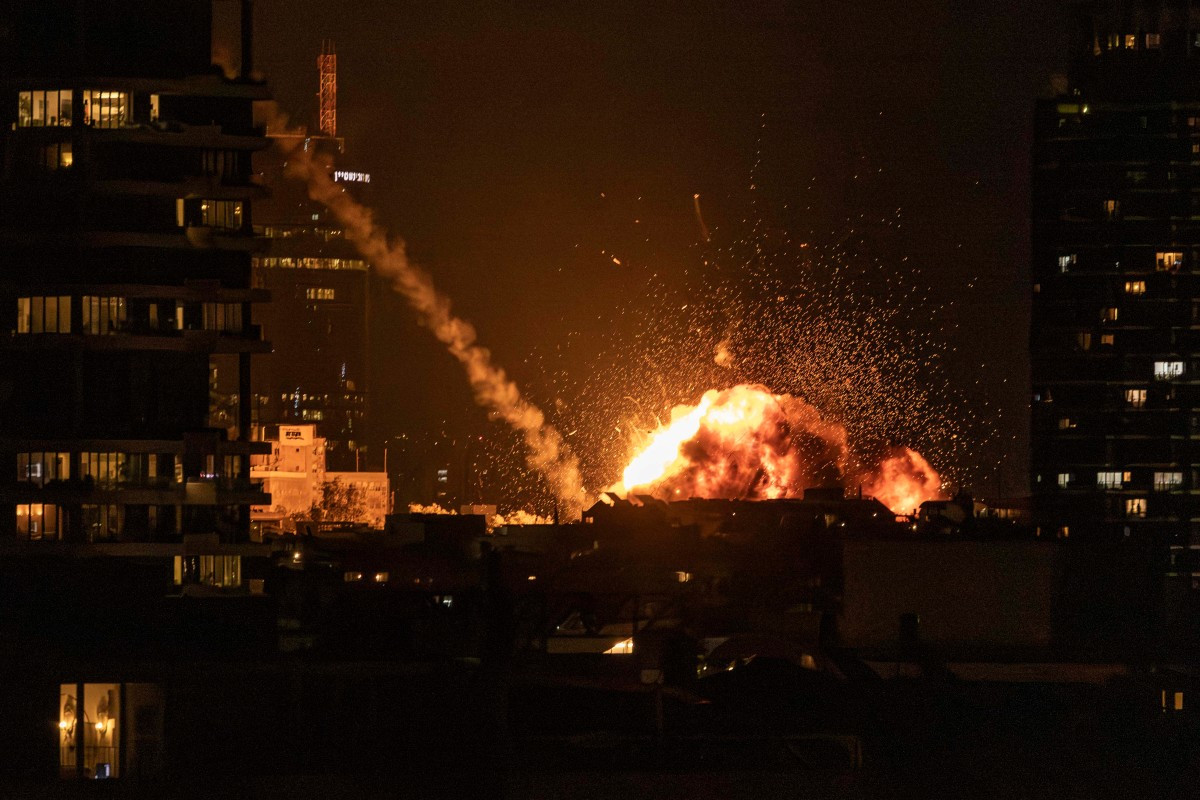 A fireball lights the sky following a missile strike on Tel Aviv on February 28, 2026. The United States and Israel launched strikes against Iran on February 28, with Israel's public broadcaster reporting that the Iranian supreme leader had been targeted, as the Islamic republic retaliated with barrages of missiles at Gulf states and Israel. (AFP/John Wessels)
A
yatollah Ali Khamenei, Iran's supreme leader since 1989 and sworn enemy of the West, was killed Saturday in the opening salvo of a massive US and Israeli attack, President Donald Trump said, as he urged the overthrow of the Islamic republic.
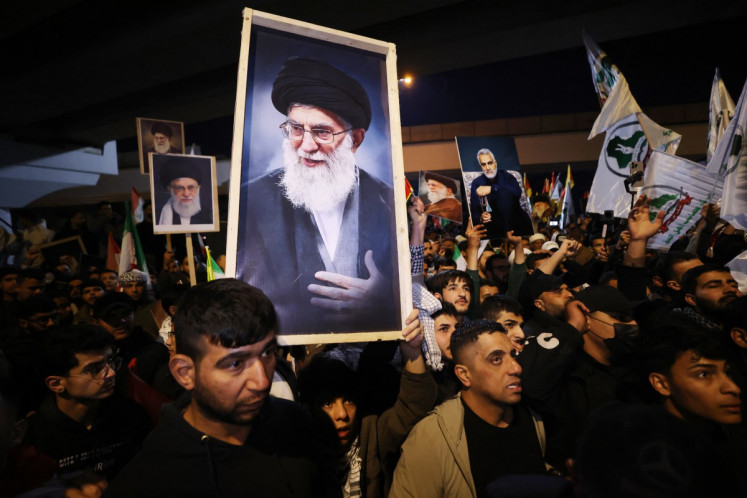
Cheers could be heard on Tehran's streets after reports first emerged from Israel of the death of Khamenei, as plumes of black smoke hovered over the district where he usually resides, witnesses told AFP.
The attack came weeks after Iranian authorities ruthlessly put down mass protests, killing thousands.
"Khamenei, one of the most evil people in History, is dead," Trump said in a statement.
Trump vowed no let-up in the strikes until the fall of the Islamic republic as he urged security forces to stand down.
"This is the single greatest chance for the Iranian people to take back their Country," Trump said.
Iran responded to the attack with a flurry of missile and drone strikes across the Middle East, killing at least one person in Abu Dhabi and another in Tel Aviv as explosions rocked the showcase cities of Gulf Arab monarchies.
There was no immediate confirmation from Iranian authorities of Khamenei's death.
Iranian Foreign Minister Abbas Araghchi had earlier told NBC News that Khamenei was alive "as far as I know" and foreign ministry spokesman Esmail Baqaei told the BBC he was "not in a situation to confirm anything".
Speaking before Trump, Israeli Prime Minister Benjamin Netanyahu said of Khamenei that there were "many signs that this tyrant is no longer alive" and said to Iranians, "This is your time to join forces, to overthrow the regime and to secure your future."
The Israeli army said that Ali Shamkhani, a top advisor to Khamenei, and the head of Iran's powerful Revolutionary Guards, General Mohammad Pakpour, were both also killed.
One apparent survivor, Ali Larijani, head of Iran's Supreme National Security Council, vowed defiance.
"The brave soldiers and the great nation of Iran will teach an unforgettable lesson to the international oppressors," he said.
Read also: Trump's Iran strikes mark his biggest foreign policy gamble
Reza Pahlavi, the son of the late pro-Western shah deposed in the 1979 Islamic revolution, called on Iranians to "stay vigilant" and then to take to the streets in massive numbers when he issues a call.
Hailing the reported demise of Khamenei, only the second supreme leader of the cleric-run state after Ayatollah Ruhollah Khomeini, Pahlavi said, "With his death, the Islamic Republic has effectively come to an end and will soon be consigned to the dustbin of history."
Pahlavi, who has spent most of his life in exile near Washington, has presented himself as a transitional figure to a secular democracy although he does not enjoy support from all the opposition.
Strikes across Iran
Iranian authorities urged residents to evacuate Tehran, a capital city of 10 million. The country's Red Crescent society said that at least 201 people had been killed in the strikes and more than 700 wounded.
The Iranian judiciary said one strike that hit a school in the south killed 108 people, although AFP was unable to access the site to verify the toll or the circumstances surrounding the incident.
Meanwhile in Israel, city streets stood deserted as residents took cover in shelters while the blasts of intercepted Iranian missiles reverberated overhead.
Israeli emergency services said that an Iranian missile strike killed a woman in the Tel Aviv area and that some 20 others were wounded.
Residents and AFP correspondents in the Emirati, Qatari and Bahraini capitals heard multiple rounds of explosions from Iran's retaliatory strikes.
Smoke poured from US bases in the UAE and Bahrain, home to the US Navy's Fifth Fleet.
"When we heard the sounds, we cried out of fear," said Jana Hassan, a 15-year-old student who was near the strike in Bahrain. "I will never forget the sound of those loud blasts."
Read also: Moscow says attacks on Iran 'dangerous', could spark 'catastrophe'
In Abu Dhabi, the UAE's capital, golfers were stunned to see dozens of projectiles flying overhead. One civilian, a Pakistani, was killed by falling debris in Abu Dhabi, authorities said.
Two witnesses told AFP they heard an explosion and saw a plume of smoke rising from Dubai's famed man-made island The Palm, with authorities reporting four injured.
Iran's Revolutionary Guards also contacted ships to announce the closure of the Strait of Hormuz, the vital waterway for oil from the Gulf, although it was not clear if the threat was being enforced.
Unprecedented scale
Tehran residents had been going about their usual business when the strikes began. Security forces quickly flooded the streets, shops pulled down their shutters and few pedestrians risked venturing out, an AFP journalist saw.
"I saw with my own eyes two Tomahawk missiles flying horizontally toward targets," a Tehran office worker told AFP before communications and internet access were cut.
It was the first US military action of this scale apparently aimed at toppling a foreign government since the 2003 invasion of Iraq.
Israel's army chief Lieutenant General Eyal Zamir said the operation was "taking place at a completely different scale" than the 12-day war it fought against Iran in June, which the US briefly joined.
An Israeli military statement said it was the largest military air raid in the history of its air force.
Iran, Iraq, Kuwait, Syria, the UAE and Israel all closed their airspaces to civilian traffic, at least in part, and multiple airlines cancelled flights to the Middle East.
Trump's envoys had negotiated in Geneva on Thursday with Iran's foreign minister.
Trump said that Iran's leaders had not compromised sufficiently on its disputed nuclear program, although he made clear after the attack that the goal was regime change and not a nuclear deal.
Oman had been mediating and had on Friday reported what it called a breakthrough, with Iran said to agree not to stockpile any uranium.
Oman called Saturday for an immediate ceasefire. Iran also called on the UN Security Council, which held an emergency session Saturday and where the United States holds veto power, to act to stop the attack.