The Jakarta Post
Please Update your browser
Your browser is out of date, and may not be compatible with our website. A list of the most popular web browsers can be found below.
Just click on the icons to get to the download page.


Popular Reads
Top Results
No results found. Please check your search term and try again
Can't find what you're looking for?
View all search results
Popular Reads
Top Results
No results found. Please check your search term and try again
Can't find what you're looking for?
View all search resultsUS begins Philippines war games amidst Middle East conflict
The war games will feature live-fire exercises in the north of the country facing the Taiwan Strait, as well as a province off the disputed South China Sea, where the Philippines and China have engaged in repeated confrontations.
Change text size
Gift Premium Articles
to Anyone
Share the best of The Jakarta Post with friends, family, or colleagues. As a subscriber, you can gift 3 to 5 articles each month that anyone can read—no subscription needed!
 Set as preferred source
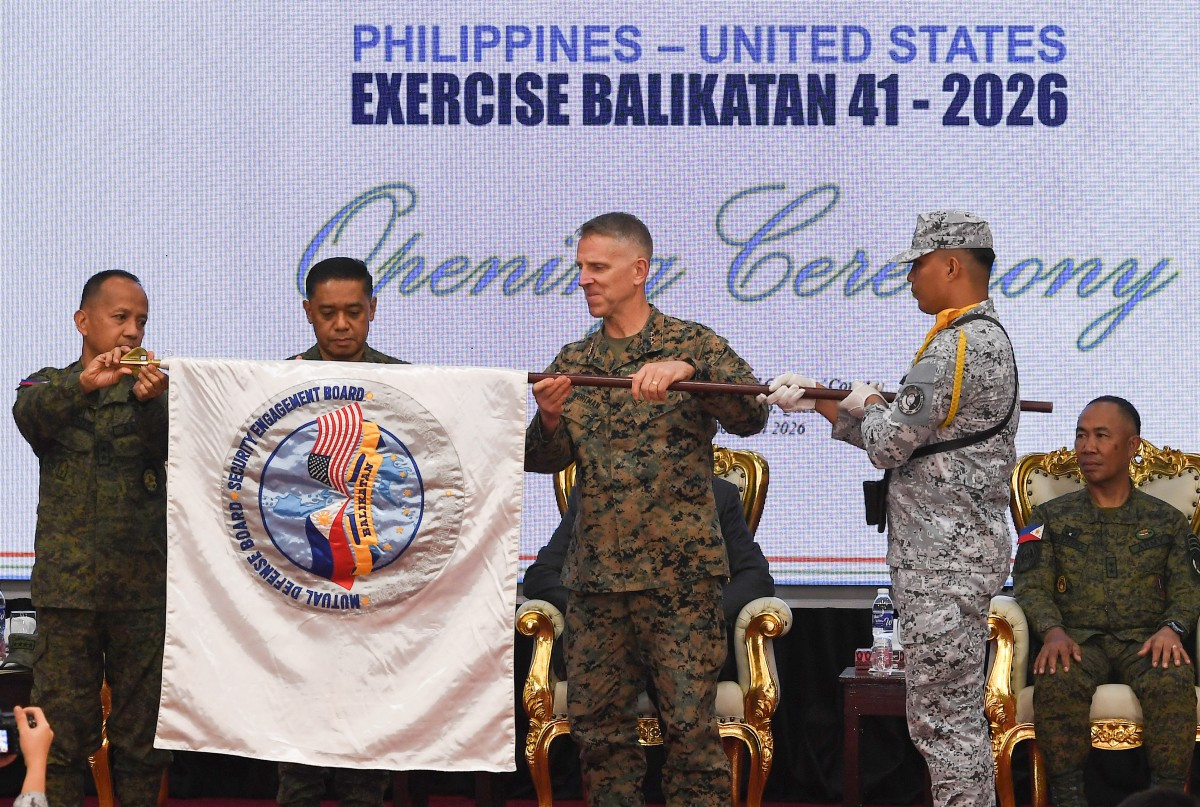 (L-R) Major General Francisco Lorenzo, Philippine exercise director, Philippine military Chief General Romeo Brawner, and US Lieutenant General Christian Wortman, Commanding General I Marine Expeditionary Force, unfurl the joint military exercise flag during the opening ceremony of the annual Balikatan (shoulder to shoulder) joint military exercise at Camp Aguinaldo in Quezon city, suburban Manila on Aril 20, 2026. (AFP/Ted Aljibe)
T
housands of American and Philippine troops, joined for the first time by a significant contingent of Japanese forces, began annual military exercises Monday set against the backdrop of the Middle East war.
The war games will feature live-fire exercises in the north of the country facing the Taiwan Strait, as well as a province off the disputed South China Sea, where the Philippines and China have engaged in repeated confrontations.
The Japanese military, which is contributing 1,400 personnel, will use a Type 88 cruise missile to sink a target ship off northern Paoay, Philippine exercise spokesman Colonel Dennis Hernandez said.
Tokyo has been strengthening its defence engagement with Manila after they signed a reciprocal access agreement in 2024, allowing them to deploy their militaries in each other's territory.
More than 17,000 soldiers, airmen and sailors are taking part in the 19-day Balikatan, or Shoulder to Shoulder, exercises -- about the same number as last year's edition -- including contingents from Australia, New Zealand, France and Canada.
"Balikatan... represents an opportunity to showcase our ironclad alliance with the Philippines and demonstrate our commitment to a free and open Indo-Pacific," US exercise spokesman Colonel Robert Bunn said ahead of Monday's opening ceremony.
Bunn added that US troop levels he described as "one of the largest deployments" in years would be unaffected by the ongoing Middle East war his country is waging, while declining to provide specific numbers.
Balikatan comes as Iran and the United States, along with Israel, are just days away from the end of the two-week ceasefire that halted the Middle East war, ignited by surprise US-Israeli strikes on Iran on February 28.
The conflict has sparked a global energy crisis that has left import-dependent Philippines reeling.
The drills also come as Beijing ramps up military pressure around Taiwan, which it considers part of its territory and has threatened to use force to seize.
Philippine President Ferdinand Marcos said last November that given his country's proximity to the self-ruled island and its surrounding waters, "a war over Taiwan will drag the Philippines, kicking and screaming, into the conflict".
In February, US, Japanese and Philippine aircraft patrolled over the Bashi Channel separating the Philippines from Taiwan to test what Manila called their "ability to operate seamlessly together in complex maritime environments".
Marcos considers Manila's 1951 mutual defence pact with Washington a bedrock of national security and has been building up security ties with Western nations to deter China.
Over the past two years, Manila has signed visiting forces or equivalent agreements with Japan, New Zealand, Canada and France, deals aimed at facilitating their participation in joint military exercises in the Philippines.
Bunn said American forces would have the option of firing Tomahawk and NMESIS anti-ship missiles, without confirming they would.
Integrated air and missile defence systems will also be put to the test, including technology for countering drones, Philippine spokesman Hernandez said.
Week-long naval exercises will also take place in so far unspecified waters off the main Philippine island of Luzon, he added.
Japan is deploying a tank landing ship, a destroyer, and a helicopter destroyer, while the US will use a cutter and a dock landing ship.
They will join two Philippine frigates and another from Canada.
Activities will span air, land, sea, and cyber domains, including maritime operations, integrated air and missile defence, counter-landing live-fire exercises, and humanitarian missions.